
Research
The Cost of Sending Money to Africa
Stablecoin FX Insights — January 2026
Executive Summary
Africa is where stablecoins should shine brightest - and where they still fall shortest.
Every month, we track stablecoin-to-fiat exchange rates across 66+ corridors and 33 currencies through the Borderless Network. This month, we are focusing on data across 13 African currencies, nearly 94,000 rate observations, and a continent where the cost of converting stablecoins to local fiat varies more dramatically than anywhere else in the world.
The cheapest African corridor (South Africa) costs 152 bps to convert stablecoins to local fiat. The most expensive (Botswana) costs 1,944 bps. That's a 13x gap on a single continent.
The biggest insight: provider competition is the strongest predictor of what a corridor costs. Where multiple providers compete, spreads cluster around 150–410 bps. Where a single provider operates alone, costs can exceed 1,300 bps.
Key Numbers
Metric | Value |
|---|---|
Date range | January 1–31, 2026 |
Total data points | 93,971 rate observations (2.4% excluded as outliers) |
Corridors tracked | 66 (across 33 currencies, 33 countries) |
Overall median spread | 296 bps |
Tightest corridor (spread) | USDC→PHP (PH) — 7 bps |
Widest corridor (spread) | USDC/USDT→BWP (BW) — 1,944 bps |
Largest TradFi premium | CDF (Congo) — +3,436 bps above interbank |
Largest TradFi discount | BWP (Botswana) — -342 bps below interbank |
Africa median spread | 299 bps |
Africa median TradFi premium | +119 bps vs mid-market |
Currencies compared vs TradFi | 33 (all using historical daily rates) |
A note on "spread": Throughout this report, "spread" refers to the buy-sell spread within a single stablecoin-to-fiat pair — the gap between what a provider charges to buy stablecoins (BuyRate) and what they pay to sell them (SellRate) for a given fiat currency. This is the provider's execution cost, analogous to a bid-ask spread in traditional markets. A basis point (bps) equals 0.01%; 100 bps = 1%. This is distinct from the "TradFi premium" discussed below.
A note on "TradFi premium": The TradFi premium measures how stablecoin-to-fiat exchange rates compare to traditional interbank mid-market rates. Positive = stablecoins more expensive than traditional FX. Negative = stablecoins cheaper. This tells treasury teams whether they're paying more or less using stablecoin rails versus traditional FX channels.
How Africa Compares Globally
The global spread landscape reveals a clear hierarchy. The five tightest corridors globally, which are all outside Africa, range from just 7 bps (PHP) to 100 bps (CLP). The five widest are all in Africa: BWP (1,944 bps), CDF (1,311 bps), ZMW (850 bps), XOF (594 bps), and XAF (513 bps). This concentration means that nearly all of the global spread dispersion in stablecoin FX is driven by African corridors.
Regional medians tell the cost story clearly:
Region | Median Spread (bps) | Mean Spread (bps) |
|---|---|---|
Asia | 7 | 6 |
Europe | 0 | 53 |
LatAm | 128 | 178 |
Africa | 299 | 443 |
Note: Europe's 0 bps median reflects corridors where providers report identical buy and sell rates (no real bid-ask), making the spread data unreliable for ranking purposes.
At 299 bps, Africa is 2.3x more expensive than LatAm and 44x more expensive than Asia. The five widest corridors globally are all African. The five tightest are all outside the continent.
The Cost of Sending Money to Africa
African stablecoin corridors span a wide cost range. Here are the five cheapest and five most expensive African corridors:
Tightest 5 | Spread (bps) | Widest 5 | Spread (bps) |
|---|---|---|---|
USDT→ZAR (South Africa) | 152 | BWP (Botswana) | 1,944 |
USDC→ZAR (South Africa) | 222 | CDF (Congo) | 1,311 |
UGX (Uganda) | 250 | ZMW (Zambia) | 850 |
KES (Kenya) | 295 | XOF (Cote d'Ivoire) | 594 |
MWK (Malawi) | 296 | XAF (Cameroon) | 513 |
South Africa's ZAR at 152 bps is already in LatAm territory - it has the continent's most liquid FX market and the most providers competing. At the other extreme, Botswana's BWP at 1,944 bps means a 19.4% cost on every transaction, and Congo's CDF at 1,311 bps isn't far behind. Both are single-provider corridors with limited market depth.
The middle of the continent matters just as much. NGN (Nigeria) - the continent's largest economy and most active stablecoin market - carries a 306 bps median spread with multiple providers competing. KES (Kenya) matches at 295 bps with several providers, and GHS (Ghana) sits at 300 bps with multiple providers. These three corridors form the backbone of African stablecoin payments, and they're all clustered tightly around the 300 bps mark.
The CFA franc zones tell a split story. XAF (Cameroon) comes in at 513 bps vs. XOF (Cote d'Ivoire) at 594 bps - an 81 bps gap despite being pegged to the same value. The difference is likely provider routing and local banking infrastructure.
What would it take for Africa to match LatAm's 128 bps median? More network providers and more volume. Every African currency with meaningful provider competition (NGN, ZAR, GHS, KES) already prices at or below 306 bps. Single-provider corridors (CDF, BWP, MWK) sit above or near 1,300 bps.
This month's biggest story is BWP: spreads compressed 1,191 bps (61% tighter) over January, from 1,951 bps in week 1 to 759 bps by month's end, consistent with a provider improving its pricing infrastructure. Our pipeline correctly identified this as a regime change rather than anomalous data.
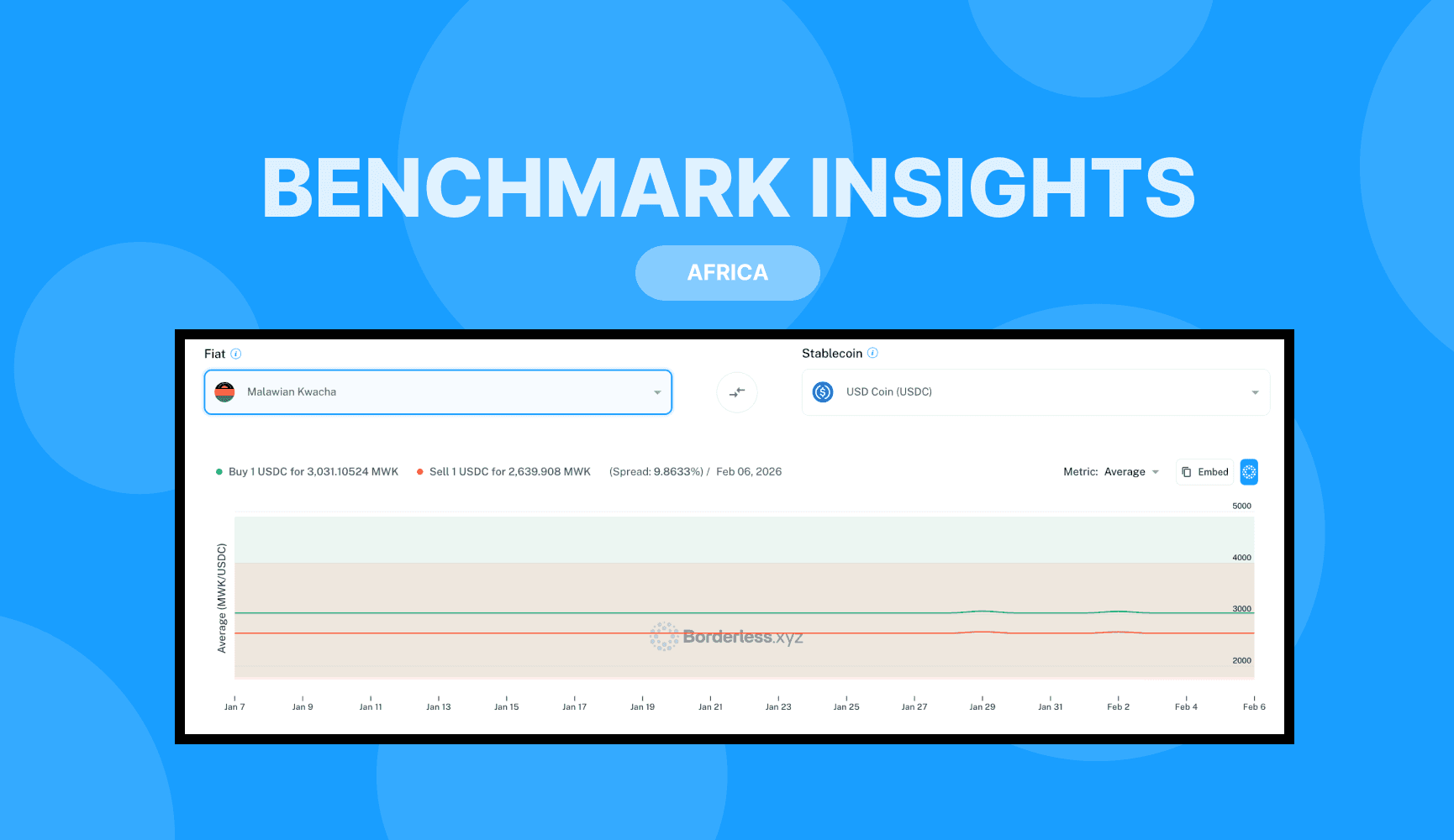
A note on MWK (Malawi): This corridor has multiple providers with fundamentally different pricing. Some quote official rates (~1,760 MWK/USD) and others quote parallel market rates (~4,450 MWK/USD), a 43% divergence. We exclude the parallel-market providers from headline statistics so the data reflects what institutional remittance companies using official channels should expect. With only the official-rate providers, MWK carries a 296 bps spread and a +147 bps TradFi premium - high but not extreme.
Why Competition is the Biggest Predictor of Cost
The pattern across the continent is consistent: more providers in a corridor means tighter spreads.
Competition Level | African Currencies | Typical Spread |
|---|---|---|
Deepest competition | KES, TZS | 295–411 bps |
Multiple providers | NGN, ZAR, GHS, RWF | 152–436 bps |
Limited competition | XAF, XOF, UGX, ZMW | 250–850 bps |
Single provider | CDF, BWP, MWK | 296–1,944 bps |
But it's not just about how many providers exist in a corridor - it's about which provider you choose. In Zambia, the gap between the best and worst provider is 650 bps, meaning provider selection alone can swing your cost by 6.5% per transaction. In Tanzania, the range is 310 bps.
There's also a risk that's easy to overlook: many African currencies depend entirely on a single provider. If that provider goes down, there's zero stablecoin FX coverage for that corridor.
Stablecoin vs Traditional FX: The Real Premium
This is where the TradFi premium comes in. We compared stablecoin mid-rates against traditional interbank mid-market rates (using ECB and CurrencyBeacon data from the same January period) to see whether stablecoin rails actually cost more than the traditional banking alternative.
Across all 33 currencies, stablecoin rates carry a median premium of just +5 bps over traditional FX. For major currencies with ECB data, the median is actually -4.5 bps — stablecoins are marginally cheaper than TradFi.
In Africa, the gap is bigger but varies wildly by currency. The regional median is +119 bps which is about 1.2% above traditional interbank rates.
Currency | Stablecoin Mid | TradFi Rate | Premium (bps) |
|---|---|---|---|
CDF (Congo) | 3,050.00 | 2,270.07 | +3,436 |
XAF (CFA-CEMAC) | 585.00 | 560.94 | +429 |
NGN (Nigeria) | 1,467.95 | 1,422.92 | +317 |
MWK (Malawi) | 1,760.44 | 1,734.94 | +147 |
GHS (Ghana) | 10.97 | 10.81 | +146 |
ZMW (Zambia) | 20.15 | 19.90 | +126 |
XOF (CFA-WAEMU) | 567.60 | 560.94 | +119 |
UGX (Uganda) | 3,582.32 | 3,561.08 | +60 |
ZAR (South Africa) | 16.48 | 16.39 | +54 |
RWF (Rwanda) | 1,460.09 | 1,456.20 | +27 |
KES (Kenya) | 129.13 | 129.01 | +9 |
TZS (Tanzania) | 2,509.10 | 2,507.86 | +5 |
BWP (Botswana) | 13.19 | 13.65 | -342 |
A few things stand out. Congo's +3,436 bps isn't really "market pricing" - it's a single provider quoting one static rate all month, reflecting parallel market dynamics rather than competitive FX. Botswana's -342 bps is the opposite story - stablecoin rails are genuinely cheaper than the traditional alternative there. And for the five currencies near parity (Kenya through Uganda), the premium is so small that the real cost difference comes from the execution spread, not the mid-rate.
Anomalies and Events
The biggest anomaly this month was Botswana (BWP): the mid-rate shifted 5.8% in a single day on January 20 (from 13.15 to 13.92 BWP/USD). Our regime-change detection correctly identified this as a sustained shift rather than a one-off outlier — spreads compressed from 1,951 bps to 759 bps and stayed there, suggesting a provider meaningfully improved its pricing. If that holds, BWP could look very different by Q2.
Zambia (ZMW) saw a -4.4% rate move on January 7, the second-largest single-day move among African corridors.
On the data quality side, our outlier detection flagged 2,212 records (2.4%) this month. The bulk, 1,474 records, came from a parallel-market provider in Malawi (MWK), excluded for diverging 43% from consensus. The remaining 738 were statistical outliers detected via Hampel filter. Regime-change recovery correctly preserved 651 records across BWP and BDT that represented genuine sustained rate shifts rather than anomalies.
One broader pattern worth noting: African corridors showed near-zero intra-regional correlation (0.02) in daily rate movements. Each African currency moves independently. Compare that to Europe (0.56) and Oceania (0.64). There is no single "African stablecoin market". There are 13 distinct local markets, each driven by local conditions rather than continental macro factors.
Methodology
Hourly buy/sell rates were collected from anonymized Borderless Network providers across 66 stablecoin-to-fiat corridors covering January 1–31, 2026. Rates are median-aggregated per corridor.
Outlier exclusions: Providers whose median mid-rate diverges more than 10% from multi-provider consensus are excluded as parallel-market outliers. This month, that affected providers for MWK (Malawi), where parallel-market rates of ~4,450 MWK/USD diverged 43% from official-rate providers at ~1,760 MWK/USD. On top of that, a Hampel filter (z > 6) removes point anomalies, with regime-change recovery to preserve genuine sustained rate shifts — applied this month to BWP and BDT. Total exclusions: 2,212 records (2.4%).
Static data corridors - which are those with fewer than 5 unique mid-rate values (CDF, GBP, SGD, EUR) - are flagged as low-quality for spread analysis.
Spreads are calculated as (BuyRate - SellRate) / MidRate in basis points, measuring provider execution cost. Corridors where providers report identical buy and sell rates are excluded from spread rankings.
Traditional FX comparison uses ECB historical daily rates for 11 major currencies and CurrencyBeacon historical daily rates for 22 frontier currencies, both covering the same January 2026 date range for an apples-to-apples comparison.
Executive Summary
Africa is where stablecoins should shine brightest - and where they still fall shortest.
Every month, we track stablecoin-to-fiat exchange rates across 66+ corridors and 33 currencies through the Borderless Network. This month, we are focusing on data across 13 African currencies, nearly 94,000 rate observations, and a continent where the cost of converting stablecoins to local fiat varies more dramatically than anywhere else in the world.
The cheapest African corridor (South Africa) costs 152 bps to convert stablecoins to local fiat. The most expensive (Botswana) costs 1,944 bps. That's a 13x gap on a single continent.
The biggest insight: provider competition is the strongest predictor of what a corridor costs. Where multiple providers compete, spreads cluster around 150–410 bps. Where a single provider operates alone, costs can exceed 1,300 bps.
Key Numbers
Metric | Value |
|---|---|
Date range | January 1–31, 2026 |
Total data points | 93,971 rate observations (2.4% excluded as outliers) |
Corridors tracked | 66 (across 33 currencies, 33 countries) |
Overall median spread | 296 bps |
Tightest corridor (spread) | USDC→PHP (PH) — 7 bps |
Widest corridor (spread) | USDC/USDT→BWP (BW) — 1,944 bps |
Largest TradFi premium | CDF (Congo) — +3,436 bps above interbank |
Largest TradFi discount | BWP (Botswana) — -342 bps below interbank |
Africa median spread | 299 bps |
Africa median TradFi premium | +119 bps vs mid-market |
Currencies compared vs TradFi | 33 (all using historical daily rates) |
A note on "spread": Throughout this report, "spread" refers to the buy-sell spread within a single stablecoin-to-fiat pair — the gap between what a provider charges to buy stablecoins (BuyRate) and what they pay to sell them (SellRate) for a given fiat currency. This is the provider's execution cost, analogous to a bid-ask spread in traditional markets. A basis point (bps) equals 0.01%; 100 bps = 1%. This is distinct from the "TradFi premium" discussed below.
A note on "TradFi premium": The TradFi premium measures how stablecoin-to-fiat exchange rates compare to traditional interbank mid-market rates. Positive = stablecoins more expensive than traditional FX. Negative = stablecoins cheaper. This tells treasury teams whether they're paying more or less using stablecoin rails versus traditional FX channels.
How Africa Compares Globally
The global spread landscape reveals a clear hierarchy. The five tightest corridors globally, which are all outside Africa, range from just 7 bps (PHP) to 100 bps (CLP). The five widest are all in Africa: BWP (1,944 bps), CDF (1,311 bps), ZMW (850 bps), XOF (594 bps), and XAF (513 bps). This concentration means that nearly all of the global spread dispersion in stablecoin FX is driven by African corridors.
Regional medians tell the cost story clearly:
Region | Median Spread (bps) | Mean Spread (bps) |
|---|---|---|
Asia | 7 | 6 |
Europe | 0 | 53 |
LatAm | 128 | 178 |
Africa | 299 | 443 |
Note: Europe's 0 bps median reflects corridors where providers report identical buy and sell rates (no real bid-ask), making the spread data unreliable for ranking purposes.
At 299 bps, Africa is 2.3x more expensive than LatAm and 44x more expensive than Asia. The five widest corridors globally are all African. The five tightest are all outside the continent.
The Cost of Sending Money to Africa
African stablecoin corridors span a wide cost range. Here are the five cheapest and five most expensive African corridors:
Tightest 5 | Spread (bps) | Widest 5 | Spread (bps) |
|---|---|---|---|
USDT→ZAR (South Africa) | 152 | BWP (Botswana) | 1,944 |
USDC→ZAR (South Africa) | 222 | CDF (Congo) | 1,311 |
UGX (Uganda) | 250 | ZMW (Zambia) | 850 |
KES (Kenya) | 295 | XOF (Cote d'Ivoire) | 594 |
MWK (Malawi) | 296 | XAF (Cameroon) | 513 |
South Africa's ZAR at 152 bps is already in LatAm territory - it has the continent's most liquid FX market and the most providers competing. At the other extreme, Botswana's BWP at 1,944 bps means a 19.4% cost on every transaction, and Congo's CDF at 1,311 bps isn't far behind. Both are single-provider corridors with limited market depth.
The middle of the continent matters just as much. NGN (Nigeria) - the continent's largest economy and most active stablecoin market - carries a 306 bps median spread with multiple providers competing. KES (Kenya) matches at 295 bps with several providers, and GHS (Ghana) sits at 300 bps with multiple providers. These three corridors form the backbone of African stablecoin payments, and they're all clustered tightly around the 300 bps mark.
The CFA franc zones tell a split story. XAF (Cameroon) comes in at 513 bps vs. XOF (Cote d'Ivoire) at 594 bps - an 81 bps gap despite being pegged to the same value. The difference is likely provider routing and local banking infrastructure.
What would it take for Africa to match LatAm's 128 bps median? More network providers and more volume. Every African currency with meaningful provider competition (NGN, ZAR, GHS, KES) already prices at or below 306 bps. Single-provider corridors (CDF, BWP, MWK) sit above or near 1,300 bps.
This month's biggest story is BWP: spreads compressed 1,191 bps (61% tighter) over January, from 1,951 bps in week 1 to 759 bps by month's end, consistent with a provider improving its pricing infrastructure. Our pipeline correctly identified this as a regime change rather than anomalous data.
A note on MWK (Malawi): This corridor has multiple providers with fundamentally different pricing. Some quote official rates (~1,760 MWK/USD) and others quote parallel market rates (~4,450 MWK/USD), a 43% divergence. We exclude the parallel-market providers from headline statistics so the data reflects what institutional remittance companies using official channels should expect. With only the official-rate providers, MWK carries a 296 bps spread and a +147 bps TradFi premium - high but not extreme.
Why Competition is the Biggest Predictor of Cost
The pattern across the continent is consistent: more providers in a corridor means tighter spreads.
Competition Level | African Currencies | Typical Spread |
|---|---|---|
Deepest competition | KES, TZS | 295–411 bps |
Multiple providers | NGN, ZAR, GHS, RWF | 152–436 bps |
Limited competition | XAF, XOF, UGX, ZMW | 250–850 bps |
Single provider | CDF, BWP, MWK | 296–1,944 bps |
But it's not just about how many providers exist in a corridor - it's about which provider you choose. In Zambia, the gap between the best and worst provider is 650 bps, meaning provider selection alone can swing your cost by 6.5% per transaction. In Tanzania, the range is 310 bps.
There's also a risk that's easy to overlook: many African currencies depend entirely on a single provider. If that provider goes down, there's zero stablecoin FX coverage for that corridor.
Stablecoin vs Traditional FX: The Real Premium
This is where the TradFi premium comes in. We compared stablecoin mid-rates against traditional interbank mid-market rates (using ECB and CurrencyBeacon data from the same January period) to see whether stablecoin rails actually cost more than the traditional banking alternative.
Across all 33 currencies, stablecoin rates carry a median premium of just +5 bps over traditional FX. For major currencies with ECB data, the median is actually -4.5 bps — stablecoins are marginally cheaper than TradFi.
In Africa, the gap is bigger but varies wildly by currency. The regional median is +119 bps which is about 1.2% above traditional interbank rates.
Currency | Stablecoin Mid | TradFi Rate | Premium (bps) |
|---|---|---|---|
CDF (Congo) | 3,050.00 | 2,270.07 | +3,436 |
XAF (CFA-CEMAC) | 585.00 | 560.94 | +429 |
NGN (Nigeria) | 1,467.95 | 1,422.92 | +317 |
MWK (Malawi) | 1,760.44 | 1,734.94 | +147 |
GHS (Ghana) | 10.97 | 10.81 | +146 |
ZMW (Zambia) | 20.15 | 19.90 | +126 |
XOF (CFA-WAEMU) | 567.60 | 560.94 | +119 |
UGX (Uganda) | 3,582.32 | 3,561.08 | +60 |
ZAR (South Africa) | 16.48 | 16.39 | +54 |
RWF (Rwanda) | 1,460.09 | 1,456.20 | +27 |
KES (Kenya) | 129.13 | 129.01 | +9 |
TZS (Tanzania) | 2,509.10 | 2,507.86 | +5 |
BWP (Botswana) | 13.19 | 13.65 | -342 |
A few things stand out. Congo's +3,436 bps isn't really "market pricing" - it's a single provider quoting one static rate all month, reflecting parallel market dynamics rather than competitive FX. Botswana's -342 bps is the opposite story - stablecoin rails are genuinely cheaper than the traditional alternative there. And for the five currencies near parity (Kenya through Uganda), the premium is so small that the real cost difference comes from the execution spread, not the mid-rate.
Anomalies and Events
The biggest anomaly this month was Botswana (BWP): the mid-rate shifted 5.8% in a single day on January 20 (from 13.15 to 13.92 BWP/USD). Our regime-change detection correctly identified this as a sustained shift rather than a one-off outlier — spreads compressed from 1,951 bps to 759 bps and stayed there, suggesting a provider meaningfully improved its pricing. If that holds, BWP could look very different by Q2.
Zambia (ZMW) saw a -4.4% rate move on January 7, the second-largest single-day move among African corridors.
On the data quality side, our outlier detection flagged 2,212 records (2.4%) this month. The bulk, 1,474 records, came from a parallel-market provider in Malawi (MWK), excluded for diverging 43% from consensus. The remaining 738 were statistical outliers detected via Hampel filter. Regime-change recovery correctly preserved 651 records across BWP and BDT that represented genuine sustained rate shifts rather than anomalies.
One broader pattern worth noting: African corridors showed near-zero intra-regional correlation (0.02) in daily rate movements. Each African currency moves independently. Compare that to Europe (0.56) and Oceania (0.64). There is no single "African stablecoin market". There are 13 distinct local markets, each driven by local conditions rather than continental macro factors.
Methodology
Hourly buy/sell rates were collected from anonymized Borderless Network providers across 66 stablecoin-to-fiat corridors covering January 1–31, 2026. Rates are median-aggregated per corridor.
Outlier exclusions: Providers whose median mid-rate diverges more than 10% from multi-provider consensus are excluded as parallel-market outliers. This month, that affected providers for MWK (Malawi), where parallel-market rates of ~4,450 MWK/USD diverged 43% from official-rate providers at ~1,760 MWK/USD. On top of that, a Hampel filter (z > 6) removes point anomalies, with regime-change recovery to preserve genuine sustained rate shifts — applied this month to BWP and BDT. Total exclusions: 2,212 records (2.4%).
Static data corridors - which are those with fewer than 5 unique mid-rate values (CDF, GBP, SGD, EUR) - are flagged as low-quality for spread analysis.
Spreads are calculated as (BuyRate - SellRate) / MidRate in basis points, measuring provider execution cost. Corridors where providers report identical buy and sell rates are excluded from spread rankings.
Traditional FX comparison uses ECB historical daily rates for 11 major currencies and CurrencyBeacon historical daily rates for 22 frontier currencies, both covering the same January 2026 date range for an apples-to-apples comparison.
Other Articles
Global Stablecoin Orchestration Network

Borderless Innovations Labs Inc. (Borderless) is a technology and smart contract development company. Borderless in not a broker-dealer or financial institution and does not engage any conduct or transactions requiring such registration. All financial products are offered by and through financial institutions directly. Borderless does not make any recommendation for the purchase or sale of digital assets. Our products and services are offered in limited jurisdictions so please contact our partnerships team for further information and refer to our Terms of Services.
Global Stablecoin Orchestration Network
Borderless Innovations Labs Inc. (Borderless) is a technology and smart contract development company. Borderless in not a broker-dealer or financial institution and does not engage any conduct or transactions requiring such registration. All financial products are offered by and through financial institutions directly. Borderless does not make any recommendation for the purchase or sale of digital assets. Our products and services are offered in limited jurisdictions so please contact our partnerships team for further information and refer to our Terms of Services.
Global Stablecoin Orchestration Network
Borderless Innovations Labs Inc. (Borderless) is a technology and smart contract development company. Borderless in not a broker-dealer or financial institution and does not engage any conduct or transactions requiring such registration. All financial products are offered by and through financial institutions directly. Borderless does not make any recommendation for the purchase or sale of digital assets. Our products and services are offered in limited jurisdictions so please contact our partnerships team for further information and refer to our Terms of Services.