
Updates
RFI Case Management. Nothing Falls Through the Cracks.
Product Feature

More than one provider means more than one channel
Any business working with more than one provider runs into this, whether the integrations were built in-house or through a single network connection. Each provider relationship is its own RFI channel: its own inbox, its own notification style, its own habit your team has to remember. This is a known job, not a hidden cost. Someone has to catch the request, route it, chase the answer, and get it back before the deadline.
Run that job on a spreadsheet and memory, and gaps happen, no matter how many providers you're connected to or how you got there. A missed compliance RFI holds up onboarding. A missed transaction RFI can reverse a payment that already looked done. Building your own tracker doesn't fix it either. Every provider needs its own detection logic, its own reply routing, its own record of what was asked and when.
Who it's for
RFI Case Management is for operations and compliance teams working across more than one provider, whoever ends up owning the request when it lands. If you're tracking RFIs today across a spreadsheet, a shared inbox, and a few people's memory, this replaces all of it with one queue everyone can see.
RFI Case Management: one inbox for all your providers requests
RFI Case Management gives your team one place to see, respond to, and resolve every RFI from every provider you work with. Cases replace threads.
Cases open themselves. Every RFI from every provider becomes a case automatically. No manual entry, no per-provider setup.
One thread per case. Chat-style, provider messages visually distinct from your team's, attachments inline, full history in order.
Both request types, same queue. Compliance RFIs (proof of address, source of funds, entity disclosures) and transaction RFIs (invoices, proof of payment, beneficiary address corrections) land in one place.
Here's what that looks like in practice. A provider flags a customer's proof of address as expired. Someone on your team uploads the corrected document and replies right from the case. When the provider comes back asking for a notarized copy instead, that same case picks it up, no new email, no one hunting for where things stand.
The back-and-forth that never stops
That loop, not any single reply, is where the time and the headache actually go: reconstructing who asked what, when, and whether it was ever answered.
RFI Case Management keeps every round trip in the same case. A follow-up moves the case back to Action Required instead of becoming a new thread. Every ask, every document, every reply stays in order, in one place. Nobody has to rebuild the history before they can move it forward.
Built from what we felt first
We built this around a reality we know firsthand: multi-provider RFI handling is real, recurring work, and it gets heavier as you add corridors and providers, whatever your stack looks like. Someone has to catch the request, route it, and close the loop before the deadline. RFI Case Management removes the manual relay. The provider's request and your team's response meet directly in one case, not through separate inboxes and chat threads along the way.
That's the differentiator. RFI handling gets absorbed once, at the network layer connecting you to every provider, instead of stitched together per integration on your own stack. Add a provider and it slots into the same queue, the same states, the same thread. Nothing new to build.
What's live, what's next
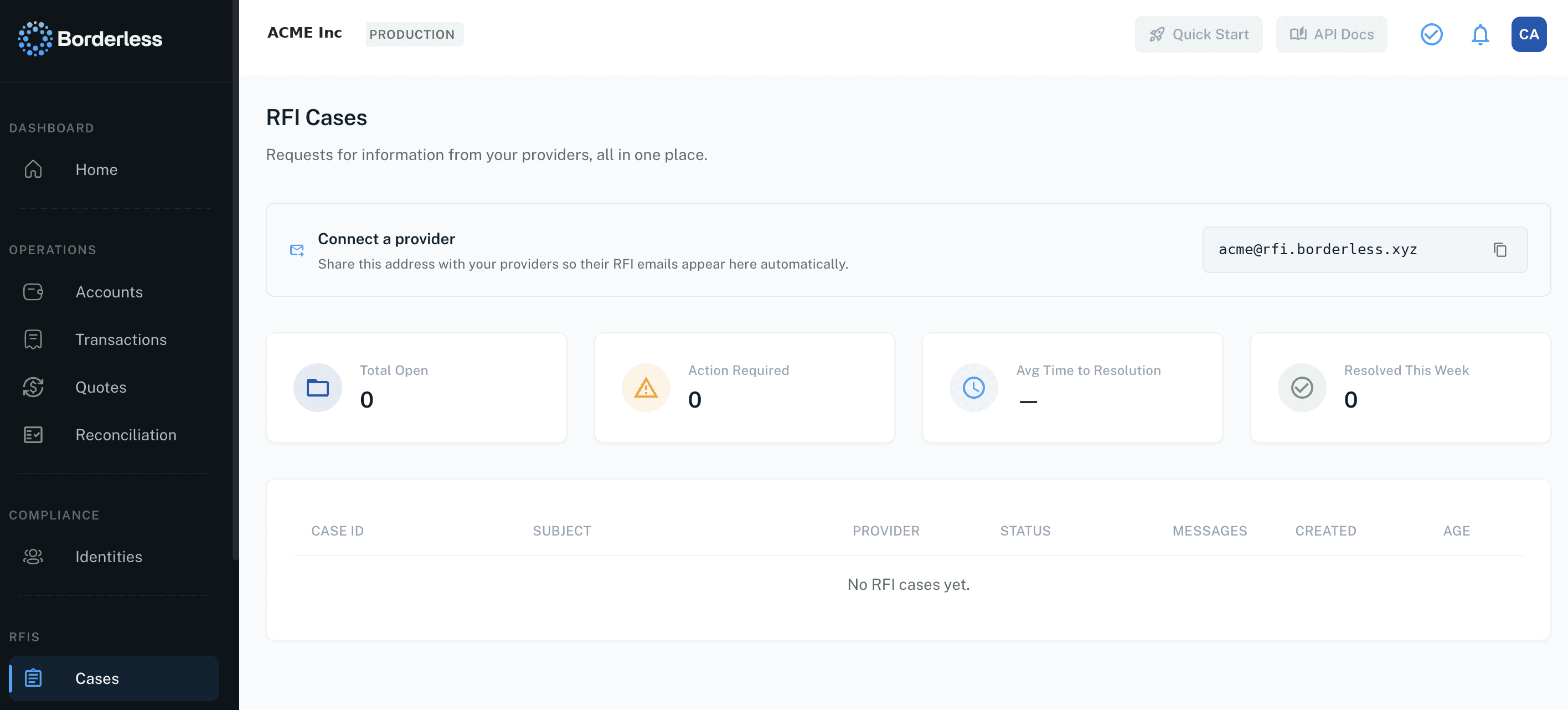
The MVP ships today with a case list, a case detail view, and one configuration card. An Age column surfaces what's been sitting longest, instead of a priority tag someone has to remember to set
This is the first piece of a bigger operations hub we're building inside the Borderless.xyz dashboard. Assignee routing, SLA tracking with deadline warnings, smarter, content-based auto-classification of RFI type, and multi-channel support (like Slack) are next, and we're shaping all of it from what customers tell us as they use the queue, not from a spec written in advance. The direction is clear: one central place for every RFI, across every provider and every channel, for as long as you're moving money through them. This is the start of that, not the whole of it.
RFI Case Management is available now. Your forwarding address is already in the dashboard. Copy it there, then work with your account team to start routing your providers' RFIs to it.
More than one provider means more than one channel
Any business working with more than one provider runs into this, whether the integrations were built in-house or through a single network connection. Each provider relationship is its own RFI channel: its own inbox, its own notification style, its own habit your team has to remember. This is a known job, not a hidden cost. Someone has to catch the request, route it, chase the answer, and get it back before the deadline.
Run that job on a spreadsheet and memory, and gaps happen, no matter how many providers you're connected to or how you got there. A missed compliance RFI holds up onboarding. A missed transaction RFI can reverse a payment that already looked done. Building your own tracker doesn't fix it either. Every provider needs its own detection logic, its own reply routing, its own record of what was asked and when.
Who it's for
RFI Case Management is for operations and compliance teams working across more than one provider, whoever ends up owning the request when it lands. If you're tracking RFIs today across a spreadsheet, a shared inbox, and a few people's memory, this replaces all of it with one queue everyone can see.
RFI Case Management: one inbox for all your providers requests
RFI Case Management gives your team one place to see, respond to, and resolve every RFI from every provider you work with. Cases replace threads.
Cases open themselves. Every RFI from every provider becomes a case automatically. No manual entry, no per-provider setup.
One thread per case. Chat-style, provider messages visually distinct from your team's, attachments inline, full history in order.
Both request types, same queue. Compliance RFIs (proof of address, source of funds, entity disclosures) and transaction RFIs (invoices, proof of payment, beneficiary address corrections) land in one place.
Here's what that looks like in practice. A provider flags a customer's proof of address as expired. Someone on your team uploads the corrected document and replies right from the case. When the provider comes back asking for a notarized copy instead, that same case picks it up, no new email, no one hunting for where things stand.
The back-and-forth that never stops
That loop, not any single reply, is where the time and the headache actually go: reconstructing who asked what, when, and whether it was ever answered.
RFI Case Management keeps every round trip in the same case. A follow-up moves the case back to Action Required instead of becoming a new thread. Every ask, every document, every reply stays in order, in one place. Nobody has to rebuild the history before they can move it forward.
Built from what we felt first
We built this around a reality we know firsthand: multi-provider RFI handling is real, recurring work, and it gets heavier as you add corridors and providers, whatever your stack looks like. Someone has to catch the request, route it, and close the loop before the deadline. RFI Case Management removes the manual relay. The provider's request and your team's response meet directly in one case, not through separate inboxes and chat threads along the way.
That's the differentiator. RFI handling gets absorbed once, at the network layer connecting you to every provider, instead of stitched together per integration on your own stack. Add a provider and it slots into the same queue, the same states, the same thread. Nothing new to build.
What's live, what's next
The MVP ships today with a case list, a case detail view, and one configuration card. An Age column surfaces what's been sitting longest, instead of a priority tag someone has to remember to set
This is the first piece of a bigger operations hub we're building inside the Borderless.xyz dashboard. Assignee routing, SLA tracking with deadline warnings, smarter, content-based auto-classification of RFI type, and multi-channel support (like Slack) are next, and we're shaping all of it from what customers tell us as they use the queue, not from a spec written in advance. The direction is clear: one central place for every RFI, across every provider and every channel, for as long as you're moving money through them. This is the start of that, not the whole of it.
RFI Case Management is available now. Your forwarding address is already in the dashboard. Copy it there, then work with your account team to start routing your providers' RFIs to it.
Other Articles
Global Stablecoin Orchestration Network

Borderless Innovations Labs Inc. (Borderless) is a technology and smart contract development company. Borderless in not a broker-dealer or financial institution and does not engage any conduct or transactions requiring such registration. All financial products are offered by and through financial institutions directly. Borderless does not make any recommendation for the purchase or sale of digital assets. Our products and services are offered in limited jurisdictions so please contact our partnerships team for further information and refer to our Terms of Services.
Global Stablecoin Orchestration Network
Borderless Innovations Labs Inc. (Borderless) is a technology and smart contract development company. Borderless in not a broker-dealer or financial institution and does not engage any conduct or transactions requiring such registration. All financial products are offered by and through financial institutions directly. Borderless does not make any recommendation for the purchase or sale of digital assets. Our products and services are offered in limited jurisdictions so please contact our partnerships team for further information and refer to our Terms of Services.
Global Stablecoin Orchestration Network
Borderless Innovations Labs Inc. (Borderless) is a technology and smart contract development company. Borderless in not a broker-dealer or financial institution and does not engage any conduct or transactions requiring such registration. All financial products are offered by and through financial institutions directly. Borderless does not make any recommendation for the purchase or sale of digital assets. Our products and services are offered in limited jurisdictions so please contact our partnerships team for further information and refer to our Terms of Services.