
Updates
The Borderless Operations Layer
The back-office tooling to scale providers without scaling the work

Every new provider you transact with creates additional overhead, requiring more staffing and building better tools to manage that complexity. Another inbound channel compliance needs to monitor for RFIs. Another dashboard and fragmented transaction history operations needs to consolidate and tie out. Another status page the product and engineering teams need to track for uptime alerting. We have seen firsthand how this operational work slows a team's ability to quickly scale volumes and expand, forcing them to throttle growth while they figure out how to absorb the load.
Borderless.xyz built the provider network and connectivity to go global fast. Now we’ve added the operations tooling to scale those flows built hand in hand with some of our fastest growing customers. RFI handling, automated reconciliation and provider rail monitoring & alerting are all in the platform today, done once and applied to every provider you turn on. This means adding a provider adds coverage, not headcount.
RFI case management
An RFI lands when money is already in motion: the payout stops and waits for an answer, while the request sits unseen in whichever inbox the provider happened to have.
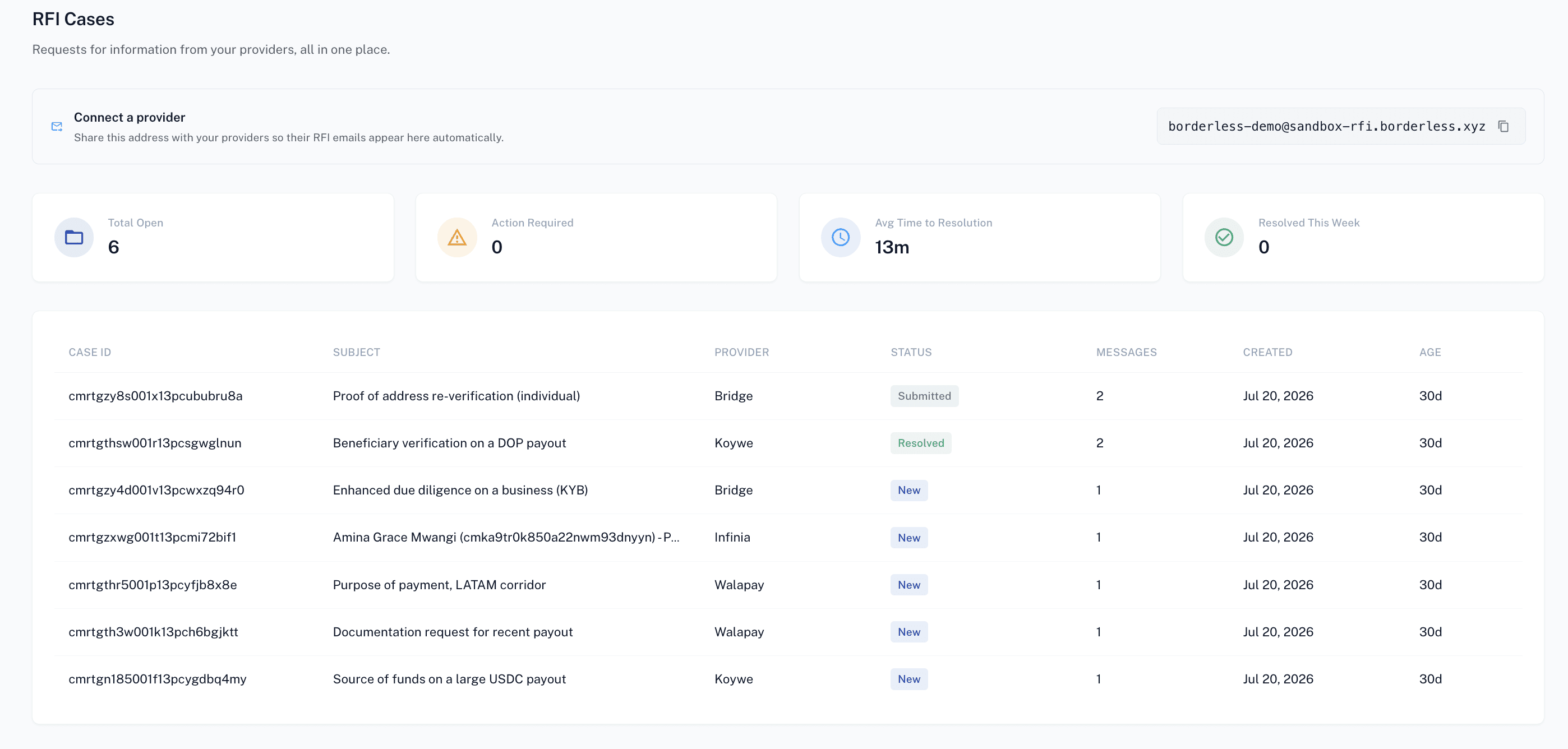
We built RFI case management so all requests from a provider become a case with an age and a status anyone on the team can see. Providers with RFI APIs open cases on the platform directly. Everyone else reaches a dedicated case mailbox on your own address, and their emails open cases automatically. You share that address once during onboarding and the routing holds from then on. Follow-ups reopen the same case instead of starting a new thread, so a request's history stays in one place rather than fragmenting across replies.
The queue orders itself by what is closest to costing you a stalled payment. The oldest requests surface first, and cases needing action from you are flagged separately from cases already submitted and waiting on the provider.
The RFI gets tracked, can be answered quickly, and the payout is on its way. Average resolution is a number you can watch come down.
Reconciliation
By the time a gap shows up at month-end, the mismatch is weeks old and the trail starts in a pile of exports from each provider. Borderless built back-office reconciliation to verify transactions against each provider's own ledger, with overlapping look back periods, the money moves.
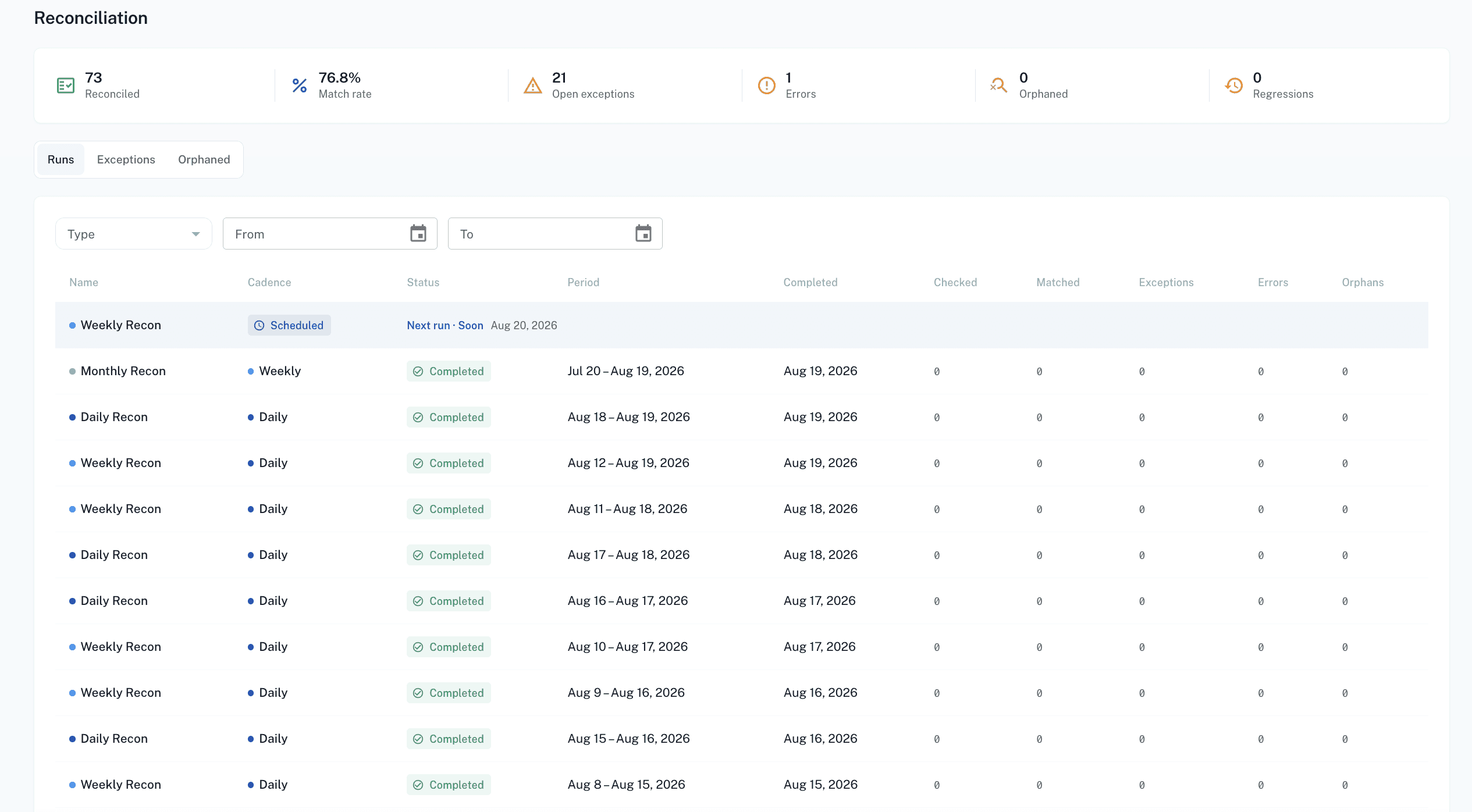
Passes run daily, weekly, and monthly, and report back with how many exceptions it turned up. You can see what has completed and what is scheduled next, so nobody has to ask where reconciliation stands.
Each pass looks back as far as 90 days, covering asynchronous failures and reversals. A payout settles on Tuesday and reverses the following week. A pass that only checks the last 24 hours never sees it. The look-back does.
When your ledger and the provider's disagree, that difference is immediately flagged instead of a gap nobody notices.
The match rate tells you how much of it agrees. Without it, someone is pulling exports from each providers, each on its own schedule and in its own schema, and matching them by hand in the same week finance is trying to close the month.
Provider monitoring and alerting
 |  |
|---|
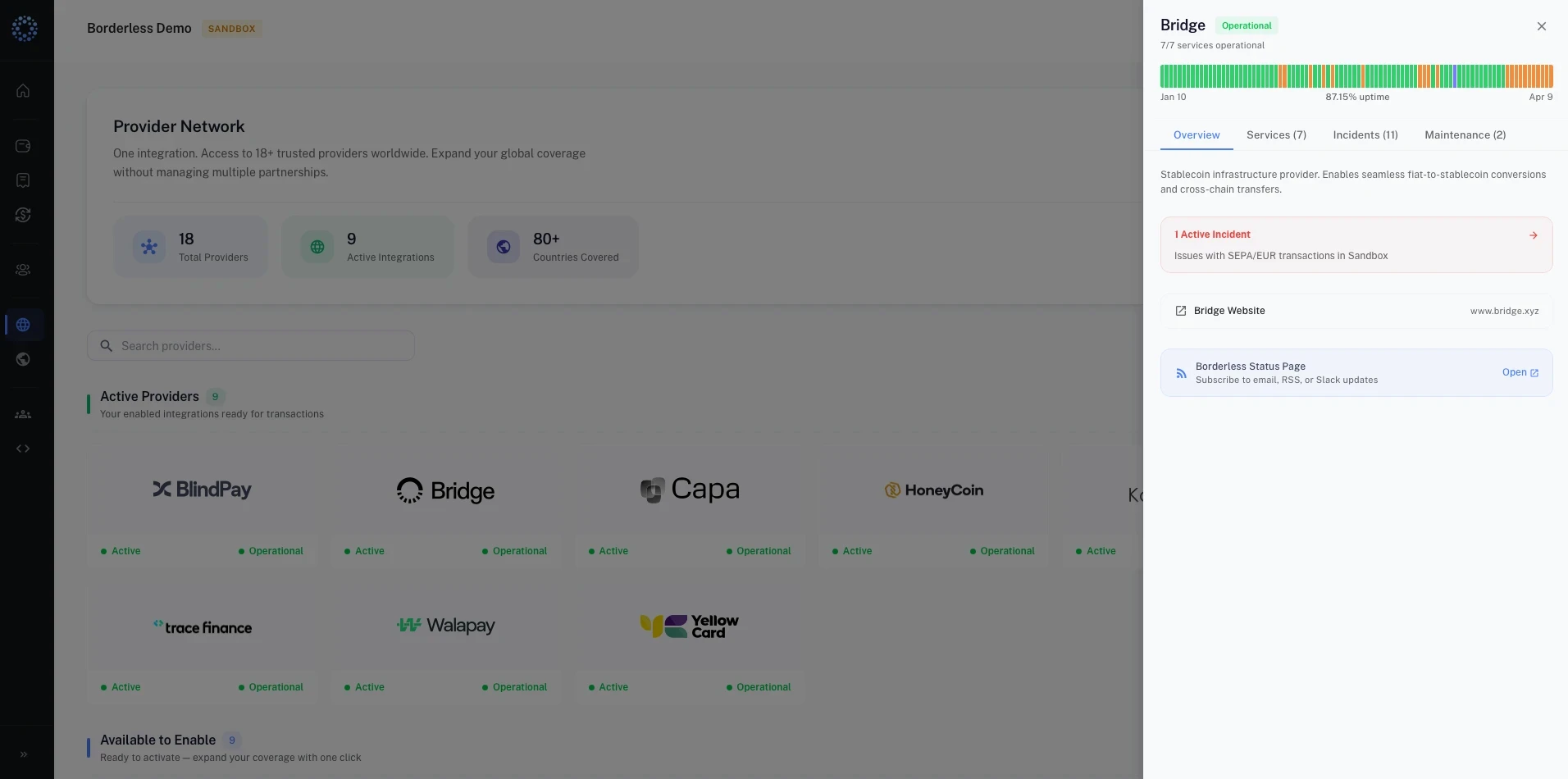
Most teams find out a rail is degraded when failed payouts have backed up and customers start complaining. To solve this, we built provider monitoring so every rail on the network is constantly watched and the alert reaches you through our dashboard.
Monitoring runs on three signals: the provider's status page, our operations team, and, most importantly, the live transaction data of the whole network. When error rates climb on a rail, Borderless flags it, often before the provider has posted an incident, because the network sees the same failure across everyone routing through that rail.
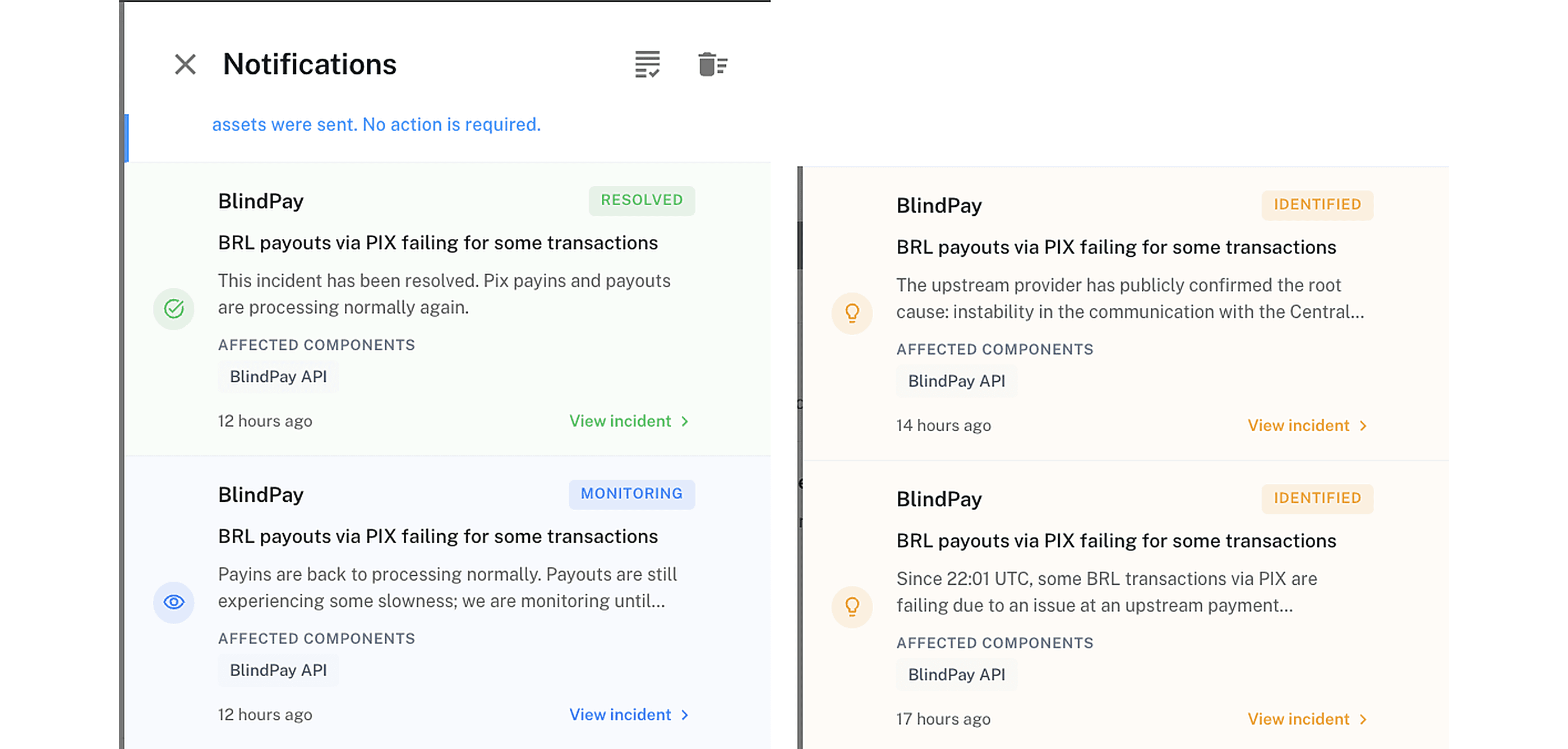
Incidents are scoped to the service they affect, so an incident on a provider's payouts API is separate from one on its webhooks. Each incident carries a timeline from first investigation to resolution and every update on that timeline is timestamped with the provider error reasoning.
Across providers, a single notification feed shows every incident on the network as it moves from investigating to resolved, so a team running eight providers watches one feed instead of flipping through eight different status pages.
You route around the outage before payments back up. Customers never feel it, and payment operations keep flowing.
Reporting
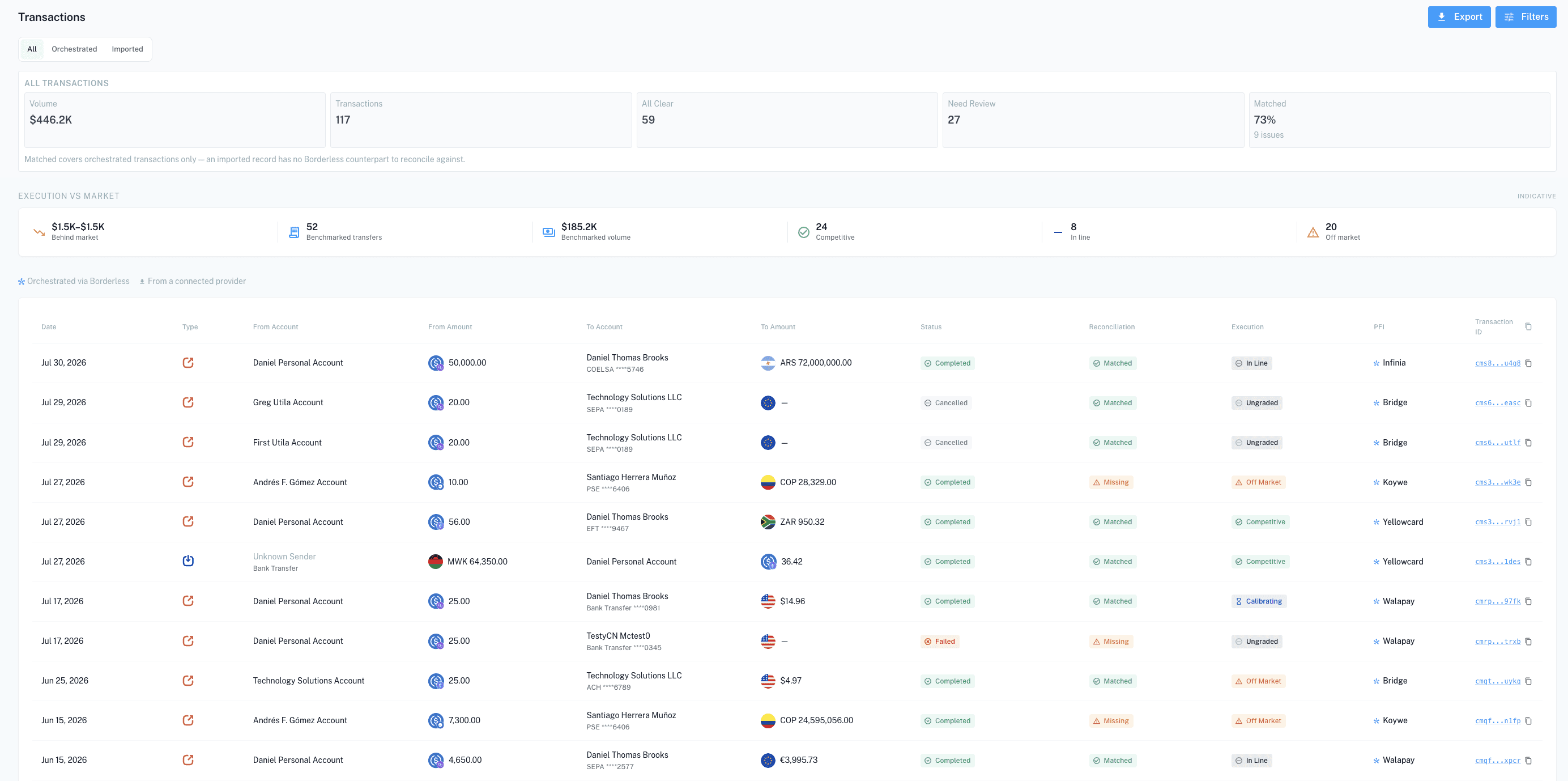
Borderless also has built reporting to give you one view of transaction activity across every provider, on a unified data schema.
Transactions that run through Borderless.xyz and transactions imported from connected providers sit in the same view. Statuses and failure reasons are normalized to the same fields for every provider, so a numeric settlement state from one and a Spanish-language rejection code from another arrive as the same two values. A failure rate measured across providers is measuring one thing.
Payouts and deposits sit in the same table, and you can filter it and export it all from one place.
The export finance pulls matches what actually settled.
Additional operational tools
The same reasoning runs through the rest of the tooling. Each of these is built in, and none of them is a separate integration.
No-Code Routing: Change which provider serves a corridor without a code change, with defaults set by country, currency, rail, or transaction type.
Price Discovery: Compare live quotes across every provider on a corridor in real time, each one shown against the best available, so you see the spread before you send.
Needs Attention Notifications: Every transaction waiting on something from you sits in one queue, counted and aged, with notifications on each state change from pending to completed.
Refund Management: Return destinations, refund status, and the record of every returned payment in one place, with returns triggering automatically on failure. I
Audit Trail Log: Every action is logged and searchable. When a payment behaves differently than it did yesterday, you can see what changed, who changed it, and when.
Provider Balances: Hold local currency with providers that support it, and convert between stablecoins and fiat on your timing, not the payment's.
Granular Permissions: Role-based access down to the action, from view-only to payout approval.
Webhooks: Signed webhooks push every status change to your systems as it happens, so nothing polls and nothing is missed.
None of this requires moving an integration. The operations tooling and the benchmarking run on the providers you have already integrated and the volume you already move, with no code changes. Turn on connectivity when the next market comes up.
All of these capabilities are available to all clients on the Borderless.xyz network under your Operations dashboard. Reach out to your account team to walk through coverage for your specific corridors.
Every new provider you transact with creates additional overhead, requiring more staffing and building better tools to manage that complexity. Another inbound channel compliance needs to monitor for RFIs. Another dashboard and fragmented transaction history operations needs to consolidate and tie out. Another status page the product and engineering teams need to track for uptime alerting. We have seen firsthand how this operational work slows a team's ability to quickly scale volumes and expand, forcing them to throttle growth while they figure out how to absorb the load.
Borderless.xyz built the provider network and connectivity to go global fast. Now we’ve added the operations tooling to scale those flows built hand in hand with some of our fastest growing customers. RFI handling, automated reconciliation and provider rail monitoring & alerting are all in the platform today, done once and applied to every provider you turn on. This means adding a provider adds coverage, not headcount.
RFI case management
An RFI lands when money is already in motion: the payout stops and waits for an answer, while the request sits unseen in whichever inbox the provider happened to have.
We built RFI case management so all requests from a provider become a case with an age and a status anyone on the team can see. Providers with RFI APIs open cases on the platform directly. Everyone else reaches a dedicated case mailbox on your own address, and their emails open cases automatically. You share that address once during onboarding and the routing holds from then on. Follow-ups reopen the same case instead of starting a new thread, so a request's history stays in one place rather than fragmenting across replies.
The queue orders itself by what is closest to costing you a stalled payment. The oldest requests surface first, and cases needing action from you are flagged separately from cases already submitted and waiting on the provider.
The RFI gets tracked, can be answered quickly, and the payout is on its way. Average resolution is a number you can watch come down.
Reconciliation
By the time a gap shows up at month-end, the mismatch is weeks old and the trail starts in a pile of exports from each provider. Borderless built back-office reconciliation to verify transactions against each provider's own ledger, with overlapping look back periods, the money moves.
Passes run daily, weekly, and monthly, and report back with how many exceptions it turned up. You can see what has completed and what is scheduled next, so nobody has to ask where reconciliation stands.
Each pass looks back as far as 90 days, covering asynchronous failures and reversals. A payout settles on Tuesday and reverses the following week. A pass that only checks the last 24 hours never sees it. The look-back does.
When your ledger and the provider's disagree, that difference is immediately flagged instead of a gap nobody notices.
The match rate tells you how much of it agrees. Without it, someone is pulling exports from each providers, each on its own schedule and in its own schema, and matching them by hand in the same week finance is trying to close the month.
Provider monitoring and alerting
| |
|---|
Most teams find out a rail is degraded when failed payouts have backed up and customers start complaining. To solve this, we built provider monitoring so every rail on the network is constantly watched and the alert reaches you through our dashboard.
Monitoring runs on three signals: the provider's status page, our operations team, and, most importantly, the live transaction data of the whole network. When error rates climb on a rail, Borderless flags it, often before the provider has posted an incident, because the network sees the same failure across everyone routing through that rail.
Incidents are scoped to the service they affect, so an incident on a provider's payouts API is separate from one on its webhooks. Each incident carries a timeline from first investigation to resolution and every update on that timeline is timestamped with the provider error reasoning.
Across providers, a single notification feed shows every incident on the network as it moves from investigating to resolved, so a team running eight providers watches one feed instead of flipping through eight different status pages.
You route around the outage before payments back up. Customers never feel it, and payment operations keep flowing.
Reporting
Borderless also has built reporting to give you one view of transaction activity across every provider, on a unified data schema.
Transactions that run through Borderless.xyz and transactions imported from connected providers sit in the same view. Statuses and failure reasons are normalized to the same fields for every provider, so a numeric settlement state from one and a Spanish-language rejection code from another arrive as the same two values. A failure rate measured across providers is measuring one thing.
Payouts and deposits sit in the same table, and you can filter it and export it all from one place.
The export finance pulls matches what actually settled.
Additional operational tools
The same reasoning runs through the rest of the tooling. Each of these is built in, and none of them is a separate integration.
No-Code Routing: Change which provider serves a corridor without a code change, with defaults set by country, currency, rail, or transaction type.
Price Discovery: Compare live quotes across every provider on a corridor in real time, each one shown against the best available, so you see the spread before you send.
Needs Attention Notifications: Every transaction waiting on something from you sits in one queue, counted and aged, with notifications on each state change from pending to completed.
Refund Management: Return destinations, refund status, and the record of every returned payment in one place, with returns triggering automatically on failure. I
Audit Trail Log: Every action is logged and searchable. When a payment behaves differently than it did yesterday, you can see what changed, who changed it, and when.
Provider Balances: Hold local currency with providers that support it, and convert between stablecoins and fiat on your timing, not the payment's.
Granular Permissions: Role-based access down to the action, from view-only to payout approval.
Webhooks: Signed webhooks push every status change to your systems as it happens, so nothing polls and nothing is missed.
None of this requires moving an integration. The operations tooling and the benchmarking run on the providers you have already integrated and the volume you already move, with no code changes. Turn on connectivity when the next market comes up.
All of these capabilities are available to all clients on the Borderless.xyz network under your Operations dashboard. Reach out to your account team to walk through coverage for your specific corridors.
Other Articles
Global Stablecoin Orchestration Network

Borderless Innovations Labs Inc. (Borderless) is a technology and smart contract development company. Borderless in not a broker-dealer or financial institution and does not engage any conduct or transactions requiring such registration. All financial products are offered by and through financial institutions directly. Borderless does not make any recommendation for the purchase or sale of digital assets. Our products and services are offered in limited jurisdictions so please contact our partnerships team for further information and refer to our Terms of Services.
Global Stablecoin Orchestration Network
Borderless Innovations Labs Inc. (Borderless) is a technology and smart contract development company. Borderless in not a broker-dealer or financial institution and does not engage any conduct or transactions requiring such registration. All financial products are offered by and through financial institutions directly. Borderless does not make any recommendation for the purchase or sale of digital assets. Our products and services are offered in limited jurisdictions so please contact our partnerships team for further information and refer to our Terms of Services.
Global Stablecoin Orchestration Network
Borderless Innovations Labs Inc. (Borderless) is a technology and smart contract development company. Borderless in not a broker-dealer or financial institution and does not engage any conduct or transactions requiring such registration. All financial products are offered by and through financial institutions directly. Borderless does not make any recommendation for the purchase or sale of digital assets. Our products and services are offered in limited jurisdictions so please contact our partnerships team for further information and refer to our Terms of Services.