
Research
Latin America Liquidity Landscape
Stablecoin FX Insights — December 2025
Executive Summary
Latin America's stablecoin corridors are splitting into two tiers and the gap is widening.
Every month, we track stablecoin-to-fiat exchange rates through the Borderless Network. This month, we're focusing on 10 LatAm currencies, over 92,000 rate observations, and a region where the difference between the cheapest and most expensive corridor now spans nearly 400 bps.
The biggest insight: stablecoin mid-rates in LatAm are basically at parity with traditional FX - the median TradFi premium is just +1.8 bps across 10 currencies. But that number hides a 360 bps range. On the same corridor, the gap between best and worst execution can exceed 300 bps. Provider selection, stablecoin routing, and transaction timing are the three levers that matter.
Metric | Value |
|---|---|
Period | December 1–31, 2025 |
Total observations | 92,733 |
Corridors tracked | 66 (33 currencies, USDC + USDT) |
LatAm currencies | 10 (ARS, BOB, BRL, CLP, COP, CRC, DOP, GTQ, MXN, PEN) |
Global median spread | 306 bps |
LatAm median spread | 122 bps |
LatAm median TradFi premium | +1.8 bps |
"Spread" is the gap between what a provider charges to buy stablecoins and what they pay to sell them for a given fiat currency. Think of it as the provider's execution cost - like a bid-ask spread in traditional markets. A tighter spread means cheaper transactions. We measure it in basis points (bps), where 100 bps = 1%.
"TradFi premium" measures whether stablecoin exchange rates are more expensive or cheaper than traditional interbank mid-market rates. A positive premium means stablecoins cost more than traditional FX. A negative premium means stablecoins are the cheaper option.
These are two different lenses on the same market. Spread tells you what a provider charges. TradFi premium tells you how stablecoin pricing compares to the traditional banking alternative.
How LatAm Compares Globally
LatAm's regional median of 122 bps sits well below the global median of 306 bps and well below Africa's 340 bps. But that headline number masks a significant split within the region.
Region | Median Spread (bps) | Mean Spread (bps) |
|---|---|---|
Asia | 7 | 6 |
LatAm | 122 | 170 |
Africa | 340 | 480 |
The mean-median gap in LatAm (122 vs. 170 bps) tells the story: ARS and COP pull the average up significantly. For corridors outside Argentina and Colombia, execution costs cluster tightly in the 72–128 bps range.
Globally, the tightest corridors in December were PHP at 7 bps and MXN at 72 bps. The widest were BWP at 1,950 bps and CDF at 1,311 bps.
The Cost of Sending Money to Latin America
Latin America's stablecoin-to-fiat corridors span a wider cost range than any other region, from near-Asian efficiency to Africa-level pricing, all within a single continent. Companies relying on a single provider or a single stablecoin are almost certainly leaving money on the table. Those with access to the full provider network can capture savings that compound at scale.
The Two Tiers
Tier 1: Competitive execution (sub-130 bps). MXN, CLP, and PEN deliver execution costs that weren't possible on stablecoin rails two years ago.
Corridor | Median Spread (bps) |
|---|---|
USDC→MXN | 72 |
USDT→CLP | 100 |
USDC→CLP | 101 |
USDC→PEN | 119 |
USDT→MXN | 128 |
USDC→MXN at 72 bps benefits from the deepest provider competition of any currency in the Benchmark. CLP holds at 100 bps across both stablecoins. PEN's USDC corridor comes in at 119 bps. At these levels, the execution cost argument against stablecoins has largely collapsed.
Tier 2: Work in progress (275+ bps). ARS and COP tell a different story.
Corridor | Median Spread (bps) |
|---|---|
USDC→ARS | 278 |
USDT→COP | 349 |
USDT→ARS | 464 |
USDC→ARS at 278 bps approaches the global median, while USDT→ARS at 464 bps is the costliest corridor in the LatAm network, territory more commonly associated with frontier African currencies.
What's Happening in Argentina
The gap between USDC→ARS (278 bps) and USDT→ARS (464 bps) is 186 bps. This means the choice of stablecoin alone determines whether execution cost sits near the regional median or in the costliest decile globally.
This is a market access story. USDC's regulated, US-domiciled structure makes it the preferred instrument for settlement channels closer to Argentina's official exchange rate. USDT corridors trade on venues more closely tied to the parallel "blue dollar" market, absorbing the full informal premium into their spreads. The 186 bps gap is a direct measure of how wide Argentina's dual exchange rate regime remains.
The provider range reinforces this. The best USDT→ARS spread is 312 bps while the worst is 621 bps - a 309 bps range. On $1M in monthly ARS flow, routing through USDC rather than USDT saves roughly $18,600 in execution cost alone, before considering provider selection.
What's Happening in Colombia
COP spreads widened steadily through December. USDC→COP moved from 228 bps in week one to 300 bps by month's end - a 72 bps widening (31.4%). Not a single-event spike. A sustained trend across the full month.
Banco de la Republica's aggressive rate-cutting cycle in late 2025 drove COP depreciation and increased FX volatility, forcing liquidity providers to reprice risk around a weakening peso. Despite meaningful provider competition, wider spreads persisted. Competition is necessary but not sufficient for tight execution when the underlying currency is under macro stress.
Why Mexico Stands Out
USDC→MXN at 72 bps is a standout regionally and globally. Mexico's large remittance-driven stablecoin demand creates volume that attracts providers, relatively clear regulatory frameworks reduce compliance friction, and deep peso liquidity in traditional FX markets anchors provider pricing. The flywheel is textbook: volume attracts providers, competition compresses spreads, tighter spreads attract more volume.
USDT→MXN trades 56 bps wider at 128 bps, reinforcing the LatAm-wide pattern that USDC consistently outprices USDT.
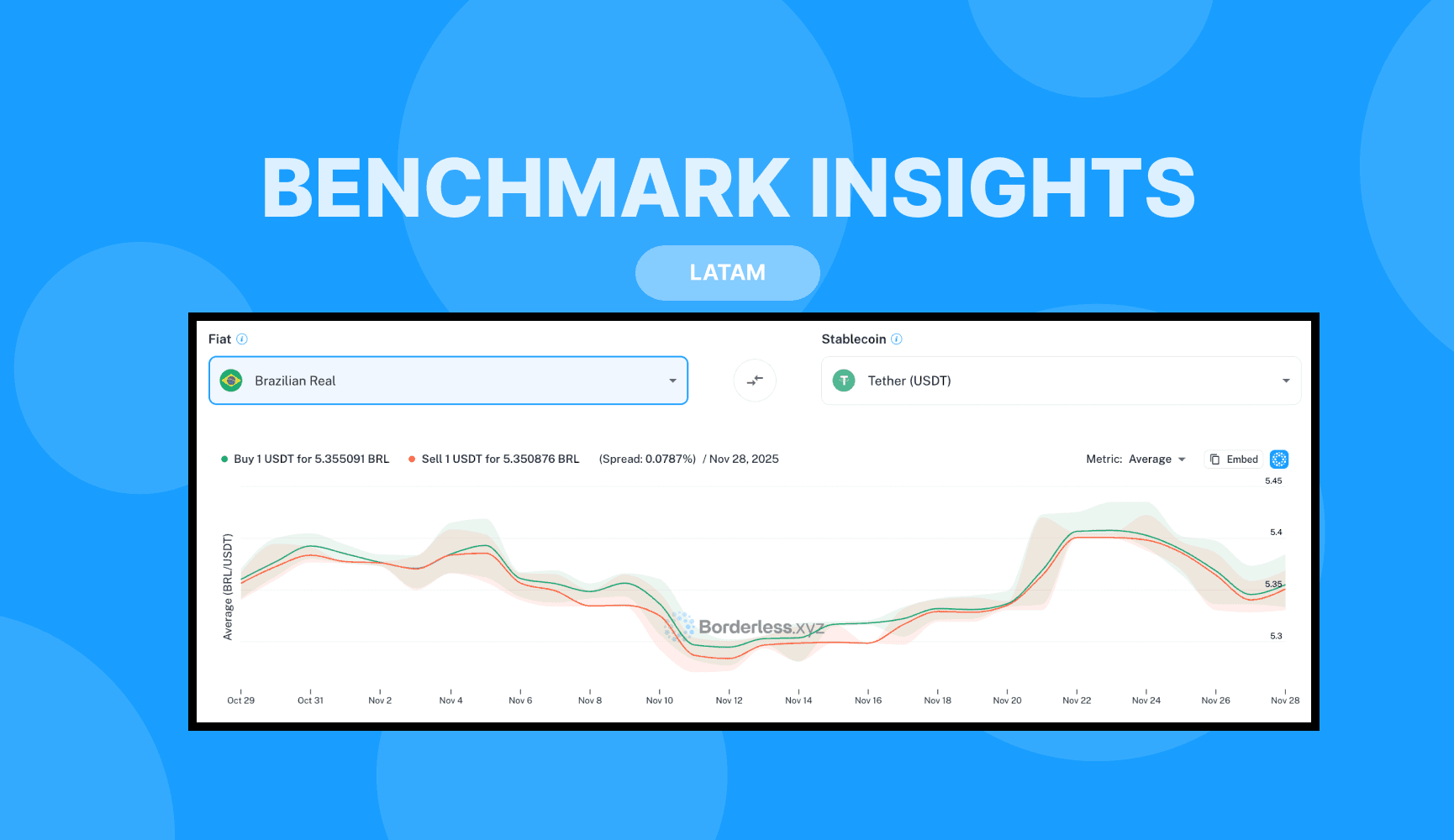
A note on BRL: Multiple providers quote BRL, but the spread data shows buy rates equaling sell rates, collapsing the apparent spread to zero. This is a reporting artifact rather than genuine execution pricing. BRL's TradFi premium data (+60 bps) is more reliable since it uses external reference rates, but spread rankings for BRL should be treated with caution until data quality improves.
USDC vs. USDT: It Matters in LatAm
Globally, USDC and USDT price at near-parity (median premium: 0 bps). But in LatAm, USDC consistently outprices USDT in every corridor:
Corridor | USDC Spread | USDT Spread | Gap |
|---|---|---|---|
MXN | 72 bps | 128 bps | 56 bps |
CLP | 101 bps | 100 bps | ~0 bps |
PEN | 119 bps | 194 bps | 75 bps |
COP | 136 bps | 349 bps | 213 bps |
ARS | 278 bps | 464 bps | 186 bps |
The USDC advantage isn't driven by different competitive structures as the same providers typically quote both stablecoins. The gap reflects higher hedging costs, thinner on-chain liquidity, or elevated regulatory risk premium embedded in USDT pricing across the region.
One outlier worth noting: PEN shows a persistent USDC discount of -638 bps relative to USDT - the only corridor globally with a persistent stablecoin pricing gap of this size.
Market Depth and Competition
LatAm has the widest competition gradient of any region.
Multi-provider corridors: ARS, BRL, COP, and MXN enjoy meaningful competition. CLP and PEN have limited competition, enough for a fallback but not enough to drive aggressive spread compression.
Single-provider corridors: BOB, CRC, DOP, and GTQ have zero redundancy. If the sole provider experiences downtime or reprices unilaterally, the corridor goes dark. The DOP rate shock of -2.41% on December 18 - an outsized move for a normally stable Caribbean currency - reflects this single-provider fragility. With no competitive check, a modest flow imbalance or pricing error produces an outsized rate print. For any payments company building on stablecoin rails, single-provider corridors are operational liabilities that require either a broader network with built-in redundancy or explicit SLA protections from the incumbent provider.
In the USDT→ARS corridor, the tightest provider quotes 312 bps while the widest quotes 621 bps. That 309 bps range means smart routing saves roughly $30,900 per $1M in volume.
Are Stablecoins More Expensive Than Traditional FX?
At a median TradFi premium of just +1.8 bps, LatAm stablecoin mid-rates are basically identical to interbank rates for most currencies. Six of ten fall within a +/- 25 bps band:
Currency | TradFi Premium (bps) | Assessment |
|---|---|---|
CLP | +0.7 | At parity |
GTQ | +0.8 | At parity |
MXN | +2.8 | At parity |
DOP | -9.9 | Slight discount |
BOB | -12.6 | Slight discount |
CRC | +24.1 | Near parity |
PEN | +26.3 | Near parity |
BRL | +60.3 | Moderate premium |
ARS | +295.5 | Significant premium |
COP | -64.7 | Significant discount |
The two outliers tell a very different story.
ARS: Capital controls priced in. The 296 bps premium reflects the well-documented gap between Argentina's official and parallel exchange rates. A stablecoin mid-rate of 1,492.55 ARS/USD versus an interbank reference of 1,449.72 represents a 2.96% markup. This is the price of accessing dollars outside restricted traditional channels.
COP: The discount anomaly. Stablecoin COP rates are 65 bps cheaper than traditional interbank (stablecoin mid of 3,780 vs TradFi 3,805). But this mid-rate advantage sits alongside widening execution spreads. The mid-rate is favorable, but the cost to execute has increased. For large-value transfers where the mid-rate matters most, stablecoins offer a genuine cost advantage. For smaller transfers where spread is the dominant cost, the advantage narrows.
Region | Median Premium (bps) | Range |
|---|---|---|
LatAm | +1.8 | -65 to +296 |
Africa | +80 | -316 to +3,338 |
Asia | -7 | -14 to -2 |
Europe | -2 | -39 to +36 |
LatAm's positioning alongside Asia and Europe on TradFi premium - apart from Africa - suggests stablecoin FX infrastructure in the region's core corridors has reached pricing maturity.
Anomalies and Events
BRL fiscal shock (December 6). The real moved +2.45% in a single session after markets repriced Brazil's fiscal trajectory following the Lula government's weaker-than-expected fiscal consolidation package. Stablecoin pricing tracked the move symmetrically across both USDC and USDT - on-chain pricing infrastructure passed through the shock without latency or divergence.
DOP rate shock (December 18). The Dominican peso moved -2.41%, anomalous for a currency managed within a tight band. Year-end dollar demand seasonality in the DR's tourism-heavy economy, amplified by the corridor's single-provider structure, drove the move. A modest flow imbalance with no competitive check produced an outsized rate print.
ARS mid-month move (December 16). Both ARS corridors moved +1.66–1.69%, coinciding with month-end peso liquidity stress and speculation about crawling-peg adjustment schedules.
USDT→PEN outlier concentration. The Peruvian sol USDT corridor had 739 records excluded as outliers - the highest of any corridor in December. This signals meaningful pricing instability in the PEN USDT market, driven by Peru's ongoing political uncertainty. PEN's USDC corridor was much more stable.
A note on December seasonality: December is structurally different from other months - reduced trading desk staffing, holiday volume drops, year-end treasury rebalancing, and tax-driven flows. Some patterns observed, particularly COP spread widening and reduced liquidity in single-provider corridors, may reflect seasonal effects as much as durable structural trends.
Methodology
Hourly buy/sell rates were collected from anonymized Borderless Network providers across 66 stablecoin-to-fiat corridors covering December 1–31, 2025. Rates are median-aggregated per corridor.
Outlier exclusions: Hampel filter (z > 6) removes point anomalies, with regime-change recovery to preserve genuine sustained rate shifts (1,020 records excluded). Providers whose median mid-rate diverges more than 10% from multi-provider consensus are excluded as parallel-market outliers (1,422 records from one MWK provider excluded due to 43.4% divergence). Total exclusion rate: 2.6%.
Static data corridors - those with fewer than 5 unique mid-rate values (CDF, GBP, SGD, EUR) — are flagged as low-quality for spread analysis.
Spreads are calculated as (BuyRate - SellRate) / MidRate in basis points, measuring provider execution cost. Corridors where providers report identical buy and sell rates are excluded from spread rankings.
Traditional FX comparison uses ECB historical daily rates for major currencies and CurrencyBeacon historical daily rates for frontier currencies, both covering the same December 2025 date range for an apples-to-apples comparison.
What This Means for Your Operations
The Latin American stablecoin liquidity landscape is fragmented by design. Different providers have different strengths, different local partnerships, and different pricing strategies depending on the corridor.
For businesses serious about optimizing their cross-border payment flows in the region, the path forward is clear:
Don't rely on a single provider. The cost savings from multi-provider connectivity - especially in high-variance markets - justify the operational complexity.
Match providers to corridors. Route volume strategically based on where each provider excels.
Test stablecoin choice in secondary markets.
Executive Summary
Latin America's stablecoin corridors are splitting into two tiers and the gap is widening.
Every month, we track stablecoin-to-fiat exchange rates through the Borderless Network. This month, we're focusing on 10 LatAm currencies, over 92,000 rate observations, and a region where the difference between the cheapest and most expensive corridor now spans nearly 400 bps.
The biggest insight: stablecoin mid-rates in LatAm are basically at parity with traditional FX - the median TradFi premium is just +1.8 bps across 10 currencies. But that number hides a 360 bps range. On the same corridor, the gap between best and worst execution can exceed 300 bps. Provider selection, stablecoin routing, and transaction timing are the three levers that matter.
Metric | Value |
|---|---|
Period | December 1–31, 2025 |
Total observations | 92,733 |
Corridors tracked | 66 (33 currencies, USDC + USDT) |
LatAm currencies | 10 (ARS, BOB, BRL, CLP, COP, CRC, DOP, GTQ, MXN, PEN) |
Global median spread | 306 bps |
LatAm median spread | 122 bps |
LatAm median TradFi premium | +1.8 bps |
"Spread" is the gap between what a provider charges to buy stablecoins and what they pay to sell them for a given fiat currency. Think of it as the provider's execution cost - like a bid-ask spread in traditional markets. A tighter spread means cheaper transactions. We measure it in basis points (bps), where 100 bps = 1%.
"TradFi premium" measures whether stablecoin exchange rates are more expensive or cheaper than traditional interbank mid-market rates. A positive premium means stablecoins cost more than traditional FX. A negative premium means stablecoins are the cheaper option.
These are two different lenses on the same market. Spread tells you what a provider charges. TradFi premium tells you how stablecoin pricing compares to the traditional banking alternative.
How LatAm Compares Globally
LatAm's regional median of 122 bps sits well below the global median of 306 bps and well below Africa's 340 bps. But that headline number masks a significant split within the region.
Region | Median Spread (bps) | Mean Spread (bps) |
|---|---|---|
Asia | 7 | 6 |
LatAm | 122 | 170 |
Africa | 340 | 480 |
The mean-median gap in LatAm (122 vs. 170 bps) tells the story: ARS and COP pull the average up significantly. For corridors outside Argentina and Colombia, execution costs cluster tightly in the 72–128 bps range.
Globally, the tightest corridors in December were PHP at 7 bps and MXN at 72 bps. The widest were BWP at 1,950 bps and CDF at 1,311 bps.
The Cost of Sending Money to Latin America
Latin America's stablecoin-to-fiat corridors span a wider cost range than any other region, from near-Asian efficiency to Africa-level pricing, all within a single continent. Companies relying on a single provider or a single stablecoin are almost certainly leaving money on the table. Those with access to the full provider network can capture savings that compound at scale.
The Two Tiers
Tier 1: Competitive execution (sub-130 bps). MXN, CLP, and PEN deliver execution costs that weren't possible on stablecoin rails two years ago.
Corridor | Median Spread (bps) |
|---|---|
USDC→MXN | 72 |
USDT→CLP | 100 |
USDC→CLP | 101 |
USDC→PEN | 119 |
USDT→MXN | 128 |
USDC→MXN at 72 bps benefits from the deepest provider competition of any currency in the Benchmark. CLP holds at 100 bps across both stablecoins. PEN's USDC corridor comes in at 119 bps. At these levels, the execution cost argument against stablecoins has largely collapsed.
Tier 2: Work in progress (275+ bps). ARS and COP tell a different story.
Corridor | Median Spread (bps) |
|---|---|
USDC→ARS | 278 |
USDT→COP | 349 |
USDT→ARS | 464 |
USDC→ARS at 278 bps approaches the global median, while USDT→ARS at 464 bps is the costliest corridor in the LatAm network, territory more commonly associated with frontier African currencies.
What's Happening in Argentina
The gap between USDC→ARS (278 bps) and USDT→ARS (464 bps) is 186 bps. This means the choice of stablecoin alone determines whether execution cost sits near the regional median or in the costliest decile globally.
This is a market access story. USDC's regulated, US-domiciled structure makes it the preferred instrument for settlement channels closer to Argentina's official exchange rate. USDT corridors trade on venues more closely tied to the parallel "blue dollar" market, absorbing the full informal premium into their spreads. The 186 bps gap is a direct measure of how wide Argentina's dual exchange rate regime remains.
The provider range reinforces this. The best USDT→ARS spread is 312 bps while the worst is 621 bps - a 309 bps range. On $1M in monthly ARS flow, routing through USDC rather than USDT saves roughly $18,600 in execution cost alone, before considering provider selection.
What's Happening in Colombia
COP spreads widened steadily through December. USDC→COP moved from 228 bps in week one to 300 bps by month's end - a 72 bps widening (31.4%). Not a single-event spike. A sustained trend across the full month.
Banco de la Republica's aggressive rate-cutting cycle in late 2025 drove COP depreciation and increased FX volatility, forcing liquidity providers to reprice risk around a weakening peso. Despite meaningful provider competition, wider spreads persisted. Competition is necessary but not sufficient for tight execution when the underlying currency is under macro stress.
Why Mexico Stands Out
USDC→MXN at 72 bps is a standout regionally and globally. Mexico's large remittance-driven stablecoin demand creates volume that attracts providers, relatively clear regulatory frameworks reduce compliance friction, and deep peso liquidity in traditional FX markets anchors provider pricing. The flywheel is textbook: volume attracts providers, competition compresses spreads, tighter spreads attract more volume.
USDT→MXN trades 56 bps wider at 128 bps, reinforcing the LatAm-wide pattern that USDC consistently outprices USDT.
A note on BRL: Multiple providers quote BRL, but the spread data shows buy rates equaling sell rates, collapsing the apparent spread to zero. This is a reporting artifact rather than genuine execution pricing. BRL's TradFi premium data (+60 bps) is more reliable since it uses external reference rates, but spread rankings for BRL should be treated with caution until data quality improves.
USDC vs. USDT: It Matters in LatAm
Globally, USDC and USDT price at near-parity (median premium: 0 bps). But in LatAm, USDC consistently outprices USDT in every corridor:
Corridor | USDC Spread | USDT Spread | Gap |
|---|---|---|---|
MXN | 72 bps | 128 bps | 56 bps |
CLP | 101 bps | 100 bps | ~0 bps |
PEN | 119 bps | 194 bps | 75 bps |
COP | 136 bps | 349 bps | 213 bps |
ARS | 278 bps | 464 bps | 186 bps |
The USDC advantage isn't driven by different competitive structures as the same providers typically quote both stablecoins. The gap reflects higher hedging costs, thinner on-chain liquidity, or elevated regulatory risk premium embedded in USDT pricing across the region.
One outlier worth noting: PEN shows a persistent USDC discount of -638 bps relative to USDT - the only corridor globally with a persistent stablecoin pricing gap of this size.
Market Depth and Competition
LatAm has the widest competition gradient of any region.
Multi-provider corridors: ARS, BRL, COP, and MXN enjoy meaningful competition. CLP and PEN have limited competition, enough for a fallback but not enough to drive aggressive spread compression.
Single-provider corridors: BOB, CRC, DOP, and GTQ have zero redundancy. If the sole provider experiences downtime or reprices unilaterally, the corridor goes dark. The DOP rate shock of -2.41% on December 18 - an outsized move for a normally stable Caribbean currency - reflects this single-provider fragility. With no competitive check, a modest flow imbalance or pricing error produces an outsized rate print. For any payments company building on stablecoin rails, single-provider corridors are operational liabilities that require either a broader network with built-in redundancy or explicit SLA protections from the incumbent provider.
In the USDT→ARS corridor, the tightest provider quotes 312 bps while the widest quotes 621 bps. That 309 bps range means smart routing saves roughly $30,900 per $1M in volume.
Are Stablecoins More Expensive Than Traditional FX?
At a median TradFi premium of just +1.8 bps, LatAm stablecoin mid-rates are basically identical to interbank rates for most currencies. Six of ten fall within a +/- 25 bps band:
Currency | TradFi Premium (bps) | Assessment |
|---|---|---|
CLP | +0.7 | At parity |
GTQ | +0.8 | At parity |
MXN | +2.8 | At parity |
DOP | -9.9 | Slight discount |
BOB | -12.6 | Slight discount |
CRC | +24.1 | Near parity |
PEN | +26.3 | Near parity |
BRL | +60.3 | Moderate premium |
ARS | +295.5 | Significant premium |
COP | -64.7 | Significant discount |
The two outliers tell a very different story.
ARS: Capital controls priced in. The 296 bps premium reflects the well-documented gap between Argentina's official and parallel exchange rates. A stablecoin mid-rate of 1,492.55 ARS/USD versus an interbank reference of 1,449.72 represents a 2.96% markup. This is the price of accessing dollars outside restricted traditional channels.
COP: The discount anomaly. Stablecoin COP rates are 65 bps cheaper than traditional interbank (stablecoin mid of 3,780 vs TradFi 3,805). But this mid-rate advantage sits alongside widening execution spreads. The mid-rate is favorable, but the cost to execute has increased. For large-value transfers where the mid-rate matters most, stablecoins offer a genuine cost advantage. For smaller transfers where spread is the dominant cost, the advantage narrows.
Region | Median Premium (bps) | Range |
|---|---|---|
LatAm | +1.8 | -65 to +296 |
Africa | +80 | -316 to +3,338 |
Asia | -7 | -14 to -2 |
Europe | -2 | -39 to +36 |
LatAm's positioning alongside Asia and Europe on TradFi premium - apart from Africa - suggests stablecoin FX infrastructure in the region's core corridors has reached pricing maturity.
Anomalies and Events
BRL fiscal shock (December 6). The real moved +2.45% in a single session after markets repriced Brazil's fiscal trajectory following the Lula government's weaker-than-expected fiscal consolidation package. Stablecoin pricing tracked the move symmetrically across both USDC and USDT - on-chain pricing infrastructure passed through the shock without latency or divergence.
DOP rate shock (December 18). The Dominican peso moved -2.41%, anomalous for a currency managed within a tight band. Year-end dollar demand seasonality in the DR's tourism-heavy economy, amplified by the corridor's single-provider structure, drove the move. A modest flow imbalance with no competitive check produced an outsized rate print.
ARS mid-month move (December 16). Both ARS corridors moved +1.66–1.69%, coinciding with month-end peso liquidity stress and speculation about crawling-peg adjustment schedules.
USDT→PEN outlier concentration. The Peruvian sol USDT corridor had 739 records excluded as outliers - the highest of any corridor in December. This signals meaningful pricing instability in the PEN USDT market, driven by Peru's ongoing political uncertainty. PEN's USDC corridor was much more stable.
A note on December seasonality: December is structurally different from other months - reduced trading desk staffing, holiday volume drops, year-end treasury rebalancing, and tax-driven flows. Some patterns observed, particularly COP spread widening and reduced liquidity in single-provider corridors, may reflect seasonal effects as much as durable structural trends.
Methodology
Hourly buy/sell rates were collected from anonymized Borderless Network providers across 66 stablecoin-to-fiat corridors covering December 1–31, 2025. Rates are median-aggregated per corridor.
Outlier exclusions: Hampel filter (z > 6) removes point anomalies, with regime-change recovery to preserve genuine sustained rate shifts (1,020 records excluded). Providers whose median mid-rate diverges more than 10% from multi-provider consensus are excluded as parallel-market outliers (1,422 records from one MWK provider excluded due to 43.4% divergence). Total exclusion rate: 2.6%.
Static data corridors - those with fewer than 5 unique mid-rate values (CDF, GBP, SGD, EUR) — are flagged as low-quality for spread analysis.
Spreads are calculated as (BuyRate - SellRate) / MidRate in basis points, measuring provider execution cost. Corridors where providers report identical buy and sell rates are excluded from spread rankings.
Traditional FX comparison uses ECB historical daily rates for major currencies and CurrencyBeacon historical daily rates for frontier currencies, both covering the same December 2025 date range for an apples-to-apples comparison.
What This Means for Your Operations
The Latin American stablecoin liquidity landscape is fragmented by design. Different providers have different strengths, different local partnerships, and different pricing strategies depending on the corridor.
For businesses serious about optimizing their cross-border payment flows in the region, the path forward is clear:
Don't rely on a single provider. The cost savings from multi-provider connectivity - especially in high-variance markets - justify the operational complexity.
Match providers to corridors. Route volume strategically based on where each provider excels.
Test stablecoin choice in secondary markets.
Other Articles
Global Stablecoin Orchestration Network

Borderless Innovations Labs Inc. (Borderless) is a technology and smart contract development company. Borderless in not a broker-dealer or financial institution and does not engage any conduct or transactions requiring such registration. All financial products are offered by and through financial institutions directly. Borderless does not make any recommendation for the purchase or sale of digital assets. Our products and services are offered in limited jurisdictions so please contact our partnerships team for further information and refer to our Terms of Services.
Global Stablecoin Orchestration Network
Borderless Innovations Labs Inc. (Borderless) is a technology and smart contract development company. Borderless in not a broker-dealer or financial institution and does not engage any conduct or transactions requiring such registration. All financial products are offered by and through financial institutions directly. Borderless does not make any recommendation for the purchase or sale of digital assets. Our products and services are offered in limited jurisdictions so please contact our partnerships team for further information and refer to our Terms of Services.
Global Stablecoin Orchestration Network
Borderless Innovations Labs Inc. (Borderless) is a technology and smart contract development company. Borderless in not a broker-dealer or financial institution and does not engage any conduct or transactions requiring such registration. All financial products are offered by and through financial institutions directly. Borderless does not make any recommendation for the purchase or sale of digital assets. Our products and services are offered in limited jurisdictions so please contact our partnerships team for further information and refer to our Terms of Services.