
Updates
Stablecoin FX Insights: November Edition
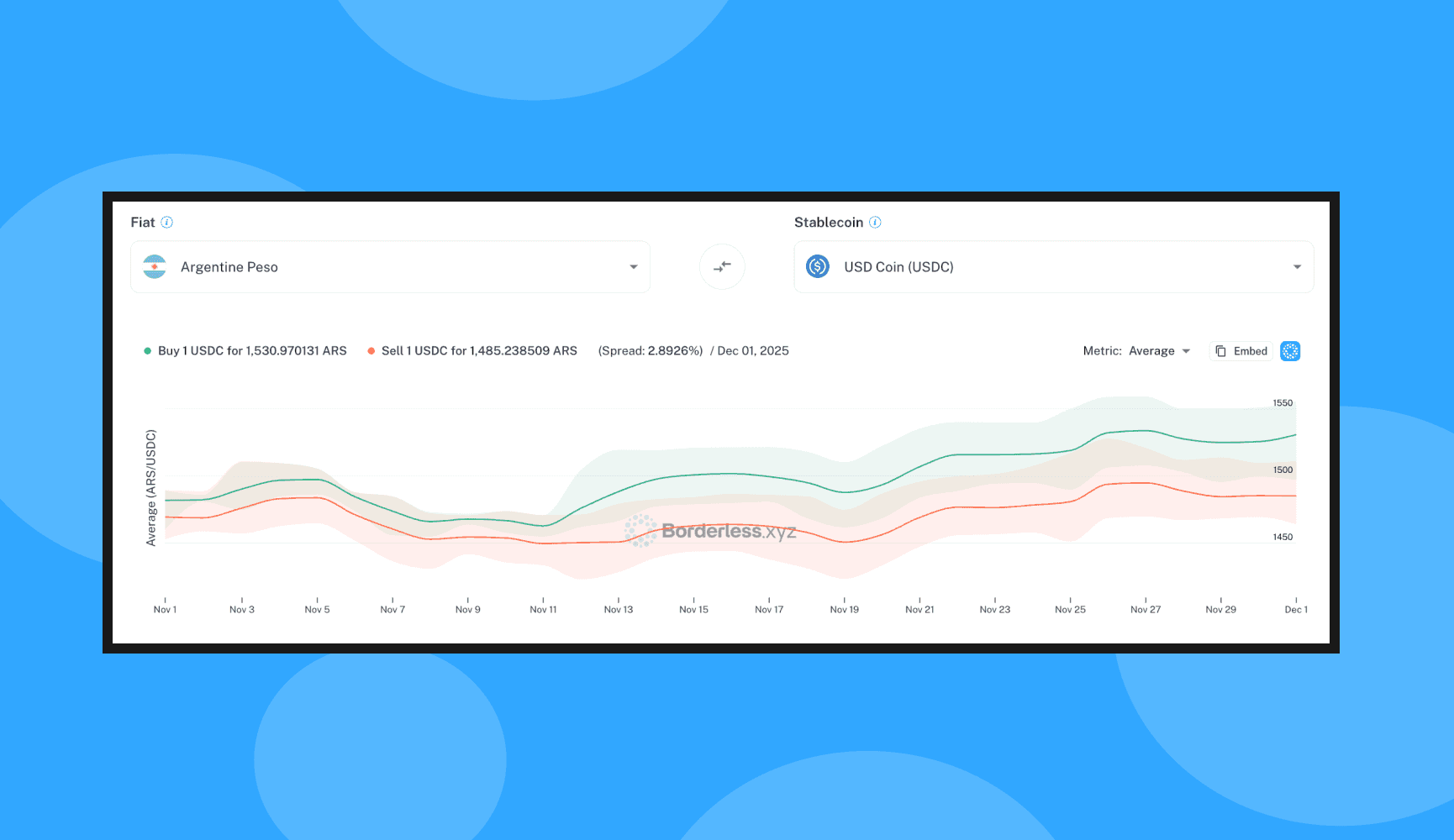
The Borderless Benchmark continues to expand. This month, we onboarded rate data from five new providers, widening corridor coverage and deepening our visibility into real-time stablecoin–fiat pricing. We also introduced a standard deviation metric to make cross-venue dispersion easier to interpret, alongside improved data-integrity checks that enhance accuracy across all benchmark surfaces.
Below are key insights from this month’s analysis.
1. Stablecoin–fiat spreads fall into clear tiers
One of the strongest patterns in the dataset is the way spreads naturally cluster into three distinct tiers across venues:
5–10 bps at the tightest venues
60–200 bps across a broad middle tier
350–600 bps at the tail
These tiers remained stable throughout the full 30-day window, across time of day and across fiat pairs, indicating a structural feature of the market, not a temporary dislocation.
Why it matters: Liquidity is heterogeneous. A single “average spread” can obscure meaningful execution differences. Smart routing and multi-venue benchmarking are essential for ensuring flows reach the tightest available pricing instead of defaulting into the wider middle or tail.
2. Best-of-book pricing tightened while wider spreads held steady
This month showed a dramatic tightening in the best-available spreads:
The tightest spreads compressed from ~90 bps → ~5 bps
Driven by new low-spread venues coming online
Median spreads narrowed only ~20%, while wide-spread venues improved just ~10%
In other words, while tight venues improved sharply, the wider tail remained largely unchanged. This created a more bimodal distribution, particularly pronounced in EM corridors.
Why it matters: Participants with access to the tightest venues saw meaningful execution gains, while those relying on static or single-provider routes may have seen little to no improvement. This widening gap underscores the importance of multi-provider routing and real-time benchmarking to capture the best-available pricing.
3. LatAm EM corridors show persistent 0.8–2.4% dispersion
Nowhere is cross-venue variability more visible than in Latin America. Across key LatAm EM corridors, the difference between the best and worst available provider quotes at the same timestamp consistently ranges from 0.8% to 2.4%.
When prices are normalized against the composite median, clear patterns emerge:
Some PFIs consistently quote 50–70 bps richer than the median
Others hug the median or come in slightly cheaper
These patterns persist across the full month, indicating structural, not episodic, differences
Why it matters: In LatAm, venue selection can shift pricing by 1–2% at the same time, making it one of the strongest examples of how fragmented liquidity impacts outcomes. Multi-provider visibility and dynamic routing materially improve execution quality, while single-provider flows risk overpaying and delivering a weaker client experience.
4. USDC and USDT track closely overall, but show meaningful basis in some corridors
Across most fiat–stablecoin combinations, USDC and USDT trade at relatively at the same level. Mid-price differences are typically a few bps, and even at their widest the deviation rarely exceeds ~60 bps, which indicates strong global fungibility between the two assets under normal conditions.
However, this relationship breaks down in a subset of regional corridors, where a persistent and significant basis emerges:
USDC priced 3–6% cheaper than USDT against the same fiat
The basis remained consistent across the full 30-day dataset
The pattern was structural, not driven by isolated outliers or short-term dislocations
Why it matters: These corridor-specific divergences reveal how local liquidity, regional demand, and settlement preferences can disrupt global parity between stablecoins.
5. EM stablecoin–fiat pairs show higher dispersion than major pairs, with modest weekend widening
Emerging-market (EM) corridors display significantly wider cross-venue dispersion than major pairs, reflecting more fragmented liquidity.
EM high–low ranges averaged 230–240 bps, versus ~60 bps for major pairs
EM median dispersion rose from 58 bps on weekdays to 65 bps on weekends (~11%)
The EM–major contrast is directionally robust, though major-pair data is based on fewer overlapping quotes
Why it matters: EM corridors are structurally less competitive and more sensitive to venue gaps, especially on weekends. Multi-provider visibility helps institutions avoid elevated or inconsistent pricing and route flows more efficiently across these markets.
The Borderless Benchmark continues to expand. This month, we onboarded rate data from five new providers, widening corridor coverage and deepening our visibility into real-time stablecoin–fiat pricing. We also introduced a standard deviation metric to make cross-venue dispersion easier to interpret, alongside improved data-integrity checks that enhance accuracy across all benchmark surfaces.
Below are key insights from this month’s analysis.
1. Stablecoin–fiat spreads fall into clear tiers
One of the strongest patterns in the dataset is the way spreads naturally cluster into three distinct tiers across venues:
5–10 bps at the tightest venues
60–200 bps across a broad middle tier
350–600 bps at the tail
These tiers remained stable throughout the full 30-day window, across time of day and across fiat pairs, indicating a structural feature of the market, not a temporary dislocation.
Why it matters: Liquidity is heterogeneous. A single “average spread” can obscure meaningful execution differences. Smart routing and multi-venue benchmarking are essential for ensuring flows reach the tightest available pricing instead of defaulting into the wider middle or tail.
2. Best-of-book pricing tightened while wider spreads held steady
This month showed a dramatic tightening in the best-available spreads:
The tightest spreads compressed from ~90 bps → ~5 bps
Driven by new low-spread venues coming online
Median spreads narrowed only ~20%, while wide-spread venues improved just ~10%
In other words, while tight venues improved sharply, the wider tail remained largely unchanged. This created a more bimodal distribution, particularly pronounced in EM corridors.
Why it matters: Participants with access to the tightest venues saw meaningful execution gains, while those relying on static or single-provider routes may have seen little to no improvement. This widening gap underscores the importance of multi-provider routing and real-time benchmarking to capture the best-available pricing.
3. LatAm EM corridors show persistent 0.8–2.4% dispersion
Nowhere is cross-venue variability more visible than in Latin America. Across key LatAm EM corridors, the difference between the best and worst available provider quotes at the same timestamp consistently ranges from 0.8% to 2.4%.
When prices are normalized against the composite median, clear patterns emerge:
Some PFIs consistently quote 50–70 bps richer than the median
Others hug the median or come in slightly cheaper
These patterns persist across the full month, indicating structural, not episodic, differences
Why it matters: In LatAm, venue selection can shift pricing by 1–2% at the same time, making it one of the strongest examples of how fragmented liquidity impacts outcomes. Multi-provider visibility and dynamic routing materially improve execution quality, while single-provider flows risk overpaying and delivering a weaker client experience.
4. USDC and USDT track closely overall, but show meaningful basis in some corridors
Across most fiat–stablecoin combinations, USDC and USDT trade at relatively at the same level. Mid-price differences are typically a few bps, and even at their widest the deviation rarely exceeds ~60 bps, which indicates strong global fungibility between the two assets under normal conditions.
However, this relationship breaks down in a subset of regional corridors, where a persistent and significant basis emerges:
USDC priced 3–6% cheaper than USDT against the same fiat
The basis remained consistent across the full 30-day dataset
The pattern was structural, not driven by isolated outliers or short-term dislocations
Why it matters: These corridor-specific divergences reveal how local liquidity, regional demand, and settlement preferences can disrupt global parity between stablecoins.
5. EM stablecoin–fiat pairs show higher dispersion than major pairs, with modest weekend widening
Emerging-market (EM) corridors display significantly wider cross-venue dispersion than major pairs, reflecting more fragmented liquidity.
EM high–low ranges averaged 230–240 bps, versus ~60 bps for major pairs
EM median dispersion rose from 58 bps on weekdays to 65 bps on weekends (~11%)
The EM–major contrast is directionally robust, though major-pair data is based on fewer overlapping quotes
Why it matters: EM corridors are structurally less competitive and more sensitive to venue gaps, especially on weekends. Multi-provider visibility helps institutions avoid elevated or inconsistent pricing and route flows more efficiently across these markets.
Other Articles
Global Stablecoin Orchestration Network

Borderless Innovations Labs Inc. (Borderless) is a technology and smart contract development company. Borderless in not a broker-dealer or financial institution and does not engage any conduct or transactions requiring such registration. All financial products are offered by and through financial institutions directly. Borderless does not make any recommendation for the purchase or sale of digital assets. Our products and services are offered in limited jurisdictions so please contact our partnerships team for further information and refer to our Terms of Services.
Global Stablecoin Orchestration Network
Borderless Innovations Labs Inc. (Borderless) is a technology and smart contract development company. Borderless in not a broker-dealer or financial institution and does not engage any conduct or transactions requiring such registration. All financial products are offered by and through financial institutions directly. Borderless does not make any recommendation for the purchase or sale of digital assets. Our products and services are offered in limited jurisdictions so please contact our partnerships team for further information and refer to our Terms of Services.
Global Stablecoin Orchestration Network
Borderless Innovations Labs Inc. (Borderless) is a technology and smart contract development company. Borderless in not a broker-dealer or financial institution and does not engage any conduct or transactions requiring such registration. All financial products are offered by and through financial institutions directly. Borderless does not make any recommendation for the purchase or sale of digital assets. Our products and services are offered in limited jurisdictions so please contact our partnerships team for further information and refer to our Terms of Services.