
Research
Borderless Benchmark Quarterly Insights: Q1 2026
Three Months of Data. Three Different Markets.
Stablecoin FX is a three-speed market. In LATAM, it's already at interbank parity - BRL execution cost hit 0 bps from multiple providers, and the region held within 22 bps of TradFi all quarter. In East Africa, provider competition is compressing pricing gaps 60-80% in Kenya, Tanzania, and Rwanda. And across 28 APAC and Middle East corridors, sell-side rates are tracking interbank within 20 bps.
The corridors that don't have that competitive depth tell a different story. Malawi's execution cost tripled mid-month. Zambia widened 701 bps in five weeks. Nigeria's stablecoin premium dropped 193 bps across Q1 while Ghana's rose 138.
For teams evaluating stablecoin rails, the question is no longer whether rates are competitive - it's which corridors have the provider depth and pricing stability to support production operations at scale.
This report is built on 1.15 million rate observations across 51 currencies from the Borderless network's proprietary dataset - broken down by region, by currency, and by week.
Key Numbers
Metric | Jan 2026 | Feb 2026 | Mar 2026 |
|---|---|---|---|
Median stablecoin premium vs TradFi | +37 bps | +39 bps | +51 bps |
Within ±100 bps of TradFi | 10 of 20 | 11 of 21 | 14 of 21 |
Global median execution cost | 303 bps | 296 bps | 322 bps |
Currencies tracked | 32 | 51 | 51 |
Currencies with execution cost data | 21 | 22 | 22 |
USDC/USDT median gap | 0 bps | 0 bps | 0 bps |
Date range | Jan 1–31 | Feb 1–28 | Mar 1–31 |
How to read this report. Three metrics appear throughout, each measuring something different:
Execution Cost - The buy-sell gap within a single provider's stablecoin-to-fiat pair, calculated as (BuyRate - SellRate) / MidRate. Expressed in basis points (bps, where 100 bps = 1%). Note: this reflects quoted rates, not filled rates. It does not include chain gas fees, settlement delays, or slippage at larger transaction sizes. Actual all-in costs will be higher.
Stablecoin Premium - How the stablecoin mid-rate compares to the traditional interbank mid-market rate for the same currency and period. Positive means stablecoins cost more than interbank. Negative means they're cheaper. Interbank mid-rates are reference rates, not tradeable prices; actual bank pricing includes relationship discounts and volume tiers.
Provider Pricing Gap - The difference between the cheapest and most expensive provider quoting the same currency, measured from their median mid-rates. This is how much you leave on the table by being locked into a single provider.
Competition depth: Throughout this report, "Deep" = 3 or more providers quoting buy and sell rates for a corridor. "Limited" = 2 providers. Single-provider corridors have no pricing gap data.
Stablecoin Premium vs Traditional FX
The headline question enterprise treasury teams ask: are stablecoin rates competitive with what we already have?
Using day-matched comparisons (stablecoin mid-rates compared against TradFi interbank rates from the same day, then aggregated), the median stablecoin premium held between +37 and +51 bps all quarter. The number of currencies within 100 bps of parity grew from 10 to 14.
Q1 Stablecoin Premium Summary
Metric | Jan | Feb | Mar |
|---|---|---|---|
Median stablecoin premium (day-matched) | +37 bps | +39 bps | +51 bps |
Currencies within ±50 bps | 9 of 20 | 11 of 21 | 10 of 21 |
Currencies within ±100 bps | 10 of 20 | 11 of 21 | 14 of 21 |
The premium was remarkably stable at the median level. The improvement shows up in the tails: more currencies moved into the ±100 bps range as the quarter progressed. Several African corridors (NGN, GHS, XAF) showed month-to-month volatility in their premiums, driven by local fiat liquidity conditions and provider repricing.
Per-Currency Premium vs TradFi Interbank (bps)
Currency | Region | Jan | Feb | Mar | Q1 Δ | Status |
|---|---|---|---|---|---|---|
BRL | LATAM | +6 | -4 | +4 | -2 | At parity |
CLP | LATAM | +22 | +39 | +2 | -20 | At parity |
COP | LATAM | -31 | -11 | -15 | +16 | At parity |
MXN | LATAM | +2 | +4 | +32 | +30 | At parity |
PEN | LATAM | +384 | +386 | +51 | -333 | Converging |
ARS | LATAM | +487 | +465 | +478 | -9 | Elevated |
KES | Africa | +9 | +19 | -13 | -22 | At parity |
RWF | Africa | +23 | +28 | +6 | -17 | At parity |
TZS | Africa | +52 | +28 | +54 | +2 | Near parity |
ZAR | Africa | +106 | +106 | +94 | -12 | Near parity |
UGX | Africa | -19 | -14 | -19 | +0 | Below parity |
XOF | Africa | +128 | +130 | +115 | -13 | Elevated |
ZMW | Africa | +112 | +122 | +80 | -32 | Near parity |
NGN | Africa | +335 | +307 | +142 | -193 | Converging |
GHS | Africa | +533 | +382 | +671 | +138 | Elevated |
BWP | Africa | -116 | +384 | +339 | +455 | Volatile |
EUR | Europe | -2 | -10 | +18 | +20 | At parity |
PHP | APAC | -3 | -4 | +3 | +6 | At parity |
AED | Middle East | N/A | -7 | -7 | +0 | At parity |
By March, 14 of 21 currencies traded within 100 bps of traditional interbank mid-rates on a day-matched basis.
Regional TradFi Premium (median, excluding parallel market outliers)
Region | Jan | Feb | Mar | Trend |
|---|---|---|---|---|
LATAM | +22 bps | +4 bps | +4 bps | Stable near parity |
Africa | +106 bps | +106 bps | +80 bps | Stable, slight improvement |
Asia-Pacific | -3 bps | -4 bps | +3 bps | At parity (PHP only) |
Europe | -2 bps | -10 bps | +18 bps | At parity |
LATAM shows the most consistent signal. The region was within 22 bps of interbank all quarter and tightened to +4 bps by February. Africa showed a February spike driven by NGN, XAF, and ZMW, then corrected sharply in March.
Parallel Market Currencies
Three currencies carry structurally elevated premiums driven by parallel market dynamics.
Currency | Q1 Range | Context |
|---|---|---|
CDF (Congo) | +3,385 to +3,542 bps | Stable ~35% premium. Dual exchange rate regime. |
GHS (Ghana) | +392 to +694 bps | Persistent 4-7% premium. Cedi instability. |
ARS (Argentina) | +473 to +596 bps | Capital controls create structural divergence. |
These currencies are priced by the stablecoin market at rates closer to what businesses actually pay on the ground. The "premium" vs interbank reflects the gap between official rates and market-clearing rates.
Provider Pricing Gap: Where Multi-Provider Access Pays
The provider pricing gap measures the difference between the cheapest and most expensive provider quoting the same currency. It answers a simple question: how much money are you leaving on the table by being locked into a single provider?
Q1 Provider Pricing Gap Trend by Currency (bps)
Currency | Region | Jan | Competition | Feb | Competition | Mar | Competition | Q1 Δ | Trend |
|---|---|---|---|---|---|---|---|---|---|
GHS | Africa | 704 | Limited | 422 | Limited | 616 | Limited | -87 | Tightening |
TZS | Africa | 340 | Deep | 279 | Deep | 68 | Deep | -272 | Tightening |
KES | Africa | 176 | Deep | 172 | Deep | 33 | Deep | -143 | Tightening |
RWF | Africa | 181 | Deep | 231 | Deep | 72 | Deep | -108 | Tightening |
ZAR | Africa | 66 | Limited | 68 | Limited | 121 | Limited | +55 | Widening |
XOF | Africa | 47 | Limited | 143 | Deep | 36 | Deep | -12 | Stable |
NGN | Africa | 6 | Limited | 221 | Deep | 41 | Deep | +35 | Widening |
ZMW | Africa | 57 | Limited | 66 | Limited | 15 | Limited | -42 | Tightening |
UGX | Africa | 45 | Limited | 37 | Limited | 22 | Limited | -24 | Tightening |
EUR | Europe | 59 | Limited | 59 | Limited | 58 | Limited | -1 | Stable |
MXN | LATAM | 35 | Deep | 32 | Deep | 42 | Deep | +7 | Stable |
BRL | LATAM | 9 | Deep | 10 | Deep | 38 | Deep | +29 | Widening |
COP | LATAM | 19 | Limited | 5 | Limited | 19 | Limited | +1 | Stable |
ARS | LATAM | 16 | Limited | 104 | Limited | 18 | Limited | +3 | Stable |
Where Competition Is Working: East African Convergence
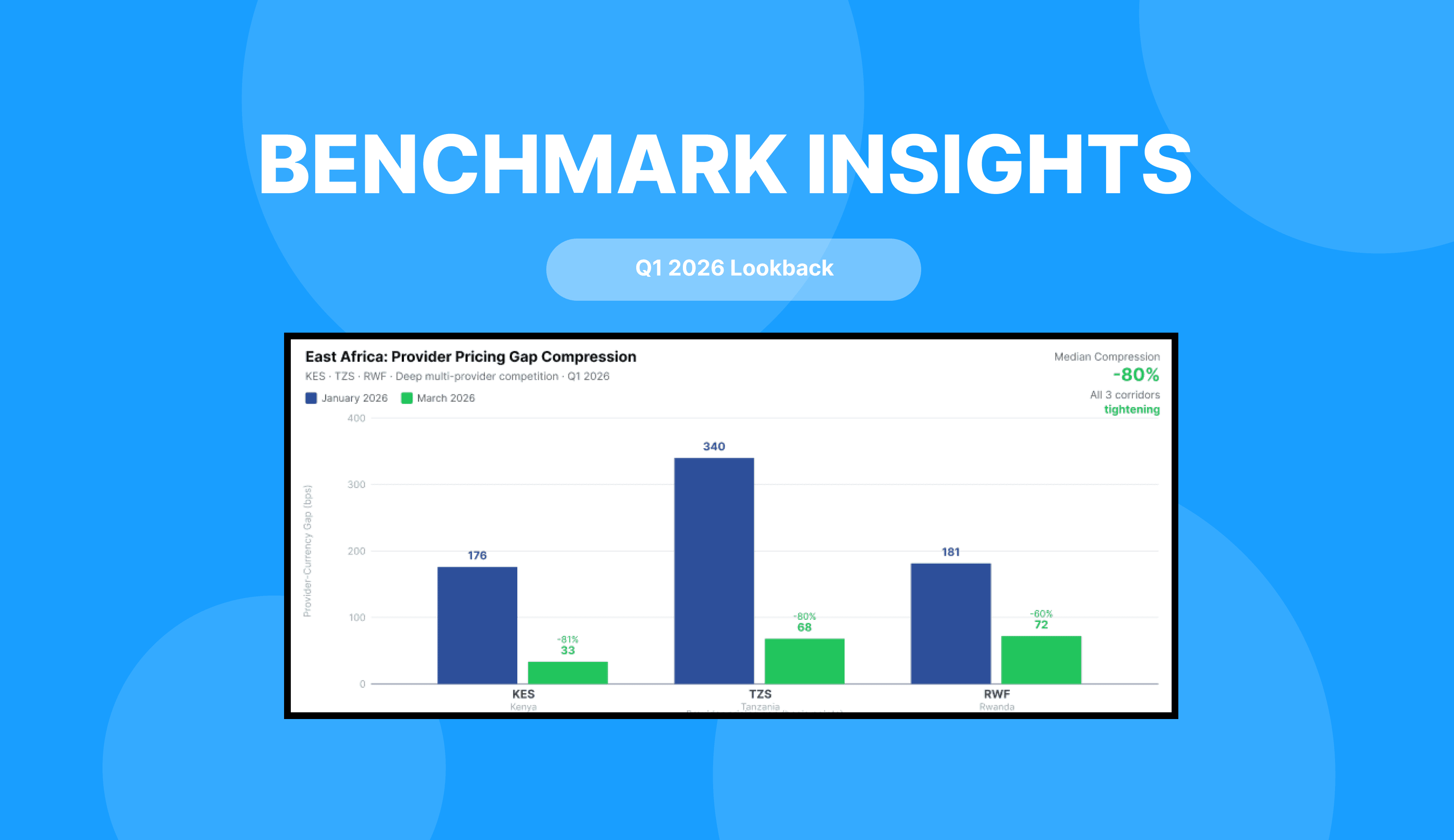
The strongest signal in Q1's pricing gap data is East Africa. Three currencies with deep multi-provider competition each showed dramatic tightening.
Currency | Jan Pricing Gap | Mar Pricing Gap | Compression |
|---|---|---|---|
TZS (Tanzania) | 340 bps | 68 bps | -80% |
KES (Kenya) | 176 bps | 33 bps | -81% |
RWF (Rwanda) | 181 bps | 72 bps | -60% |
Multiple independent providers started Q1 quoting significantly different rates for the same currencies. By March, their pricing had converged to within 33-72 bps. This is what competitive price discovery looks like in real time. Visibility across providers is what makes it measurable. The providers aren't coordinating. They're responding to the same market signals and competing for the same volume.
Compare this to corridors with limited competition, where pricing gaps are more likely to persist or widen. ZAR went from 66 to 121 bps. GHS still sits at 616 bps.
March Provider-Level Pricing (Most Dispersed Corridors)
Currency | Tightest Provider | Mid-Rate | Widest Provider | Mid-Rate | Gap |
|---|---|---|---|---|---|
GHS | Provider A | 10.93 | Provider B | 11.63 | 616 bps |
ZAR | Provider A | 16.80 | Provider B | 17.01 | 121 bps |
RWF | Provider A | 1,451.5 | Provider C | 1,462.1 | 72 bps |
TZS | Provider A | 2,588.9 | Provider C | 2,606.5 | 68 bps |
MXN | Provider A | 17.78 | Provider D | 17.86 | 42 bps |
BRL | Provider A | 5.23 | Provider C | 5.25 | 38 bps |
Regional Median Provider Pricing Gap
Region | Jan | Feb | Mar | Trend |
|---|---|---|---|---|
LATAM | 17 bps | 21 bps | 29 bps | Tight and stable |
Africa | 96 bps | 172 bps | 68 bps | Tightening (competition effect) |
Europe | 59 bps | 59 bps | 58 bps | Flat |
Africa's median pricing gap fell from 96 to 68 bps across Q1. LATAM started tight and stayed tight. The gap between regions is narrowing.
Q1 in Review: The Three-Speed Market
Q1 revealed three distinct tiers of stablecoin FX maturity, and the gap between them isn't closing.
Tier 1: Institutional Grade (LATAM)
Corridor | Execution Cost | Competition | Stablecoin Premium | Provider Pricing Gap |
|---|---|---|---|---|
BRL | 0 bps | Deep | +4 bps | 38 bps |
MXN | 73 bps | Deepest | +32 bps | 42 bps |
COP | 229 bps | Limited | -15 bps | 19 bps |
CLP | 100 bps | Limited | +2 bps | N/A (single provider) |
ARS | 406 bps | Limited | +478 bps | 18 bps |
BRL at 0 bps quoted execution cost from multiple providers for two consecutive months suggests genuine competitive pricing rather than a promotional rate. One provider held 0 bps all quarter. A second quoted 0 bps in January and February before moving to 19 bps in March.
LATAM's regional execution cost held in a 6 bps band all quarter (136-142 bps). Predictable costs, competitive provider depth, near-parity with interbank rates. This is what institutional-grade stablecoin FX looks like.
Tier 2: Active Price Discovery (Africa)
Corridor | Jan Cost | Mar Cost | Q1 Δ | Stablecoin Premium (Mar) | Pricing Gap Trend |
|---|---|---|---|---|---|
ZAR | 187 | 151 | -36 | +94 bps | Widening |
KES | 295 | 277 | -18 | -13 bps | Tightening |
NGN | 306 | 298 | -8 | +142 bps | Tightening |
RWF | 436 | 388 | -48 | +6 bps | Tightening |
TZS | 411 | 405 | -6 | +54 bps | Tightening |
UGX | 250 | 352 | +101 | -19 bps | Tightening |
GHS | 300 | 335 | +35 | +671 bps | Tightening |
XOF | 594 | 594 | 0 | +20 bps | Stable |
BWP | 1,944 | 758 | -1,186 | +517 bps | Single provider |
ZMW | 850 | 602 | -248 | +72 bps | Tightening |
CDF | 1,311 | 1,311 | 0 | +3,542 bps | Single provider) |
Africa defies generalization. KES and UGX trade below interbank parity. RWF is within 6 bps. The most useful observation is that East African corridors (KES, TZS, RWF, UGX) are converging. Provider pricing gaps tightened 60-81% across Q1. West and Southern Africa remain more volatile.
Tier 3: Sell-Rate Coverage (28 currencies)
Twenty-eight currencies in the benchmark have sell-rate data only (no buy-side quotes). These are predominantly APAC, Middle East, and European corridors served by a single provider. We can't compute execution cost or provider pricing gaps for these corridors. But we can compare their sell rates against interbank.
The result: all 28 sell-only currencies trade within ±20 bps of interbank mid-rates. Median premium: -4 bps.
Currency | Region | Sell-Rate Premium vs TradFi |
|---|---|---|
AUD | APAC | +16 bps |
CAD | Americas | -2 bps |
CNY | APAC | +4 bps |
EGP | Middle East | -6 bps |
HKD | APAC | -3 bps |
IDR | APAC | +10 bps |
INR | APAC | +2 bps |
JPY | APAC | +2 bps |
KRW | APAC | +5 bps |
MYR | APAC | -8 bps |
PLN | Europe | -7 bps |
SAR | Middle East | 0 bps |
SGD | APAC | +3 bps |
THB | APAC | +2 bps |
TRY | Europe | -3 bps |
VND | APAC | -5 bps |
(16 of 28 shown. Full table available. All 28 within ±20 bps.)
For businesses making payouts (sell-side only), these corridors are at interbank parity. The open question is whether buy-side rates, when they arrive, will be equally competitive. PHP (7 bps execution cost, single provider) and EUR (116 bps, limited competition) are the only corridors outside LATAM and Africa with full bid-ask data today.
Borderless.xyz is actively expanding the provider network in APAC, Middle East, and Europe. As new providers come online in these corridors, future reports will include full execution cost and provider pricing gap analysis.
Within-Quarter Volatility: The Quarterly Average Problem
The global median execution cost moved 19 bps across Q1 (303 to 322). This masks corridor-level regime shifts that would be material to any payments operation.
Intra-Month Execution Cost Swings (March, weekly medians, bps)
Currency | Week 1 | Week 2 | Week 3 | Week 4 | Week 5 | Swing |
|---|---|---|---|---|---|---|
ZMW | 297 | 598 | 603 | 966 | 998 | +701 |
XOF | 296 | 426 | 594 | 594 | 594 | +298 |
UGX | 371 | 346 | 368 | 357 | 165 | -206 |
ZAR | 295 | 294 | 148 | 150 | 150 | -145 |
XAF | 424 | 513 | 405 | 405 | 318 | -105 |
NGN | 308 | 280 | 316 | 308 | 216 | -92 |
KES | 275 | 275 | 279 | 278 | 190 | -85 |
RWF | 436 | 436 | 388 | 388 | 354 | -82 |
ZMW widened 701 bps across five weeks. A monthly review would catch this 2–3 weeks late. A payments operation disbursing into ZMW on a fixed schedule would have executed at a 3.4x range within the same month.
V-Shaped Corridors Across Q1
Currency | Jan | Feb | Mar | Pattern |
|---|---|---|---|---|
ZAR | 187 | 295 | 151 | Widened 108, snapped back -144 |
UGX | 250 | 347 | 352 (but wk5: 165) | Widened, then collapsed intra-March |
These are not stable corridors experiencing temporary shocks. The underlying pricing regime is changing.
Corridors That Held Steady
Currency | Jan | Feb | Mar | Range |
|---|---|---|---|---|
CLP | 101 | 100 | 100 | 1 bps |
CDF | 1,311 | 1,311 | 1,311 | 0 bps |
PHP | 7 | 9 | 7 | 2 bps |
EUR | — | 59 | 58 | 1 bps |
BRL | 0 | 19 | 0 | 19 bps |
Five corridors barely moved all quarter. CLP held at 100 bps within 1 bps. PHP held at 7 bps. BRL alternated between 0 and 19 bps. Stable corridors share two characteristics: either deep competition (BRL, CLP) or single-provider frontier markets with administered pricing (CDF).
Looking Ahead
Q1 established three things. Stablecoin FX rates in LATAM are at interbank parity, and they stayed there all quarter. African corridors are in active price discovery, with East Africa showing that multi-provider competition compresses pricing gaps fast. And 28 sell-only corridors across APAC, Middle East, and Europe are tracking interbank within 20 bps on the payout side.
The open questions for Q2: Will the sell-only corridors add buy-side liquidity? Will the East African pricing gap compression continue or plateau? And will the within-month volatility in frontier corridors (ZMW, XOF) stabilize as the market matures, or is regime-level pricing instability a permanent feature of thin corridors?
The data is clear on one point: stablecoin FX is no longer a question of whether rates are competitive. For most corridors, they are. The question is which corridors have the provider depth, pricing stability, and the infrastructure maturity to support production-grade operations. The answer varies by corridor, by week, and by provider.
The Borderless Benchmark will keep building this dataset quarter over quarter - more corridors, more providers, more depth on the buy-side in APAC and the Middle East as the network expands. Each quarter adds more signal on whether these patterns hold, whether frontier corridor volatility is structural or transitional, whether the sell-only corridors develop the two sided liquidity that makes them operationally viable. The Q1 report established the baseline. Q2 will tell us which direction the market is moving. will continue tracking these patterns quarterly. The data is clear on one point: stablecoin FX is no longer a question of whether rates are competitive. For most corridors, they are. The question is which corridors have the provider depth, pricing stability, and infrastructure maturity to support production-grade payment operations. That answer varies by corridor, by week, and by provider.
The Borderless Benchmark is derived from rate observations across activity on the Borderless network, covering 51 stablecoin-to-fiat corridors. Q1 2026 encompassed 1,147,767 rate observations across 90 calendar days. USDC and USDT are functionally interchangeable for FX purposes (median gap: 0 bps all quarter). Stablecoin premium calculations use day-matched comparisons: each day's stablecoin mid-rate is compared against the interbank rate from the same day, then aggregated to monthly medians. TradFi rates sourced from ECB daily rates and fawazahmed0/currency-api. Parallel market currencies (CDF, MWK, GHS, ARS) are flagged separately throughout.
Stablecoin FX is a three-speed market. In LATAM, it's already at interbank parity - BRL execution cost hit 0 bps from multiple providers, and the region held within 22 bps of TradFi all quarter. In East Africa, provider competition is compressing pricing gaps 60-80% in Kenya, Tanzania, and Rwanda. And across 28 APAC and Middle East corridors, sell-side rates are tracking interbank within 20 bps.
The corridors that don't have that competitive depth tell a different story. Malawi's execution cost tripled mid-month. Zambia widened 701 bps in five weeks. Nigeria's stablecoin premium dropped 193 bps across Q1 while Ghana's rose 138.
For teams evaluating stablecoin rails, the question is no longer whether rates are competitive - it's which corridors have the provider depth and pricing stability to support production operations at scale.
This report is built on 1.15 million rate observations across 51 currencies from the Borderless network's proprietary dataset - broken down by region, by currency, and by week.
Key Numbers
Metric | Jan 2026 | Feb 2026 | Mar 2026 |
|---|---|---|---|
Median stablecoin premium vs TradFi | +37 bps | +39 bps | +51 bps |
Within ±100 bps of TradFi | 10 of 20 | 11 of 21 | 14 of 21 |
Global median execution cost | 303 bps | 296 bps | 322 bps |
Currencies tracked | 32 | 51 | 51 |
Currencies with execution cost data | 21 | 22 | 22 |
USDC/USDT median gap | 0 bps | 0 bps | 0 bps |
Date range | Jan 1–31 | Feb 1–28 | Mar 1–31 |
How to read this report. Three metrics appear throughout, each measuring something different:
Execution Cost - The buy-sell gap within a single provider's stablecoin-to-fiat pair, calculated as (BuyRate - SellRate) / MidRate. Expressed in basis points (bps, where 100 bps = 1%). Note: this reflects quoted rates, not filled rates. It does not include chain gas fees, settlement delays, or slippage at larger transaction sizes. Actual all-in costs will be higher.
Stablecoin Premium - How the stablecoin mid-rate compares to the traditional interbank mid-market rate for the same currency and period. Positive means stablecoins cost more than interbank. Negative means they're cheaper. Interbank mid-rates are reference rates, not tradeable prices; actual bank pricing includes relationship discounts and volume tiers.
Provider Pricing Gap - The difference between the cheapest and most expensive provider quoting the same currency, measured from their median mid-rates. This is how much you leave on the table by being locked into a single provider.
Competition depth: Throughout this report, "Deep" = 3 or more providers quoting buy and sell rates for a corridor. "Limited" = 2 providers. Single-provider corridors have no pricing gap data.
Stablecoin Premium vs Traditional FX
The headline question enterprise treasury teams ask: are stablecoin rates competitive with what we already have?
Using day-matched comparisons (stablecoin mid-rates compared against TradFi interbank rates from the same day, then aggregated), the median stablecoin premium held between +37 and +51 bps all quarter. The number of currencies within 100 bps of parity grew from 10 to 14.
Q1 Stablecoin Premium Summary
Metric | Jan | Feb | Mar |
|---|---|---|---|
Median stablecoin premium (day-matched) | +37 bps | +39 bps | +51 bps |
Currencies within ±50 bps | 9 of 20 | 11 of 21 | 10 of 21 |
Currencies within ±100 bps | 10 of 20 | 11 of 21 | 14 of 21 |
The premium was remarkably stable at the median level. The improvement shows up in the tails: more currencies moved into the ±100 bps range as the quarter progressed. Several African corridors (NGN, GHS, XAF) showed month-to-month volatility in their premiums, driven by local fiat liquidity conditions and provider repricing.
Per-Currency Premium vs TradFi Interbank (bps)
Currency | Region | Jan | Feb | Mar | Q1 Δ | Status |
|---|---|---|---|---|---|---|
BRL | LATAM | +6 | -4 | +4 | -2 | At parity |
CLP | LATAM | +22 | +39 | +2 | -20 | At parity |
COP | LATAM | -31 | -11 | -15 | +16 | At parity |
MXN | LATAM | +2 | +4 | +32 | +30 | At parity |
PEN | LATAM | +384 | +386 | +51 | -333 | Converging |
ARS | LATAM | +487 | +465 | +478 | -9 | Elevated |
KES | Africa | +9 | +19 | -13 | -22 | At parity |
RWF | Africa | +23 | +28 | +6 | -17 | At parity |
TZS | Africa | +52 | +28 | +54 | +2 | Near parity |
ZAR | Africa | +106 | +106 | +94 | -12 | Near parity |
UGX | Africa | -19 | -14 | -19 | +0 | Below parity |
XOF | Africa | +128 | +130 | +115 | -13 | Elevated |
ZMW | Africa | +112 | +122 | +80 | -32 | Near parity |
NGN | Africa | +335 | +307 | +142 | -193 | Converging |
GHS | Africa | +533 | +382 | +671 | +138 | Elevated |
BWP | Africa | -116 | +384 | +339 | +455 | Volatile |
EUR | Europe | -2 | -10 | +18 | +20 | At parity |
PHP | APAC | -3 | -4 | +3 | +6 | At parity |
AED | Middle East | N/A | -7 | -7 | +0 | At parity |
By March, 14 of 21 currencies traded within 100 bps of traditional interbank mid-rates on a day-matched basis.
Regional TradFi Premium (median, excluding parallel market outliers)
Region | Jan | Feb | Mar | Trend |
|---|---|---|---|---|
LATAM | +22 bps | +4 bps | +4 bps | Stable near parity |
Africa | +106 bps | +106 bps | +80 bps | Stable, slight improvement |
Asia-Pacific | -3 bps | -4 bps | +3 bps | At parity (PHP only) |
Europe | -2 bps | -10 bps | +18 bps | At parity |
LATAM shows the most consistent signal. The region was within 22 bps of interbank all quarter and tightened to +4 bps by February. Africa showed a February spike driven by NGN, XAF, and ZMW, then corrected sharply in March.
Parallel Market Currencies
Three currencies carry structurally elevated premiums driven by parallel market dynamics.
Currency | Q1 Range | Context |
|---|---|---|
CDF (Congo) | +3,385 to +3,542 bps | Stable ~35% premium. Dual exchange rate regime. |
GHS (Ghana) | +392 to +694 bps | Persistent 4-7% premium. Cedi instability. |
ARS (Argentina) | +473 to +596 bps | Capital controls create structural divergence. |
These currencies are priced by the stablecoin market at rates closer to what businesses actually pay on the ground. The "premium" vs interbank reflects the gap between official rates and market-clearing rates.
Provider Pricing Gap: Where Multi-Provider Access Pays
The provider pricing gap measures the difference between the cheapest and most expensive provider quoting the same currency. It answers a simple question: how much money are you leaving on the table by being locked into a single provider?
Q1 Provider Pricing Gap Trend by Currency (bps)
Currency | Region | Jan | Competition | Feb | Competition | Mar | Competition | Q1 Δ | Trend |
|---|---|---|---|---|---|---|---|---|---|
GHS | Africa | 704 | Limited | 422 | Limited | 616 | Limited | -87 | Tightening |
TZS | Africa | 340 | Deep | 279 | Deep | 68 | Deep | -272 | Tightening |
KES | Africa | 176 | Deep | 172 | Deep | 33 | Deep | -143 | Tightening |
RWF | Africa | 181 | Deep | 231 | Deep | 72 | Deep | -108 | Tightening |
ZAR | Africa | 66 | Limited | 68 | Limited | 121 | Limited | +55 | Widening |
XOF | Africa | 47 | Limited | 143 | Deep | 36 | Deep | -12 | Stable |
NGN | Africa | 6 | Limited | 221 | Deep | 41 | Deep | +35 | Widening |
ZMW | Africa | 57 | Limited | 66 | Limited | 15 | Limited | -42 | Tightening |
UGX | Africa | 45 | Limited | 37 | Limited | 22 | Limited | -24 | Tightening |
EUR | Europe | 59 | Limited | 59 | Limited | 58 | Limited | -1 | Stable |
MXN | LATAM | 35 | Deep | 32 | Deep | 42 | Deep | +7 | Stable |
BRL | LATAM | 9 | Deep | 10 | Deep | 38 | Deep | +29 | Widening |
COP | LATAM | 19 | Limited | 5 | Limited | 19 | Limited | +1 | Stable |
ARS | LATAM | 16 | Limited | 104 | Limited | 18 | Limited | +3 | Stable |
Where Competition Is Working: East African Convergence
The strongest signal in Q1's pricing gap data is East Africa. Three currencies with deep multi-provider competition each showed dramatic tightening.
Currency | Jan Pricing Gap | Mar Pricing Gap | Compression |
|---|---|---|---|
TZS (Tanzania) | 340 bps | 68 bps | -80% |
KES (Kenya) | 176 bps | 33 bps | -81% |
RWF (Rwanda) | 181 bps | 72 bps | -60% |
Multiple independent providers started Q1 quoting significantly different rates for the same currencies. By March, their pricing had converged to within 33-72 bps. This is what competitive price discovery looks like in real time. Visibility across providers is what makes it measurable. The providers aren't coordinating. They're responding to the same market signals and competing for the same volume.
Compare this to corridors with limited competition, where pricing gaps are more likely to persist or widen. ZAR went from 66 to 121 bps. GHS still sits at 616 bps.
March Provider-Level Pricing (Most Dispersed Corridors)
Currency | Tightest Provider | Mid-Rate | Widest Provider | Mid-Rate | Gap |
|---|---|---|---|---|---|
GHS | Provider A | 10.93 | Provider B | 11.63 | 616 bps |
ZAR | Provider A | 16.80 | Provider B | 17.01 | 121 bps |
RWF | Provider A | 1,451.5 | Provider C | 1,462.1 | 72 bps |
TZS | Provider A | 2,588.9 | Provider C | 2,606.5 | 68 bps |
MXN | Provider A | 17.78 | Provider D | 17.86 | 42 bps |
BRL | Provider A | 5.23 | Provider C | 5.25 | 38 bps |
Regional Median Provider Pricing Gap
Region | Jan | Feb | Mar | Trend |
|---|---|---|---|---|
LATAM | 17 bps | 21 bps | 29 bps | Tight and stable |
Africa | 96 bps | 172 bps | 68 bps | Tightening (competition effect) |
Europe | 59 bps | 59 bps | 58 bps | Flat |
Africa's median pricing gap fell from 96 to 68 bps across Q1. LATAM started tight and stayed tight. The gap between regions is narrowing.
Q1 in Review: The Three-Speed Market
Q1 revealed three distinct tiers of stablecoin FX maturity, and the gap between them isn't closing.
Tier 1: Institutional Grade (LATAM)
Corridor | Execution Cost | Competition | Stablecoin Premium | Provider Pricing Gap |
|---|---|---|---|---|
BRL | 0 bps | Deep | +4 bps | 38 bps |
MXN | 73 bps | Deepest | +32 bps | 42 bps |
COP | 229 bps | Limited | -15 bps | 19 bps |
CLP | 100 bps | Limited | +2 bps | N/A (single provider) |
ARS | 406 bps | Limited | +478 bps | 18 bps |
BRL at 0 bps quoted execution cost from multiple providers for two consecutive months suggests genuine competitive pricing rather than a promotional rate. One provider held 0 bps all quarter. A second quoted 0 bps in January and February before moving to 19 bps in March.
LATAM's regional execution cost held in a 6 bps band all quarter (136-142 bps). Predictable costs, competitive provider depth, near-parity with interbank rates. This is what institutional-grade stablecoin FX looks like.
Tier 2: Active Price Discovery (Africa)
Corridor | Jan Cost | Mar Cost | Q1 Δ | Stablecoin Premium (Mar) | Pricing Gap Trend |
|---|---|---|---|---|---|
ZAR | 187 | 151 | -36 | +94 bps | Widening |
KES | 295 | 277 | -18 | -13 bps | Tightening |
NGN | 306 | 298 | -8 | +142 bps | Tightening |
RWF | 436 | 388 | -48 | +6 bps | Tightening |
TZS | 411 | 405 | -6 | +54 bps | Tightening |
UGX | 250 | 352 | +101 | -19 bps | Tightening |
GHS | 300 | 335 | +35 | +671 bps | Tightening |
XOF | 594 | 594 | 0 | +20 bps | Stable |
BWP | 1,944 | 758 | -1,186 | +517 bps | Single provider |
ZMW | 850 | 602 | -248 | +72 bps | Tightening |
CDF | 1,311 | 1,311 | 0 | +3,542 bps | Single provider) |
Africa defies generalization. KES and UGX trade below interbank parity. RWF is within 6 bps. The most useful observation is that East African corridors (KES, TZS, RWF, UGX) are converging. Provider pricing gaps tightened 60-81% across Q1. West and Southern Africa remain more volatile.
Tier 3: Sell-Rate Coverage (28 currencies)
Twenty-eight currencies in the benchmark have sell-rate data only (no buy-side quotes). These are predominantly APAC, Middle East, and European corridors served by a single provider. We can't compute execution cost or provider pricing gaps for these corridors. But we can compare their sell rates against interbank.
The result: all 28 sell-only currencies trade within ±20 bps of interbank mid-rates. Median premium: -4 bps.
Currency | Region | Sell-Rate Premium vs TradFi |
|---|---|---|
AUD | APAC | +16 bps |
CAD | Americas | -2 bps |
CNY | APAC | +4 bps |
EGP | Middle East | -6 bps |
HKD | APAC | -3 bps |
IDR | APAC | +10 bps |
INR | APAC | +2 bps |
JPY | APAC | +2 bps |
KRW | APAC | +5 bps |
MYR | APAC | -8 bps |
PLN | Europe | -7 bps |
SAR | Middle East | 0 bps |
SGD | APAC | +3 bps |
THB | APAC | +2 bps |
TRY | Europe | -3 bps |
VND | APAC | -5 bps |
(16 of 28 shown. Full table available. All 28 within ±20 bps.)
For businesses making payouts (sell-side only), these corridors are at interbank parity. The open question is whether buy-side rates, when they arrive, will be equally competitive. PHP (7 bps execution cost, single provider) and EUR (116 bps, limited competition) are the only corridors outside LATAM and Africa with full bid-ask data today.
Borderless.xyz is actively expanding the provider network in APAC, Middle East, and Europe. As new providers come online in these corridors, future reports will include full execution cost and provider pricing gap analysis.
Within-Quarter Volatility: The Quarterly Average Problem
The global median execution cost moved 19 bps across Q1 (303 to 322). This masks corridor-level regime shifts that would be material to any payments operation.
Intra-Month Execution Cost Swings (March, weekly medians, bps)
Currency | Week 1 | Week 2 | Week 3 | Week 4 | Week 5 | Swing |
|---|---|---|---|---|---|---|
ZMW | 297 | 598 | 603 | 966 | 998 | +701 |
XOF | 296 | 426 | 594 | 594 | 594 | +298 |
UGX | 371 | 346 | 368 | 357 | 165 | -206 |
ZAR | 295 | 294 | 148 | 150 | 150 | -145 |
XAF | 424 | 513 | 405 | 405 | 318 | -105 |
NGN | 308 | 280 | 316 | 308 | 216 | -92 |
KES | 275 | 275 | 279 | 278 | 190 | -85 |
RWF | 436 | 436 | 388 | 388 | 354 | -82 |
ZMW widened 701 bps across five weeks. A monthly review would catch this 2–3 weeks late. A payments operation disbursing into ZMW on a fixed schedule would have executed at a 3.4x range within the same month.
V-Shaped Corridors Across Q1
Currency | Jan | Feb | Mar | Pattern |
|---|---|---|---|---|
ZAR | 187 | 295 | 151 | Widened 108, snapped back -144 |
UGX | 250 | 347 | 352 (but wk5: 165) | Widened, then collapsed intra-March |
These are not stable corridors experiencing temporary shocks. The underlying pricing regime is changing.
Corridors That Held Steady
Currency | Jan | Feb | Mar | Range |
|---|---|---|---|---|
CLP | 101 | 100 | 100 | 1 bps |
CDF | 1,311 | 1,311 | 1,311 | 0 bps |
PHP | 7 | 9 | 7 | 2 bps |
EUR | — | 59 | 58 | 1 bps |
BRL | 0 | 19 | 0 | 19 bps |
Five corridors barely moved all quarter. CLP held at 100 bps within 1 bps. PHP held at 7 bps. BRL alternated between 0 and 19 bps. Stable corridors share two characteristics: either deep competition (BRL, CLP) or single-provider frontier markets with administered pricing (CDF).
Looking Ahead
Q1 established three things. Stablecoin FX rates in LATAM are at interbank parity, and they stayed there all quarter. African corridors are in active price discovery, with East Africa showing that multi-provider competition compresses pricing gaps fast. And 28 sell-only corridors across APAC, Middle East, and Europe are tracking interbank within 20 bps on the payout side.
The open questions for Q2: Will the sell-only corridors add buy-side liquidity? Will the East African pricing gap compression continue or plateau? And will the within-month volatility in frontier corridors (ZMW, XOF) stabilize as the market matures, or is regime-level pricing instability a permanent feature of thin corridors?
The data is clear on one point: stablecoin FX is no longer a question of whether rates are competitive. For most corridors, they are. The question is which corridors have the provider depth, pricing stability, and the infrastructure maturity to support production-grade operations. The answer varies by corridor, by week, and by provider.
The Borderless Benchmark will keep building this dataset quarter over quarter - more corridors, more providers, more depth on the buy-side in APAC and the Middle East as the network expands. Each quarter adds more signal on whether these patterns hold, whether frontier corridor volatility is structural or transitional, whether the sell-only corridors develop the two sided liquidity that makes them operationally viable. The Q1 report established the baseline. Q2 will tell us which direction the market is moving. will continue tracking these patterns quarterly. The data is clear on one point: stablecoin FX is no longer a question of whether rates are competitive. For most corridors, they are. The question is which corridors have the provider depth, pricing stability, and infrastructure maturity to support production-grade payment operations. That answer varies by corridor, by week, and by provider.
The Borderless Benchmark is derived from rate observations across activity on the Borderless network, covering 51 stablecoin-to-fiat corridors. Q1 2026 encompassed 1,147,767 rate observations across 90 calendar days. USDC and USDT are functionally interchangeable for FX purposes (median gap: 0 bps all quarter). Stablecoin premium calculations use day-matched comparisons: each day's stablecoin mid-rate is compared against the interbank rate from the same day, then aggregated to monthly medians. TradFi rates sourced from ECB daily rates and fawazahmed0/currency-api. Parallel market currencies (CDF, MWK, GHS, ARS) are flagged separately throughout.
Global Stablecoin Orchestration Network

Borderless Innovations Labs Inc. (Borderless) is a technology and smart contract development company. Borderless in not a broker-dealer or financial institution and does not engage any conduct or transactions requiring such registration. All financial products are offered by and through financial institutions directly. Borderless does not make any recommendation for the purchase or sale of digital assets. Our products and services are offered in limited jurisdictions so please contact our partnerships team for further information and refer to our Terms of Services.
Global Stablecoin Orchestration Network
Borderless Innovations Labs Inc. (Borderless) is a technology and smart contract development company. Borderless in not a broker-dealer or financial institution and does not engage any conduct or transactions requiring such registration. All financial products are offered by and through financial institutions directly. Borderless does not make any recommendation for the purchase or sale of digital assets. Our products and services are offered in limited jurisdictions so please contact our partnerships team for further information and refer to our Terms of Services.
Global Stablecoin Orchestration Network
Borderless Innovations Labs Inc. (Borderless) is a technology and smart contract development company. Borderless in not a broker-dealer or financial institution and does not engage any conduct or transactions requiring such registration. All financial products are offered by and through financial institutions directly. Borderless does not make any recommendation for the purchase or sale of digital assets. Our products and services are offered in limited jurisdictions so please contact our partnerships team for further information and refer to our Terms of Services.