
Updates
Reconciliation Built In. Across Every Provider.
Product Feature
Every payment platform eventually hits the same wall: your transaction data and your providers' transaction data don't always agree. Figuring out which one is right - and why they diverged - is one of the most time-consuming, error-prone, and quietly expensive problems in global cross-border payments.
Most teams don't solve it. They manage it.
At Borderless.xyz, we've made reconciliation core to the infrastructure - so the moment you connect, it's already working across every provider in your stack.
The problem that compounds with scale
When you're moving money across multiple payment providers in multiple corridors, each provider maintains its own transaction records. Status updates arrive at different times. Webhooks fail silently. A transaction that shows Completed on your side shows Failed on theirs. A deposit lands and never generates a record anywhere in your system.
That gap can go undetected for days. Often you find out on a Friday afternoon, when a client's finance team catches it during their own month-end close and files a support ticket. The most common way a reconciliation gap surfaces isn't an internal flag. It's a client complaint.
What reconciliation actually costs
Teams building cross-border payout infrastructure eventually discover that reconciliation is its own job - time-sensitive, costly, and ongoing.
If you manage it manually, picture what it actually looks like today without a system handling this for you. Someone on your ops team opens their laptop on Monday morning. They log into the first provider dashboard, navigate to the transaction export, download a CSV. Then the second. Then the third. They work through every provider your platform is integrated with - a separate login, a separate export, a separate file for each one. By the time they've downloaded everything, they have a folder of spreadsheets and an Excel file open with a growing number of tabs.
Then the matching starts - transaction IDs cross-referenced against each CSV, differences flagged row by row. A status mismatch here. An amount that doesn't line up there. A transaction that exists in a provider export but doesn't appear in your records at all. Finding it means noticing the gap across two separate files.
Hours. Every week. And it still misses things, because a manual audit only catches what someone thought to look for, in the data they remembered to download.
If you are piecing it together across different provider integrations, the scope compounds fast:
Comparison logic for every field - amount, status, timing, recipient
Status mapping per provider, because each one uses different terminology for the same states
Missing transaction detection as a separate problem from discrepancy checks -
different data, different logic
Maintenance as providers update their APIs and new corridors come online
Extension for every new provider you add - reconciliation doesn't carry over automatically
It's a real engineering project that doesn't ship any of your core product. Maintaining it requires dedicated engineering resources to something that, when it works, is invisible - and when it breaks, is urgent.
Creating a single source of truth across every provider
When you build your stack with Borderless.xyz, reconciliation is already running. Every day, across every provider in your connection - comparing every transaction field by field, surfacing discrepancies, and catching transactions that never made it into your records. No configuration. No exports. No spreadsheets. It's built into the connection itself.
This is what Borderless makes possible that direct provider integrations don’t: one place where every transaction, across every provider, has already been checked. The reconciliation layer is live the moment you connect - and it extends automatically as your provider footprint grows. Every corridor you add through Borderless comes with coverage included.
Every transaction in your dashboard now carries a reconciliation status alongside amount, status, and timestamps. Four states, no ambiguity:
Reconciled: You and the provider agree on every field.
Pending Reconciliation: The batch run for this provider hasn't completed yet. The transaction isn't yet confirmed.
Discrepancy: Flagged - A field difference was detected. Both your value and the provider's value appear inline, side by side.
Unmatched: A transaction exists at the provider with no corresponding record on your side. It surfaces as a placeholder row with all available provider data populated - nothing hidden, nothing missed.
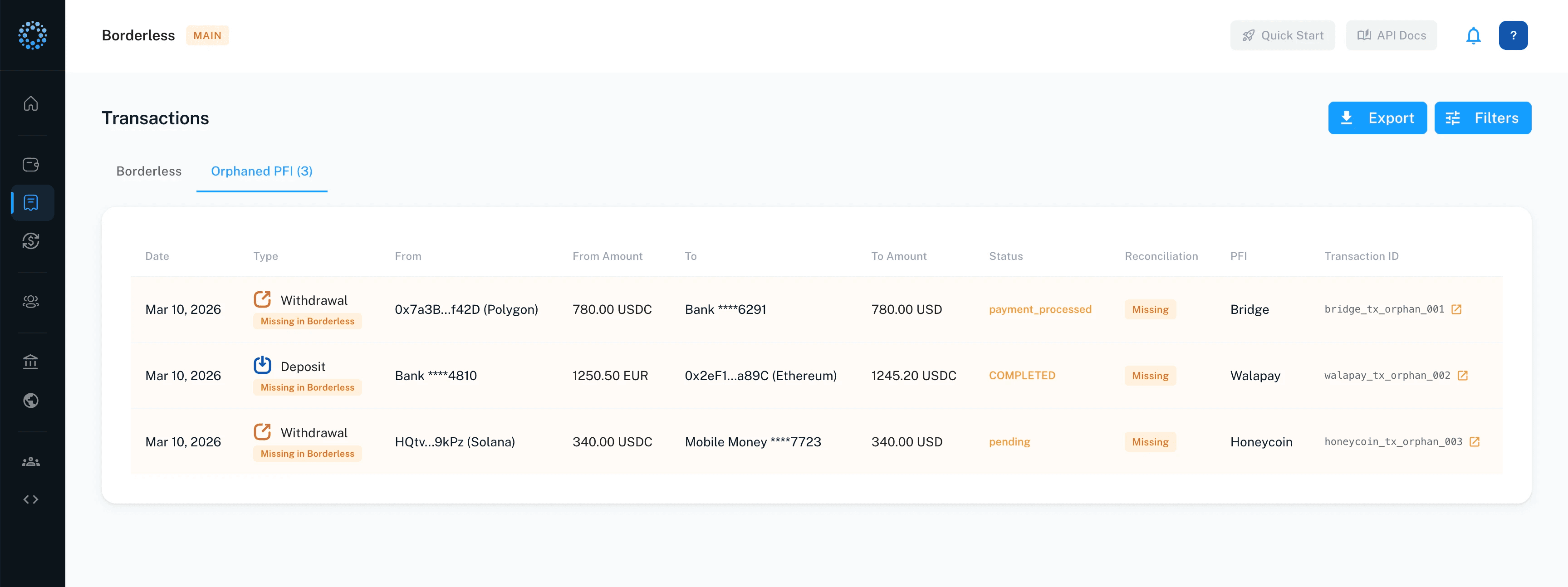
📸 The Orphaned tab surfaces transactions that exist at the provider but never made it into your records - automatically, before your ops team opens a spreadsheet.
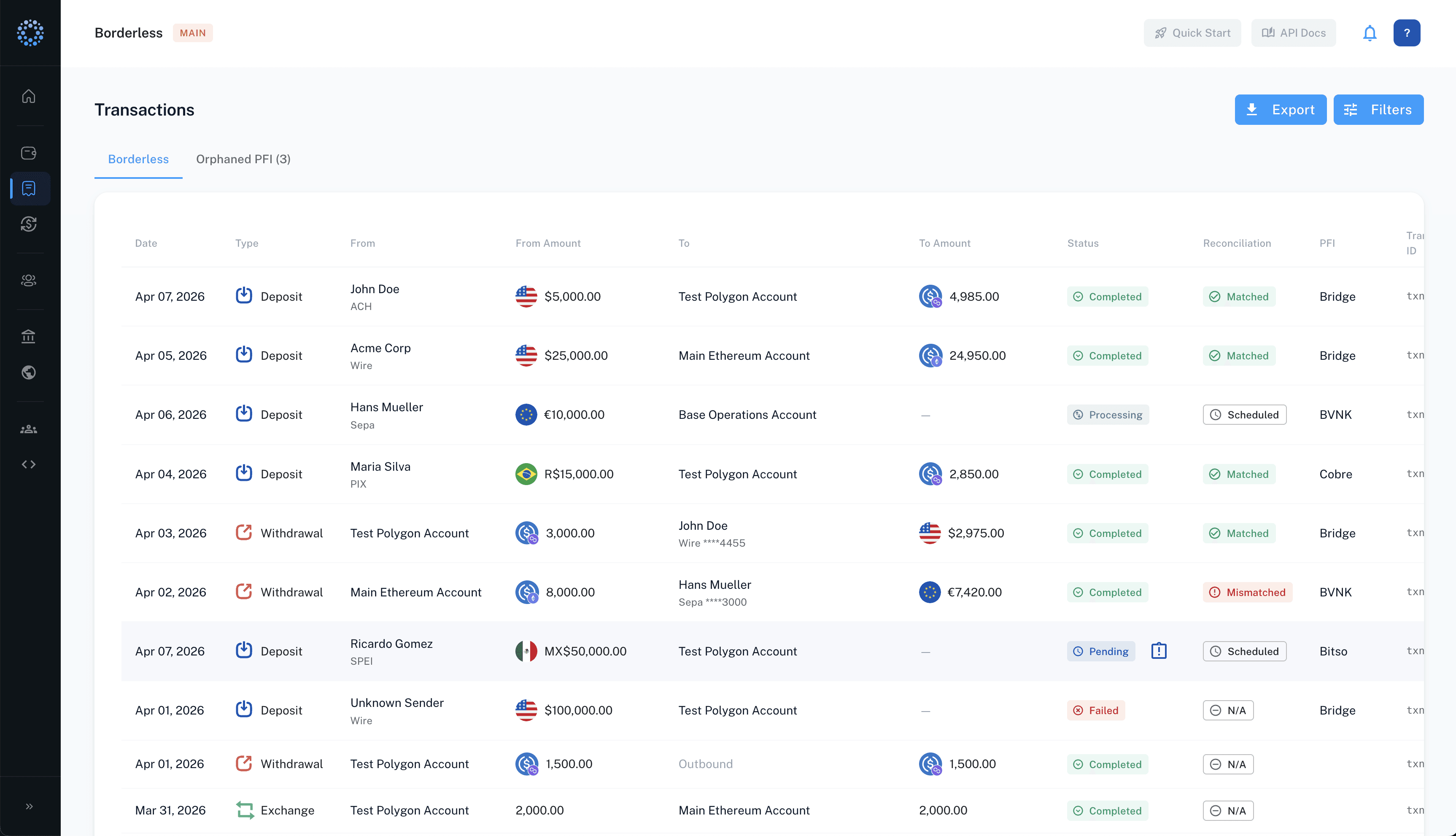
Discrepancies surface within 24 hours. Finance leads can verify records before month-end close. Developers can query reconciliation status by transaction ID via API. Leadership can pull data into board reporting knowing the numbers have already been checked against the source - across every provider, from one place.
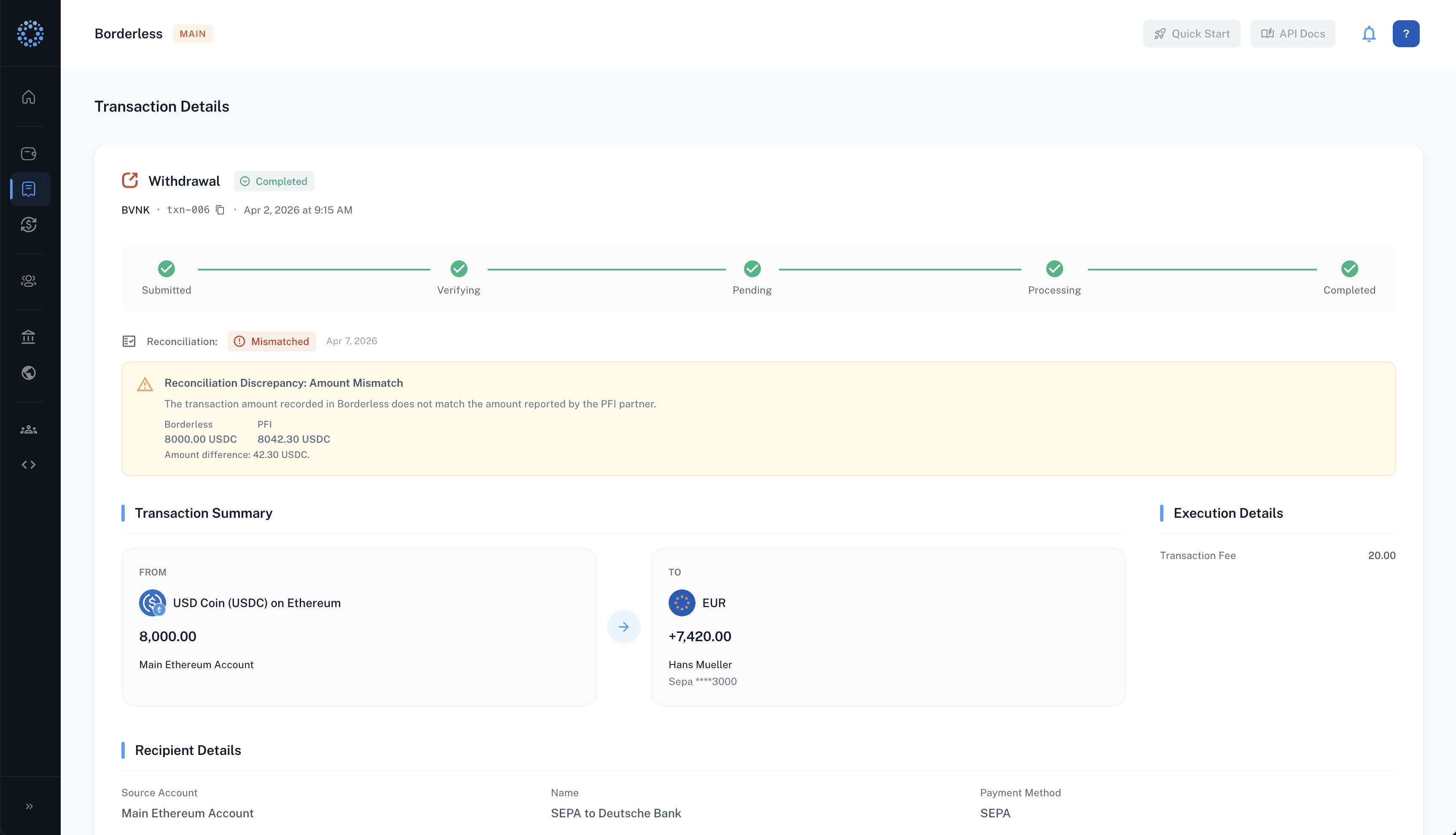
Reconciliation status on every transaction. This deposit is Matched - provider data checked and confirmed, timestamped.
Data you can stand behind
With Borderless.xyz, every transaction comes with proof. Reconciliation runs daily across every provider in your connection, checking amounts, statuses, and timing against what each provider recorded, so your dashboard reflects what actually happened, not just what was reported.
The reconciliation status is right there for every transaction, every day. When your record and the provider's agree, it's marked Reconciled. When they don't, both values are visible side by side. No investigation required. No support ticket needed.
Your dashboard becomes a verified source of truth for cross-border payments. Finance teams can close the month with confidence. Leadership can pull board-ready numbers knowing they've already been checked. Clients can see exactly what the data shows.
That's what you get with Borderless.xyz. The moment you connect, reconciliation is already running across every provider, every transaction, already checked. It's what happens when reconciliation is built into the infrastructure from the start.
Available now
Reconciliation now runs daily across all active provider integrations. The reconciliation status column is visible in your transaction table today. The GET API endpoint for reconciliation status by transaction ID is available at launch.
To understand what reconciliation coverage looks like across your active PFI integrations, reach out to the team.
Every payment platform eventually hits the same wall: your transaction data and your providers' transaction data don't always agree. Figuring out which one is right - and why they diverged - is one of the most time-consuming, error-prone, and quietly expensive problems in global cross-border payments.
Most teams don't solve it. They manage it.
At Borderless.xyz, we've made reconciliation core to the infrastructure - so the moment you connect, it's already working across every provider in your stack.
The problem that compounds with scale
When you're moving money across multiple payment providers in multiple corridors, each provider maintains its own transaction records. Status updates arrive at different times. Webhooks fail silently. A transaction that shows Completed on your side shows Failed on theirs. A deposit lands and never generates a record anywhere in your system.
That gap can go undetected for days. Often you find out on a Friday afternoon, when a client's finance team catches it during their own month-end close and files a support ticket. The most common way a reconciliation gap surfaces isn't an internal flag. It's a client complaint.
What reconciliation actually costs
Teams building cross-border payout infrastructure eventually discover that reconciliation is its own job - time-sensitive, costly, and ongoing.
If you manage it manually, picture what it actually looks like today without a system handling this for you. Someone on your ops team opens their laptop on Monday morning. They log into the first provider dashboard, navigate to the transaction export, download a CSV. Then the second. Then the third. They work through every provider your platform is integrated with - a separate login, a separate export, a separate file for each one. By the time they've downloaded everything, they have a folder of spreadsheets and an Excel file open with a growing number of tabs.
Then the matching starts - transaction IDs cross-referenced against each CSV, differences flagged row by row. A status mismatch here. An amount that doesn't line up there. A transaction that exists in a provider export but doesn't appear in your records at all. Finding it means noticing the gap across two separate files.
Hours. Every week. And it still misses things, because a manual audit only catches what someone thought to look for, in the data they remembered to download.
If you are piecing it together across different provider integrations, the scope compounds fast:
Comparison logic for every field - amount, status, timing, recipient
Status mapping per provider, because each one uses different terminology for the same states
Missing transaction detection as a separate problem from discrepancy checks -
different data, different logic
Maintenance as providers update their APIs and new corridors come online
Extension for every new provider you add - reconciliation doesn't carry over automatically
It's a real engineering project that doesn't ship any of your core product. Maintaining it requires dedicated engineering resources to something that, when it works, is invisible - and when it breaks, is urgent.
Creating a single source of truth across every provider
When you build your stack with Borderless.xyz, reconciliation is already running. Every day, across every provider in your connection - comparing every transaction field by field, surfacing discrepancies, and catching transactions that never made it into your records. No configuration. No exports. No spreadsheets. It's built into the connection itself.
This is what Borderless makes possible that direct provider integrations don’t: one place where every transaction, across every provider, has already been checked. The reconciliation layer is live the moment you connect - and it extends automatically as your provider footprint grows. Every corridor you add through Borderless comes with coverage included.
Every transaction in your dashboard now carries a reconciliation status alongside amount, status, and timestamps. Four states, no ambiguity:
Reconciled: You and the provider agree on every field.
Pending Reconciliation: The batch run for this provider hasn't completed yet. The transaction isn't yet confirmed.
Discrepancy: Flagged - A field difference was detected. Both your value and the provider's value appear inline, side by side.
Unmatched: A transaction exists at the provider with no corresponding record on your side. It surfaces as a placeholder row with all available provider data populated - nothing hidden, nothing missed.
📸 The Orphaned tab surfaces transactions that exist at the provider but never made it into your records - automatically, before your ops team opens a spreadsheet.
Discrepancies surface within 24 hours. Finance leads can verify records before month-end close. Developers can query reconciliation status by transaction ID via API. Leadership can pull data into board reporting knowing the numbers have already been checked against the source - across every provider, from one place.
Reconciliation status on every transaction. This deposit is Matched - provider data checked and confirmed, timestamped.
Data you can stand behind
With Borderless.xyz, every transaction comes with proof. Reconciliation runs daily across every provider in your connection, checking amounts, statuses, and timing against what each provider recorded, so your dashboard reflects what actually happened, not just what was reported.
The reconciliation status is right there for every transaction, every day. When your record and the provider's agree, it's marked Reconciled. When they don't, both values are visible side by side. No investigation required. No support ticket needed.
Your dashboard becomes a verified source of truth for cross-border payments. Finance teams can close the month with confidence. Leadership can pull board-ready numbers knowing they've already been checked. Clients can see exactly what the data shows.
That's what you get with Borderless.xyz. The moment you connect, reconciliation is already running across every provider, every transaction, already checked. It's what happens when reconciliation is built into the infrastructure from the start.
Available now
Reconciliation now runs daily across all active provider integrations. The reconciliation status column is visible in your transaction table today. The GET API endpoint for reconciliation status by transaction ID is available at launch.
To understand what reconciliation coverage looks like across your active PFI integrations, reach out to the team.
Global Stablecoin Orchestration Network

Borderless Innovations Labs Inc. (Borderless) is a technology and smart contract development company. Borderless in not a broker-dealer or financial institution and does not engage any conduct or transactions requiring such registration. All financial products are offered by and through financial institutions directly. Borderless does not make any recommendation for the purchase or sale of digital assets. Our products and services are offered in limited jurisdictions so please contact our partnerships team for further information and refer to our Terms of Services.
Global Stablecoin Orchestration Network
Borderless Innovations Labs Inc. (Borderless) is a technology and smart contract development company. Borderless in not a broker-dealer or financial institution and does not engage any conduct or transactions requiring such registration. All financial products are offered by and through financial institutions directly. Borderless does not make any recommendation for the purchase or sale of digital assets. Our products and services are offered in limited jurisdictions so please contact our partnerships team for further information and refer to our Terms of Services.
Global Stablecoin Orchestration Network
Borderless Innovations Labs Inc. (Borderless) is a technology and smart contract development company. Borderless in not a broker-dealer or financial institution and does not engage any conduct or transactions requiring such registration. All financial products are offered by and through financial institutions directly. Borderless does not make any recommendation for the purchase or sale of digital assets. Our products and services are offered in limited jurisdictions so please contact our partnerships team for further information and refer to our Terms of Services.