
Updates
Provider Pulse: Bird's Eye Visibility Across Every Corridor
Product Feature
A corridor slows. Payouts start queuing. Your clients are seeing delays, and nobody on your team knows why yet.
The first signal isn't an alert. It's a support ticket.
That's the operational reality when you're routing cross-border payouts across multiple providers. Each provider communicates status in their own way. Bringing that picture together across your full network doesn't happen automatically. So when something degrades, the playbook is reactive: check logs, ping ops, piece together that a provider had an issue, while your clients are already sitting on stuck payments.
Provider Health Checks changes that. A single view of every provider's operational status across your network, updated in real time, surfaced in the Borderless dashboard. And the foundation for a question that's been harder to answer: not just who's cheapest in a corridor, but who's most reliable.
The Monitoring Job You Didn't Sign Up For
Running payouts across multiple providers is the right call. No single provider has the best rate, the most reliable uptime, and full corridor coverage everywhere you need it. Spreading across the network gets you coverage, redundancy, and cost efficiency.
But every provider you add comes with a monitoring surface you now own. One more status page to check. One more maintenance window to track. One more degradation event to catch before your users do. And degradation isn't binary. Providers don't just go down. They slow. Specific corridors degrade while others stay operational. Error rates climb before failures spike. By the time a support ticket arrives, the signal was there hours earlier. You just didn't have a place to see it.
If you're integrating directly with providers, there's no layer watching all of them at once. You build that yourself, or you absorb the cost reactively. There's no shared intelligence. No one aggregating signals across the full network on your behalf.
Provider Health Checks
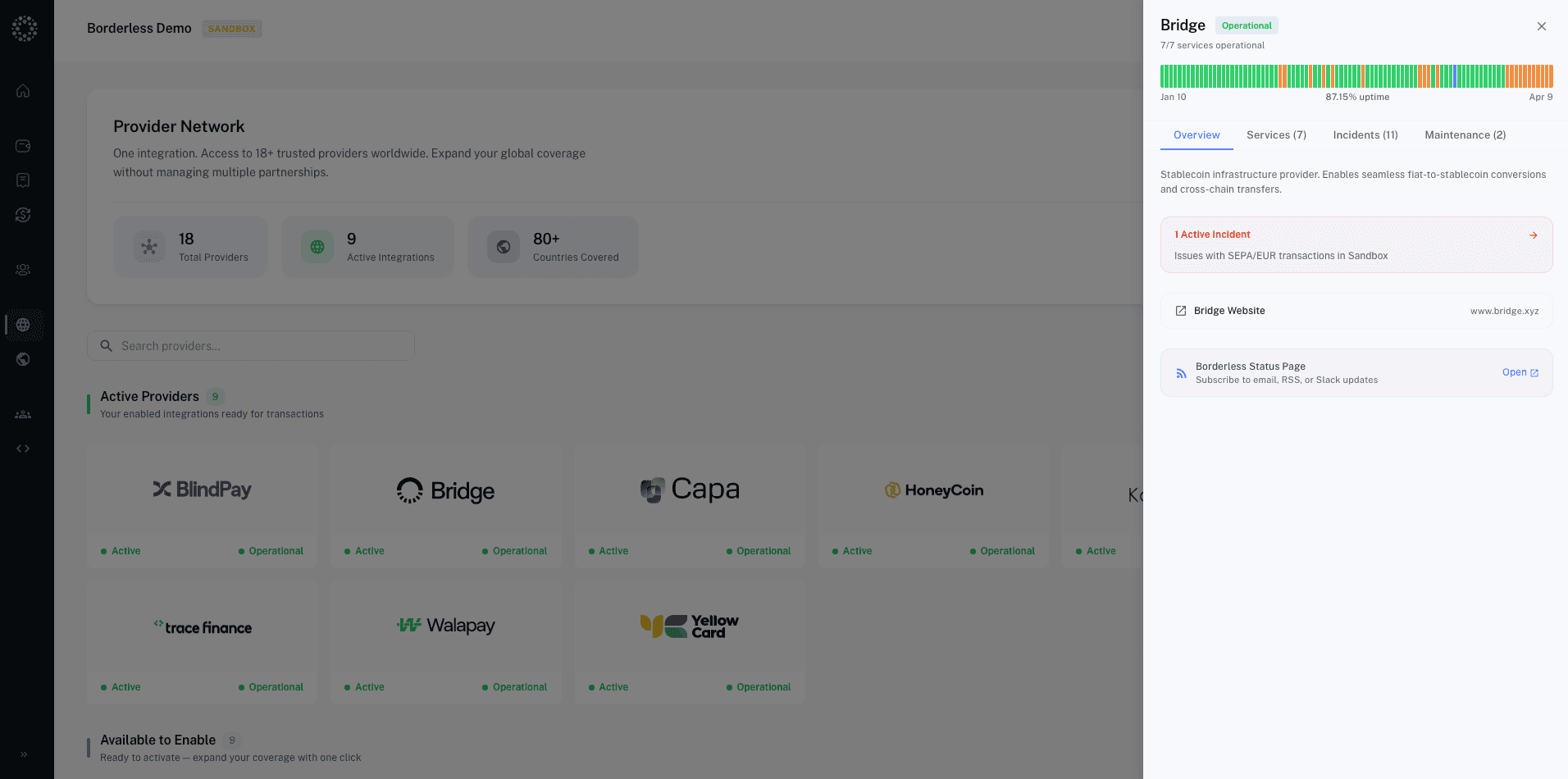
Borderless.xyz now surfaces real-time health status for providers and corridors across your network, directly in the Borderless dashboard.
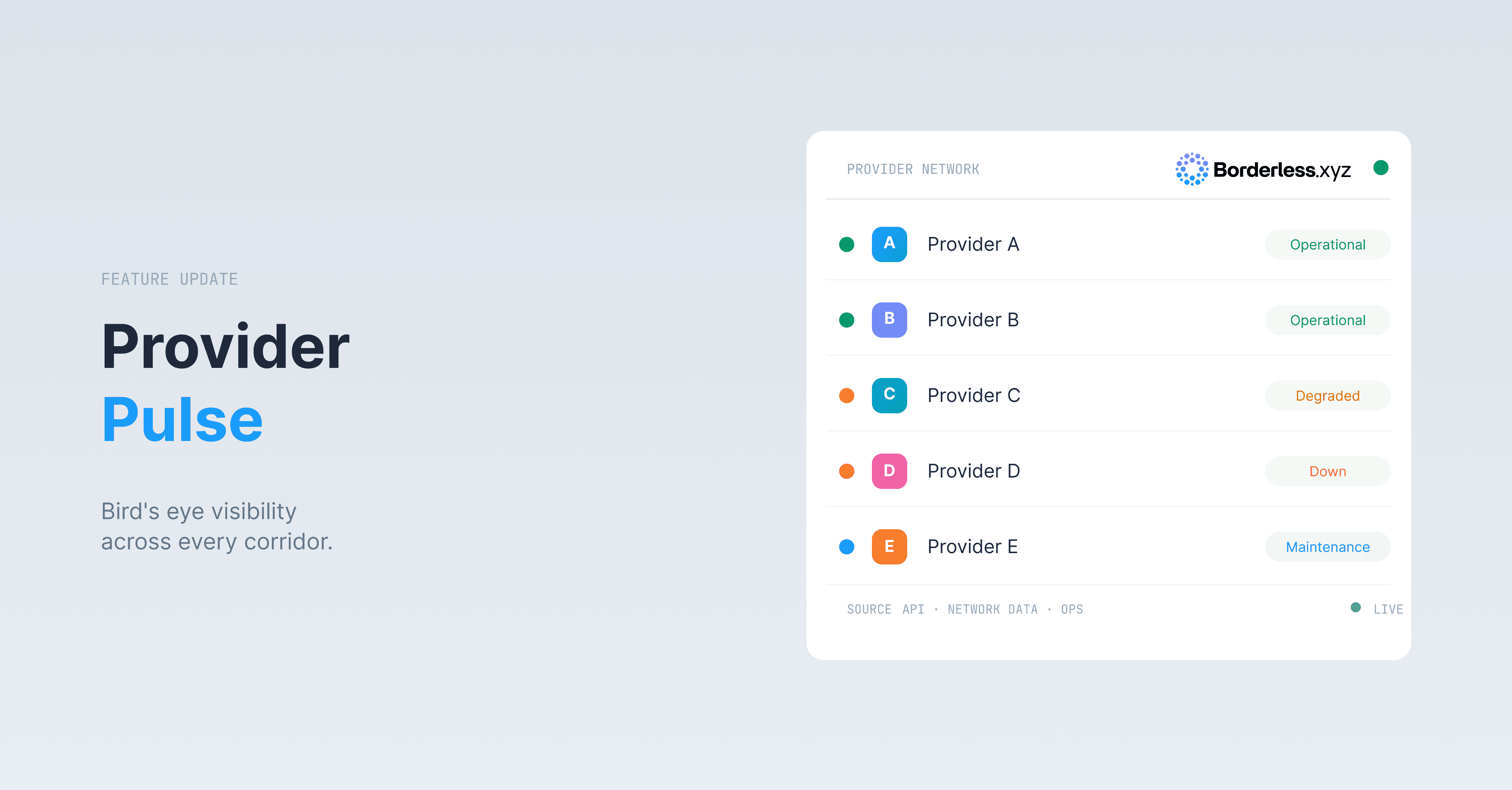
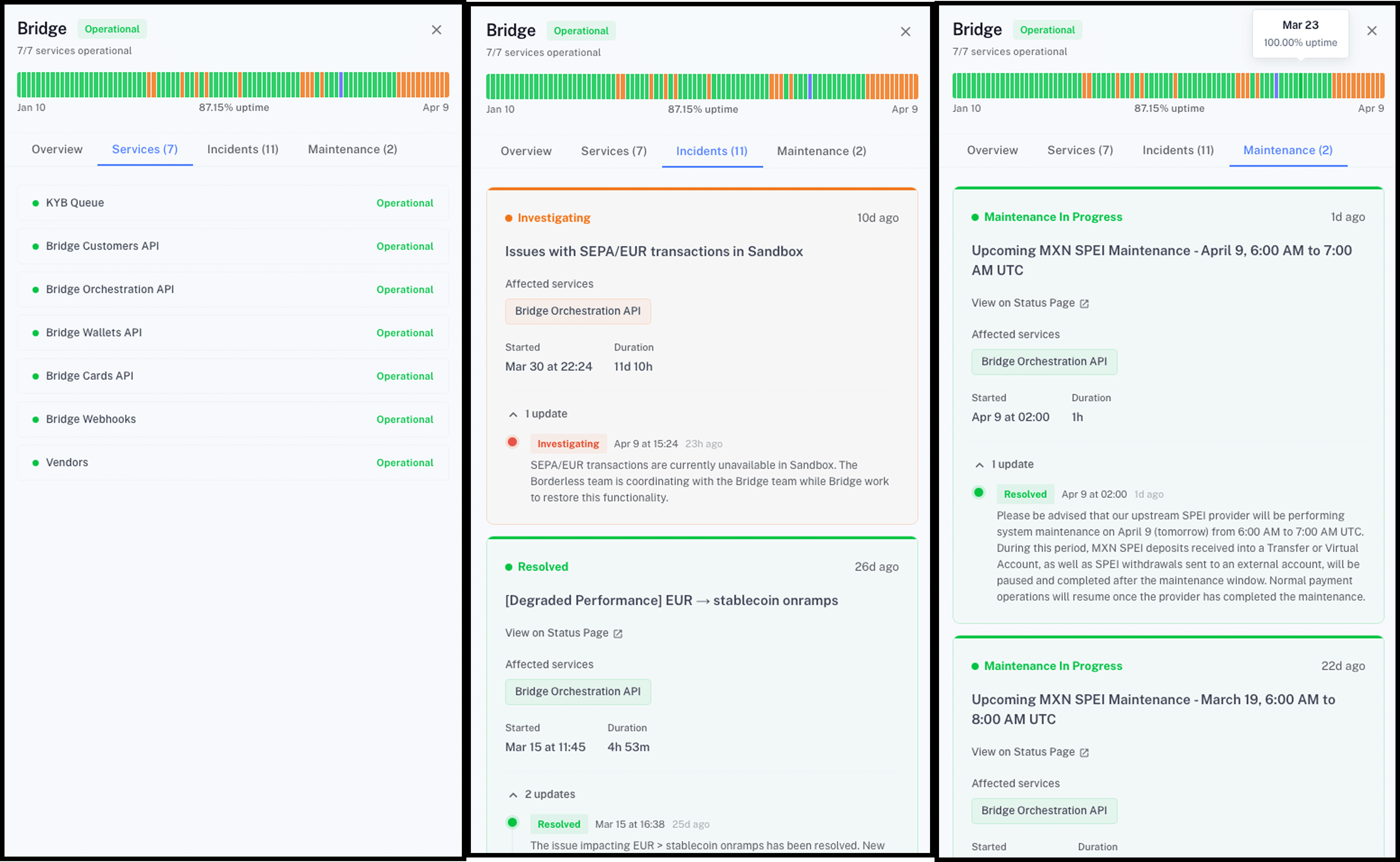
This is a bird's eye view across the entire provider network. Not a binary up/down signal, but degrees of robustness. Each provider shows as operational, degraded, down, or in a maintenance window. Corridor-level detail tells you exactly which currency pairs are affected and when the status last changed.
Three signal sources feed the status layer:
Real network data: transaction activity across the Borderless.xyz network is used to infer health where no direct signal exists. We see patterns across all clients and corridors simultaneously, which means we can distinguish a provider-level issue from a one-off error that a single operator's volume might not catch
**Borderless.xyz ops team:** when a provider's status page isn't available or needs a correction, our team enters and manages manual overrides with required expiry windows, so no status gets stuck open-ended
Provider status pages: where providers publish their own uptime data, we ingest it directly
When a provider transitions to a new state, the dashboard fires an alert. You're not checking for changes. The changes come to you.
The Signal Only the Network Can See
The most distinctive input to the health layer isn't the status page. It's the network.
Borderless.xyz has an inside view that no single operator can replicate: transaction activity flowing through multiple providers, across multiple corridors, for multiple clients simultaneously. That breadth is what makes the signal meaningful. When a provider starts degrading, it shows up in the network data. Because we're seeing patterns across the full network, we can distinguish a provider-level issue from a one-off error with confidence that a single operator's volume can't match.
That network position also makes something else possible for the first time: reliability benchmarking. Price in a corridor is easy to compare - pull quotes, see who's cheapest. Reliability has been nearly impossible to measure at scale. Who holds uptime consistently, which corridors degrade under volume, which providers are dependable week over week - those questions require longitudinal data at the network layer. Every status event we capture builds that record. Over time, it becomes the answer to a question pricing data alone never could: not just who's cheapest in your corridors, but who you should actually trust with your volume.
Every status entry is labeled by source: API, inferred from network data, or manually validated by the Borderless.xyz ops team. That label tells you how to weight the signal and gives you the context to make a routing call with confidence.
The Intelligence to Move Better
Health data is the foundation of smarter failover decisions.
Knowing a provider is degraded on a specific corridor before transactions start failing gives you the ability to move volume proactively, to a provider showing operational status on the same corridor, rather than waiting for error rates to spike. That's the shift from reactive remediation to intelligent routing.
We're capturing this data from day one. The intelligence layer to support more intelligent failover strategies builds on what the health service is already logging. That capability is on the roadmap. The data infrastructure for it is live now.
Built for Every Team That Touches Payments
Operators get the dashboard view. When a corridor changes state, the alert comes to you, not as a support ticket, but as a notification in the Borderless dashboard with corridor-level detail and a data source label. You see what's happening, where, and why, before your end users notice anything.
Developers get the API. Query current provider and corridor health programmatically, build routing logic that responds to live status signals, or surface provider availability directly in your own product. Webhooks fire on every distinct status transition without polling. Every response includes the data source, so your system can treat an inferred signal differently from a live API confirmation.
And for teams making longer-term provider decisions: every status event is logged. That log becomes the reliability track record that pricing data alone can't give you. Which providers hold up under volume. Which corridors are consistently operational. Which signals are worth routing around. Provider selection informed by actual performance, not just commercial terms.
Who Can Use This
Provider Pulse are available now to all operators on the Borderless dashboard, across all supported markets and corridors.
Log into your Borderless.xyz dashboard to see the status layer, or reach out to your account team to walk through what's live in your corridors.
A corridor slows. Payouts start queuing. Your clients are seeing delays, and nobody on your team knows why yet.
The first signal isn't an alert. It's a support ticket.
That's the operational reality when you're routing cross-border payouts across multiple providers. Each provider communicates status in their own way. Bringing that picture together across your full network doesn't happen automatically. So when something degrades, the playbook is reactive: check logs, ping ops, piece together that a provider had an issue, while your clients are already sitting on stuck payments.
Provider Health Checks changes that. A single view of every provider's operational status across your network, updated in real time, surfaced in the Borderless dashboard. And the foundation for a question that's been harder to answer: not just who's cheapest in a corridor, but who's most reliable.
The Monitoring Job You Didn't Sign Up For
Running payouts across multiple providers is the right call. No single provider has the best rate, the most reliable uptime, and full corridor coverage everywhere you need it. Spreading across the network gets you coverage, redundancy, and cost efficiency.
But every provider you add comes with a monitoring surface you now own. One more status page to check. One more maintenance window to track. One more degradation event to catch before your users do. And degradation isn't binary. Providers don't just go down. They slow. Specific corridors degrade while others stay operational. Error rates climb before failures spike. By the time a support ticket arrives, the signal was there hours earlier. You just didn't have a place to see it.
If you're integrating directly with providers, there's no layer watching all of them at once. You build that yourself, or you absorb the cost reactively. There's no shared intelligence. No one aggregating signals across the full network on your behalf.
Provider Health Checks
Borderless.xyz now surfaces real-time health status for providers and corridors across your network, directly in the Borderless dashboard.
This is a bird's eye view across the entire provider network. Not a binary up/down signal, but degrees of robustness. Each provider shows as operational, degraded, down, or in a maintenance window. Corridor-level detail tells you exactly which currency pairs are affected and when the status last changed.
Three signal sources feed the status layer:
Real network data: transaction activity across the Borderless.xyz network is used to infer health where no direct signal exists. We see patterns across all clients and corridors simultaneously, which means we can distinguish a provider-level issue from a one-off error that a single operator's volume might not catch
**Borderless.xyz ops team:** when a provider's status page isn't available or needs a correction, our team enters and manages manual overrides with required expiry windows, so no status gets stuck open-ended
Provider status pages: where providers publish their own uptime data, we ingest it directly
When a provider transitions to a new state, the dashboard fires an alert. You're not checking for changes. The changes come to you.
The Signal Only the Network Can See
The most distinctive input to the health layer isn't the status page. It's the network.
Borderless.xyz has an inside view that no single operator can replicate: transaction activity flowing through multiple providers, across multiple corridors, for multiple clients simultaneously. That breadth is what makes the signal meaningful. When a provider starts degrading, it shows up in the network data. Because we're seeing patterns across the full network, we can distinguish a provider-level issue from a one-off error with confidence that a single operator's volume can't match.
That network position also makes something else possible for the first time: reliability benchmarking. Price in a corridor is easy to compare - pull quotes, see who's cheapest. Reliability has been nearly impossible to measure at scale. Who holds uptime consistently, which corridors degrade under volume, which providers are dependable week over week - those questions require longitudinal data at the network layer. Every status event we capture builds that record. Over time, it becomes the answer to a question pricing data alone never could: not just who's cheapest in your corridors, but who you should actually trust with your volume.
Every status entry is labeled by source: API, inferred from network data, or manually validated by the Borderless.xyz ops team. That label tells you how to weight the signal and gives you the context to make a routing call with confidence.
The Intelligence to Move Better
Health data is the foundation of smarter failover decisions.
Knowing a provider is degraded on a specific corridor before transactions start failing gives you the ability to move volume proactively, to a provider showing operational status on the same corridor, rather than waiting for error rates to spike. That's the shift from reactive remediation to intelligent routing.
We're capturing this data from day one. The intelligence layer to support more intelligent failover strategies builds on what the health service is already logging. That capability is on the roadmap. The data infrastructure for it is live now.
Built for Every Team That Touches Payments
Operators get the dashboard view. When a corridor changes state, the alert comes to you, not as a support ticket, but as a notification in the Borderless dashboard with corridor-level detail and a data source label. You see what's happening, where, and why, before your end users notice anything.
Developers get the API. Query current provider and corridor health programmatically, build routing logic that responds to live status signals, or surface provider availability directly in your own product. Webhooks fire on every distinct status transition without polling. Every response includes the data source, so your system can treat an inferred signal differently from a live API confirmation.
And for teams making longer-term provider decisions: every status event is logged. That log becomes the reliability track record that pricing data alone can't give you. Which providers hold up under volume. Which corridors are consistently operational. Which signals are worth routing around. Provider selection informed by actual performance, not just commercial terms.
Who Can Use This
Provider Pulse are available now to all operators on the Borderless dashboard, across all supported markets and corridors.
Log into your Borderless.xyz dashboard to see the status layer, or reach out to your account team to walk through what's live in your corridors.
Global Stablecoin Orchestration Network

Borderless Innovations Labs Inc. (Borderless) is a technology and smart contract development company. Borderless in not a broker-dealer or financial institution and does not engage any conduct or transactions requiring such registration. All financial products are offered by and through financial institutions directly. Borderless does not make any recommendation for the purchase or sale of digital assets. Our products and services are offered in limited jurisdictions so please contact our partnerships team for further information and refer to our Terms of Services.
Global Stablecoin Orchestration Network
Borderless Innovations Labs Inc. (Borderless) is a technology and smart contract development company. Borderless in not a broker-dealer or financial institution and does not engage any conduct or transactions requiring such registration. All financial products are offered by and through financial institutions directly. Borderless does not make any recommendation for the purchase or sale of digital assets. Our products and services are offered in limited jurisdictions so please contact our partnerships team for further information and refer to our Terms of Services.
Global Stablecoin Orchestration Network
Borderless Innovations Labs Inc. (Borderless) is a technology and smart contract development company. Borderless in not a broker-dealer or financial institution and does not engage any conduct or transactions requiring such registration. All financial products are offered by and through financial institutions directly. Borderless does not make any recommendation for the purchase or sale of digital assets. Our products and services are offered in limited jurisdictions so please contact our partnerships team for further information and refer to our Terms of Services.