
Research
Same Coin, Same Chain, Different Price
Stablecoin FX Insights — February 2026
Executive Summary
USDC and USDT are functionally interchangeable in stablecoin FX. Across 33 currencies and 68 provider-corridor pairs where both assets are offered, 59% show zero pricing difference and 91% fall within 10 bps. Blockchain networks show the same convergence: 97% of multi-chain pairs price within 5 bps when comparing the same provider and stablecoin across different chains. The variable that actually moves pricing is provider selection, where gaps exceed 700 bps within a single corridor. Stablecoin choice and chain choice are solved problems. Provider choice is not.
Key Numbers
Metric | Value |
|---|---|
Corridors tracked | 66 (33 USDC, 33 USDT) |
Currencies | 33 |
Blockchain networks | 7 |
Data points analyzed | 349,378 |
Date range | Feb 1–28, 2026 |
Median spread (all corridors) | 296 bps |
Median USDC/USDT gap | 0 bps |
Median chain-to-chain gap | 0 bps |
Largest provider gap (same corridor) | 703 bps |
Spread measures the buy-sell gap within a single stablecoin-to-fiat pair, calculated as (BuyRate - SellRate) / MidRate in basis points (bps, where 100 bps = 1%). This is the provider's execution cost, analogous to a bid-ask spread.
USDC vs USDT: The Data
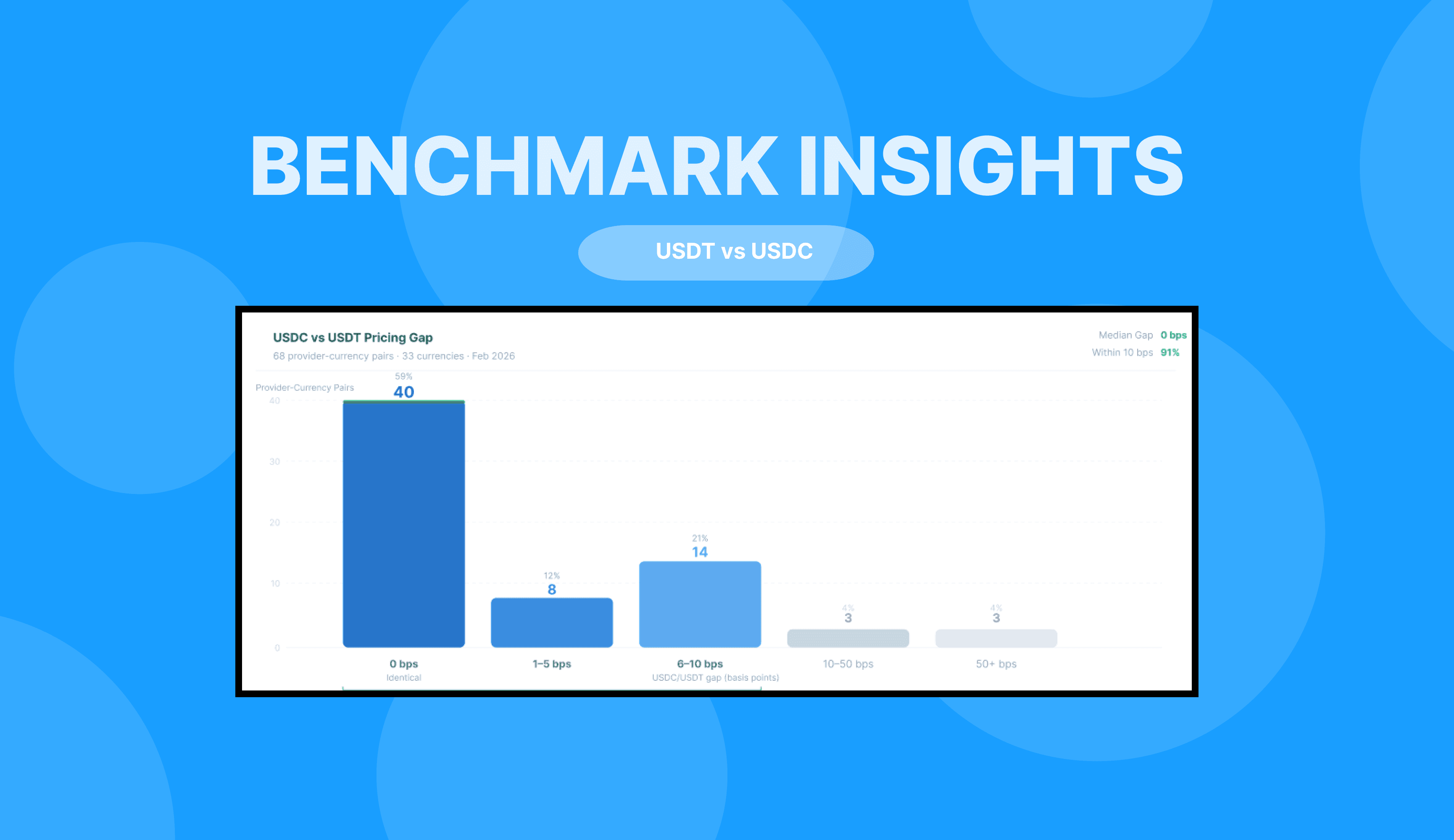
We compared median mid-rates for every provider-currency pair where both USDC and USDT are offered. Of 68 such pairs across 33 currencies:
USDC/USDT gap | Provider-currency pairs | % of total |
|---|---|---|
Identical (0 bps) | 40 | 59% |
Within 5 bps | 48 | 71% |
Within 10 bps | 62 | 91% |
10–50 bps | 3 | 4% |
50+ bps | 3 | 4% |
The median gap is exactly 0 bps. The overall median spread for USDC corridors is 295.57 bps. For USDT, 295.60 bps.
This isn't sampling noise. It reflects how providers actually price. Of the 8 providers that support both USDC and USDT, 5 price them identically to the decimal in every corridor they serve. The remaining 3 show single-digit basis point differences in most corridors. Providers are pricing fiat liquidity, not the stablecoin wrapper around it.
Where USDC and USDT diverge
The 91% parity figure has exceptions worth understanding. Six provider-corridor pairs show gaps above 10 bps:
Provider-corridor | Gap | Context |
|---|---|---|
One LatAm provider, PEN | 729 bps | USDT priced 7.3% above USDC. Provider-specific anomaly, not market-wide. |
One global provider, CAD | 73 bps | Sell-only rates, low data confidence. |
One LatAm provider, CLP | 64 bps | Intermittent, not sustained through the month. |
One LatAm provider, MXN | 32 bps | Small but persistent gap. |
One LatAm provider, COP | 27 bps | Small but persistent gap. |
One global provider, BOB | 15 bps | Sell-only rates, low data confidence. |
Five of the six outliers come from two providers. The other 11 providers show near-zero USDC/USDT gaps across every corridor they serve. When a USDC/USDT divergence appears, the first question should be "which provider?" not "which stablecoin?"
Per-currency USDC/USDT parity
Every currency where multiple providers offer both USDC and USDT:
Currency | Median gap | Max gap (any provider) | Providers with both |
|---|---|---|---|
ARS | -2 bps | 7 bps | 4 |
BRL | 0 bps | 0 bps | 3 |
COP | -3 bps | 27 bps | 5 |
GHS | 0 bps | 9 bps | 3 |
KES | 0 bps | 7 bps | 4 |
MWK | 0 bps | 0 bps | 2 |
MXN | 0 bps | 32 bps | 5 |
NGN | 0 bps | 5 bps | 3 |
RWF | 0 bps | 0 bps | 3 |
TZS | 0 bps | 7 bps | 4 |
UGX | 0 bps | 0 bps | 2 |
XAF | 0 bps | 0 bps | 2 |
XOF | 0 bps | 0 bps | 2 |
ZAR | 0 bps | 6 bps | 3 |
ZMW | 0 bps | 0 bps | 2 |
Twenty of 33 currencies have a median USDC/USDT gap of exactly 0 bps. The max gap in any multi-provider corridor (excluding the PEN anomaly) is 32 bps in MXN, driven by one provider. Across the rest of the market, USDC and USDT are the same product at different addresses.
Chain Choice: The Data
We compared median mid-rates for every case where a single provider offers the same stablecoin on multiple blockchain networks for the same currency. Of 138 such multi-chain combinations:
Chain gap | Combinations | % of total |
|---|---|---|
Identical (0 bps) | 86 | 62% |
Within 5 bps | 104 | 75% |
Within 10 bps | 108 | 78% |
10–30 bps | 16 | 12% |
30+ bps | 14 | 10% |
The 10% tail is almost entirely one provider. Excluding that provider, 97% of multi-chain pairs fall within 5 bps. That provider systematically prices Solana differently from Ethereum, Polygon, and Base across most corridors, with gaps of 15–150 bps. Every other provider in the benchmark prices chains identically or within single-digit basis points.
Chain coverage
Chain | Providers | Currencies |
|---|---|---|
Polygon | 13 | 33 |
Ethereum | 11 | 33 |
Solana | 10 | 33 |
Base | 8 | 31 |
Tron | 7 | 33 |
Optimism | 5 | 18 |
Celo | 2 | 13 |
Polygon and Ethereum have the broadest coverage. Solana matches on currency count but with one fewer provider. Base is growing fast with 8 providers across 31 currencies. For most corridors, you can pick any major chain and get the same FX rate.
Provider Choice: The Real Variable
Stablecoin selection moves pricing by 0–5 bps. Chain selection moves it by 0–5 bps (one provider aside). Provider selection moves it by hundreds of basis points.
Corridor | Best provider spread | Worst provider spread | Gap |
|---|---|---|---|
USDC→ZMW | 296 bps | 999 bps | 703 bps |
USDT→ARS | 8 bps | 621 bps | 613 bps |
USDC→ARS | 8 bps | 492 bps | 484 bps |
USDC→PEN | 120 bps | 502 bps | 382 bps |
USDT→COP | varies | varies | 321 bps |
This pattern holds across every corridor with multiple providers. The hierarchy of what matters is not close.
What parity means for infrastructure choices
If USDC and USDT cost the same, and chains cost the same, then supporting multiple stablecoins and chains carries no pricing penalty. It's free optionality. February was a calm month — no depegging events, no chain outages, no regulatory surprises. Parity holds in stable conditions because providers are pricing the underlying fiat liquidity, not the stablecoin itself.
That convergence is less certain under stress. Historical depegging events, chain congestion, and regional regulatory shifts have all temporarily broken USDC/USDT parity in specific corridors. Multi-asset and multi-chain support costs nothing in calm markets and provides fallback options when conditions change.
Provider diversity, by contrast, isn't just insurance. It pays off continuously. The 703 bps gap in ZMW exists every day, not just during crises. Access to multiple providers with intelligent routing is the single largest determinant of execution quality in stablecoin FX.
Spread Landscape
The global median spread held at 296 bps, with massive regional variation.
Tightest Corridors
Corridor | Median Spread |
|---|---|
USDC→PHP | 5 bps |
USDT→PHP | 10 bps |
USDC→BRL | 19 bps |
USDT→BRL | 19 bps |
USDC→MXN | 75 bps |
Widest Corridors
Corridor | Median Spread |
|---|---|
USDC→CDF | 1,311 bps |
USDT→CDF | 1,311 bps |
USDC→DOP | 865 bps |
USDT→DOP | 850 bps |
USDC→BWP | 761 bps |
February saw meaningful compression in NGN, where USDT spreads dropped 90 bps (from 347 to 257 bps), a 26% improvement. COP compressed on both USDC (down 27 bps) and USDT (down 37 bps). Both corridors have seen new provider entry over the past two quarters, and the compression tracks the increase in competition. UGX moved the other direction, widening 90 bps, a 35% increase worth monitoring.
Regional Spotlight
Latin America
The deepest competition in the benchmark. MXN leads with 7 providers, COP has 6, ARS has 5. Median regional spread of 127 bps. COP spreads compressed significantly through February.
Africa
Median spreads of 296 bps, ranging from KES at 270 bps to CDF at 1,311 bps. Provider coverage is thinner than LatAm but improving. NGN's 26% spread compression is the strongest positive signal this month.
Asia-Pacific
Limited multi-provider competition, but exceptional pricing where it exists. PHP at 5–10 bps represents near-zero execution cost. Single-provider currencies (INR, PKR, BDT, JPY, SGD, AUD) show competitive rates but no redundancy.
Europe
EUR at 118 bps spread. Single-provider coverage for both EUR and GBP.
Timing Patterns
February showed no statistically significant weekend effect (Mann-Whitney p = 0.99). Weekday median: 295.58 bps. Weekend median: 295.58 bps. Stablecoin FX pricing is effectively 24/7.
Two exceptions. EUR showed a 118 bps weekend penalty, driven by reduced fiat-side liquidity when European banking systems are offline. UGX widened 90 bps on weekends. For the other 31 currencies, timing is a non-factor.
Anomalies & Events
USDT→PEN was the most volatile corridor in February, with a 7.6% single-day move on February 19 and multiple 3–4% swings through the month. This volatility was concentrated in one provider's USDT pricing. USDC→PEN was stable. The divergence underscores the central finding of this report: apparent asset-level volatility often traces back to a single provider's behavior. Distinguishing between the two requires visibility across multiple providers.
Yellowcard MWK rates were excluded from analysis due to 43% divergence from consensus, reflecting parallel-market pricing. Nine corridors showed static pricing (fewer than 5 unique mid-rates in the month), all single-provider corridors, flagged as low-confidence data.
Methodology
Hourly buy/sell rates collected from multiple anonymized providers across 66 stablecoin-to-fiat corridors covering 33 currencies and 7 blockchain networks. Rates median-aggregated per corridor. Outlier exclusions: (1) Hampel filter (z > 6) removed 2,900 point anomalies with regime-change recovery to preserve genuine rate shifts; (2) One provider excluded from MWK corridor due to 43% mid-rate divergence from consensus, representing parallel-market pricing (5,212 records). Nine corridors flagged as static data (single-provider, fewer than 5 unique mid-rates) and excluded from spread rankings. Spreads are buy-sell spreads within each provider's stablecoin-to-fiat pair, calculated as (BuyRate - SellRate) / MidRate in basis points. Total exclusion rate: 2.3%.
Next month: Stablecoin vs Traditional FX — a dedicated deep dive comparing stablecoin mid-rates against interbank benchmarks across all 33 currencies, including parallel market dynamics and data confidence analysis.
Executive Summary
USDC and USDT are functionally interchangeable in stablecoin FX. Across 33 currencies and 68 provider-corridor pairs where both assets are offered, 59% show zero pricing difference and 91% fall within 10 bps. Blockchain networks show the same convergence: 97% of multi-chain pairs price within 5 bps when comparing the same provider and stablecoin across different chains. The variable that actually moves pricing is provider selection, where gaps exceed 700 bps within a single corridor. Stablecoin choice and chain choice are solved problems. Provider choice is not.
Key Numbers
Metric | Value |
|---|---|
Corridors tracked | 66 (33 USDC, 33 USDT) |
Currencies | 33 |
Blockchain networks | 7 |
Data points analyzed | 349,378 |
Date range | Feb 1–28, 2026 |
Median spread (all corridors) | 296 bps |
Median USDC/USDT gap | 0 bps |
Median chain-to-chain gap | 0 bps |
Largest provider gap (same corridor) | 703 bps |
Spread measures the buy-sell gap within a single stablecoin-to-fiat pair, calculated as (BuyRate - SellRate) / MidRate in basis points (bps, where 100 bps = 1%). This is the provider's execution cost, analogous to a bid-ask spread.
USDC vs USDT: The Data
We compared median mid-rates for every provider-currency pair where both USDC and USDT are offered. Of 68 such pairs across 33 currencies:
USDC/USDT gap | Provider-currency pairs | % of total |
|---|---|---|
Identical (0 bps) | 40 | 59% |
Within 5 bps | 48 | 71% |
Within 10 bps | 62 | 91% |
10–50 bps | 3 | 4% |
50+ bps | 3 | 4% |
The median gap is exactly 0 bps. The overall median spread for USDC corridors is 295.57 bps. For USDT, 295.60 bps.
This isn't sampling noise. It reflects how providers actually price. Of the 8 providers that support both USDC and USDT, 5 price them identically to the decimal in every corridor they serve. The remaining 3 show single-digit basis point differences in most corridors. Providers are pricing fiat liquidity, not the stablecoin wrapper around it.
Where USDC and USDT diverge
The 91% parity figure has exceptions worth understanding. Six provider-corridor pairs show gaps above 10 bps:
Provider-corridor | Gap | Context |
|---|---|---|
One LatAm provider, PEN | 729 bps | USDT priced 7.3% above USDC. Provider-specific anomaly, not market-wide. |
One global provider, CAD | 73 bps | Sell-only rates, low data confidence. |
One LatAm provider, CLP | 64 bps | Intermittent, not sustained through the month. |
One LatAm provider, MXN | 32 bps | Small but persistent gap. |
One LatAm provider, COP | 27 bps | Small but persistent gap. |
One global provider, BOB | 15 bps | Sell-only rates, low data confidence. |
Five of the six outliers come from two providers. The other 11 providers show near-zero USDC/USDT gaps across every corridor they serve. When a USDC/USDT divergence appears, the first question should be "which provider?" not "which stablecoin?"
Per-currency USDC/USDT parity
Every currency where multiple providers offer both USDC and USDT:
Currency | Median gap | Max gap (any provider) | Providers with both |
|---|---|---|---|
ARS | -2 bps | 7 bps | 4 |
BRL | 0 bps | 0 bps | 3 |
COP | -3 bps | 27 bps | 5 |
GHS | 0 bps | 9 bps | 3 |
KES | 0 bps | 7 bps | 4 |
MWK | 0 bps | 0 bps | 2 |
MXN | 0 bps | 32 bps | 5 |
NGN | 0 bps | 5 bps | 3 |
RWF | 0 bps | 0 bps | 3 |
TZS | 0 bps | 7 bps | 4 |
UGX | 0 bps | 0 bps | 2 |
XAF | 0 bps | 0 bps | 2 |
XOF | 0 bps | 0 bps | 2 |
ZAR | 0 bps | 6 bps | 3 |
ZMW | 0 bps | 0 bps | 2 |
Twenty of 33 currencies have a median USDC/USDT gap of exactly 0 bps. The max gap in any multi-provider corridor (excluding the PEN anomaly) is 32 bps in MXN, driven by one provider. Across the rest of the market, USDC and USDT are the same product at different addresses.
Chain Choice: The Data
We compared median mid-rates for every case where a single provider offers the same stablecoin on multiple blockchain networks for the same currency. Of 138 such multi-chain combinations:
Chain gap | Combinations | % of total |
|---|---|---|
Identical (0 bps) | 86 | 62% |
Within 5 bps | 104 | 75% |
Within 10 bps | 108 | 78% |
10–30 bps | 16 | 12% |
30+ bps | 14 | 10% |
The 10% tail is almost entirely one provider. Excluding that provider, 97% of multi-chain pairs fall within 5 bps. That provider systematically prices Solana differently from Ethereum, Polygon, and Base across most corridors, with gaps of 15–150 bps. Every other provider in the benchmark prices chains identically or within single-digit basis points.
Chain coverage
Chain | Providers | Currencies |
|---|---|---|
Polygon | 13 | 33 |
Ethereum | 11 | 33 |
Solana | 10 | 33 |
Base | 8 | 31 |
Tron | 7 | 33 |
Optimism | 5 | 18 |
Celo | 2 | 13 |
Polygon and Ethereum have the broadest coverage. Solana matches on currency count but with one fewer provider. Base is growing fast with 8 providers across 31 currencies. For most corridors, you can pick any major chain and get the same FX rate.
Provider Choice: The Real Variable
Stablecoin selection moves pricing by 0–5 bps. Chain selection moves it by 0–5 bps (one provider aside). Provider selection moves it by hundreds of basis points.
Corridor | Best provider spread | Worst provider spread | Gap |
|---|---|---|---|
USDC→ZMW | 296 bps | 999 bps | 703 bps |
USDT→ARS | 8 bps | 621 bps | 613 bps |
USDC→ARS | 8 bps | 492 bps | 484 bps |
USDC→PEN | 120 bps | 502 bps | 382 bps |
USDT→COP | varies | varies | 321 bps |
This pattern holds across every corridor with multiple providers. The hierarchy of what matters is not close.
What parity means for infrastructure choices
If USDC and USDT cost the same, and chains cost the same, then supporting multiple stablecoins and chains carries no pricing penalty. It's free optionality. February was a calm month — no depegging events, no chain outages, no regulatory surprises. Parity holds in stable conditions because providers are pricing the underlying fiat liquidity, not the stablecoin itself.
That convergence is less certain under stress. Historical depegging events, chain congestion, and regional regulatory shifts have all temporarily broken USDC/USDT parity in specific corridors. Multi-asset and multi-chain support costs nothing in calm markets and provides fallback options when conditions change.
Provider diversity, by contrast, isn't just insurance. It pays off continuously. The 703 bps gap in ZMW exists every day, not just during crises. Access to multiple providers with intelligent routing is the single largest determinant of execution quality in stablecoin FX.
Spread Landscape
The global median spread held at 296 bps, with massive regional variation.
Tightest Corridors
Corridor | Median Spread |
|---|---|
USDC→PHP | 5 bps |
USDT→PHP | 10 bps |
USDC→BRL | 19 bps |
USDT→BRL | 19 bps |
USDC→MXN | 75 bps |
Widest Corridors
Corridor | Median Spread |
|---|---|
USDC→CDF | 1,311 bps |
USDT→CDF | 1,311 bps |
USDC→DOP | 865 bps |
USDT→DOP | 850 bps |
USDC→BWP | 761 bps |
February saw meaningful compression in NGN, where USDT spreads dropped 90 bps (from 347 to 257 bps), a 26% improvement. COP compressed on both USDC (down 27 bps) and USDT (down 37 bps). Both corridors have seen new provider entry over the past two quarters, and the compression tracks the increase in competition. UGX moved the other direction, widening 90 bps, a 35% increase worth monitoring.
Regional Spotlight
Latin America
The deepest competition in the benchmark. MXN leads with 7 providers, COP has 6, ARS has 5. Median regional spread of 127 bps. COP spreads compressed significantly through February.
Africa
Median spreads of 296 bps, ranging from KES at 270 bps to CDF at 1,311 bps. Provider coverage is thinner than LatAm but improving. NGN's 26% spread compression is the strongest positive signal this month.
Asia-Pacific
Limited multi-provider competition, but exceptional pricing where it exists. PHP at 5–10 bps represents near-zero execution cost. Single-provider currencies (INR, PKR, BDT, JPY, SGD, AUD) show competitive rates but no redundancy.
Europe
EUR at 118 bps spread. Single-provider coverage for both EUR and GBP.
Timing Patterns
February showed no statistically significant weekend effect (Mann-Whitney p = 0.99). Weekday median: 295.58 bps. Weekend median: 295.58 bps. Stablecoin FX pricing is effectively 24/7.
Two exceptions. EUR showed a 118 bps weekend penalty, driven by reduced fiat-side liquidity when European banking systems are offline. UGX widened 90 bps on weekends. For the other 31 currencies, timing is a non-factor.
Anomalies & Events
USDT→PEN was the most volatile corridor in February, with a 7.6% single-day move on February 19 and multiple 3–4% swings through the month. This volatility was concentrated in one provider's USDT pricing. USDC→PEN was stable. The divergence underscores the central finding of this report: apparent asset-level volatility often traces back to a single provider's behavior. Distinguishing between the two requires visibility across multiple providers.
Yellowcard MWK rates were excluded from analysis due to 43% divergence from consensus, reflecting parallel-market pricing. Nine corridors showed static pricing (fewer than 5 unique mid-rates in the month), all single-provider corridors, flagged as low-confidence data.
Methodology
Hourly buy/sell rates collected from multiple anonymized providers across 66 stablecoin-to-fiat corridors covering 33 currencies and 7 blockchain networks. Rates median-aggregated per corridor. Outlier exclusions: (1) Hampel filter (z > 6) removed 2,900 point anomalies with regime-change recovery to preserve genuine rate shifts; (2) One provider excluded from MWK corridor due to 43% mid-rate divergence from consensus, representing parallel-market pricing (5,212 records). Nine corridors flagged as static data (single-provider, fewer than 5 unique mid-rates) and excluded from spread rankings. Spreads are buy-sell spreads within each provider's stablecoin-to-fiat pair, calculated as (BuyRate - SellRate) / MidRate in basis points. Total exclusion rate: 2.3%.
Next month: Stablecoin vs Traditional FX — a dedicated deep dive comparing stablecoin mid-rates against interbank benchmarks across all 33 currencies, including parallel market dynamics and data confidence analysis.
Global Stablecoin Orchestration Network

Borderless Innovations Labs Inc. (Borderless) is a technology and smart contract development company. Borderless in not a broker-dealer or financial institution and does not engage any conduct or transactions requiring such registration. All financial products are offered by and through financial institutions directly. Borderless does not make any recommendation for the purchase or sale of digital assets. Our products and services are offered in limited jurisdictions so please contact our partnerships team for further information and refer to our Terms of Services.
Global Stablecoin Orchestration Network
Borderless Innovations Labs Inc. (Borderless) is a technology and smart contract development company. Borderless in not a broker-dealer or financial institution and does not engage any conduct or transactions requiring such registration. All financial products are offered by and through financial institutions directly. Borderless does not make any recommendation for the purchase or sale of digital assets. Our products and services are offered in limited jurisdictions so please contact our partnerships team for further information and refer to our Terms of Services.
Global Stablecoin Orchestration Network
Borderless Innovations Labs Inc. (Borderless) is a technology and smart contract development company. Borderless in not a broker-dealer or financial institution and does not engage any conduct or transactions requiring such registration. All financial products are offered by and through financial institutions directly. Borderless does not make any recommendation for the purchase or sale of digital assets. Our products and services are offered in limited jurisdictions so please contact our partnerships team for further information and refer to our Terms of Services.