
Thought Leadership
You're Renting Your Payment Rails and You Don't Even Know It
Written by: Kevin Lehtiniitty
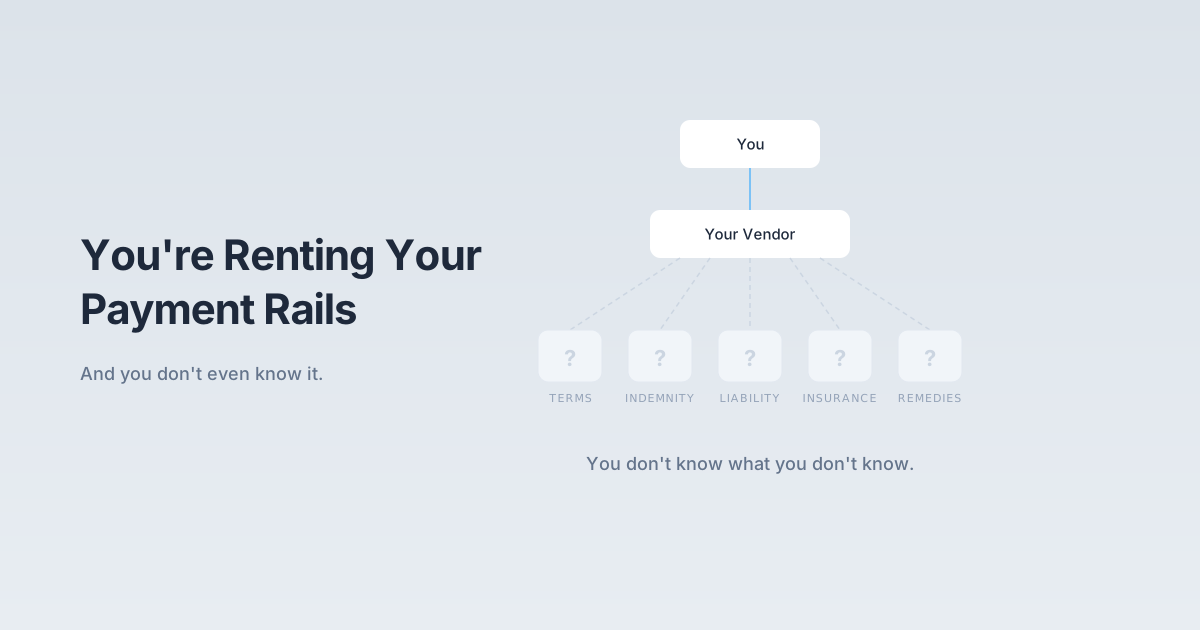
You signed one contract. Five companies you've never met are moving your money.
Your vendor is routing transactions to providers that don't know your company's name. Providers whose contracts, insurance policies, and liability terms you've never seen. Underneath that single agreement, there could be three, five, ten different providers handling your payments across different corridors. You don't know their terms. You don't know their indemnity provisions. You don't know what happens when a transaction goes sideways, when there's fraud, when a provider loses its banking relationship in a market you depend on.
You think you own your payment rails. You're renting them.
The Unknowns Cascade
In traditional payments, this abstraction is tolerable. The underlying rails are Visa, Mastercard, SWIFT. Mature infrastructure, deeply regulated, well understood. When Stripe processes your payment, you don't need to know which acquiring bank they're routing to. The risk is priced in and the system is battle-tested.
Stablecoin payments don't work like that. Not yet.
The providers handling your stablecoin on and off ramps aren't Visa. They're fintechs with local banking relationships in specific markets. A licensed operator in Nigeria. A fintech with a SPEI connection in Mexico. A regulated exchange in Brazil. Each one has different capitalization, different insurance coverage, different regulatory standing, different operational maturity. The quality variance is enormous.
When your vendor wraps and resells these providers as a single service, they're absorbing that variance into a black box. You don't see it. And when something goes wrong, you discover everything you didn't know all at once.
You don't know what terms your vendor has with the underlying provider. You don't know what indemnity looks like. You don't know the liability caps on failed transactions. You don't know what happens with fraud. You don't know what's behind their insurance. You don't know what remedies exist when a payment doesn't arrive.
Each unknown stacks. And the stack gets heavier the longer you operate.
Own vs. Rent
The actual provider doesn't know your name. The provider knows your vendor's name. Your transactions are line items inside someone else's master agreement.
That distinction doesn't matter on a good day. It matters enormously on a bad one.
If your vendor gets debanked, your rails disappear. If a provider underneath your vendor loses its banking relationship in a critical market, you won't hear about it until payments stop. If you want to leave your vendor for a better option, the provider relationships stay behind. You start from zero.
I've watched this play out. Licensing delays at a major stablecoin infrastructure provider cascaded into their customers' operations. Companies that depended on a single provider found themselves locked out of entire markets because they had no alternatives and no direct relationships to fall back on.
In any other critical vendor relationship, this would be unacceptable. Imagine telling your board that 100% of your payment infrastructure exists inside a single vendor's contract, and you've never spoken to or diligenced the companies that actually move the money. That conversation doesn't go well.
The Two-to-Ten Trade
"But setting up direct provider relationships is more work."
It is. And here's why that argument falls apart.
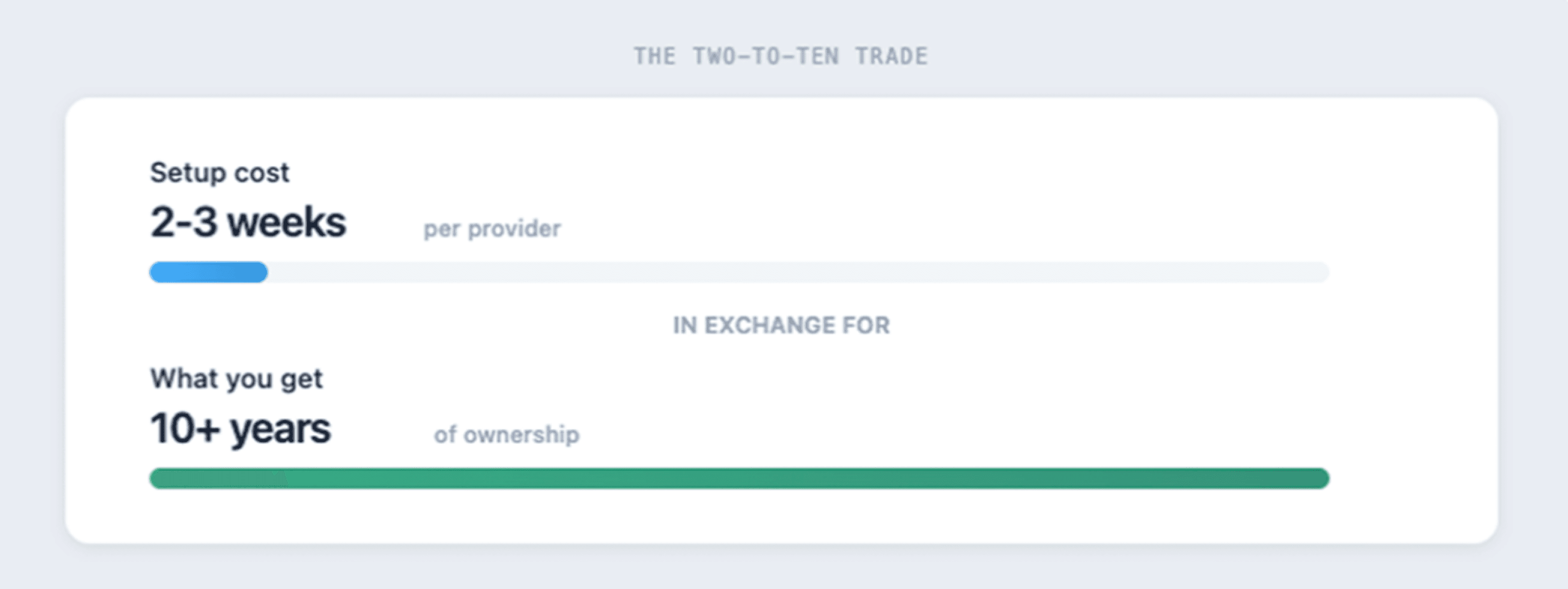
With the right tooling, onboarding directly with a stablecoin provider takes two to three weeks. Light KYB, basic contract negotiation, technical integration. It's not months of work per provider like it would be if you were building from scratch.
Compare that to the alternative: eight, ten, fifteen years of operating on rails you don't control, governed by terms you didn't negotiate, with counterparties you can't name. Two to three weeks of setup in exchange for a decade of ownership. The ROI is absurdly asymmetric.
The short-term convenience of letting someone else handle everything is a terrible long-term trade when stablecoin payments become a material part of your business. And if you're reading this, they already are or they're about to be.
Take Control of the Stack
Direct counterparty relationships aren't just about avoiding catastrophic risk. They're about running your stablecoin program the way your procurement team expects every vendor relationship to be run.
With direct relationships, you can run your own DDQ program. You can evaluate each provider's SOC 2, their regulatory licenses, their insurance coverage. You can see the full picture and make informed decisions about who touches your money.
You can choose which providers to use in which corridors and drop the ones that don't meet your risk tolerance. That's not a feature you get when someone else owns the relationship. When your vendor picks the provider, you consume whatever they give you.
You can negotiate custom terms. Indemnity provisions, liability caps, fraud remedies. Your procurement department has a playbook for this with every other vendor that moves money. Stablecoin infrastructure shouldn't get a pass just because the market is newer.
And you own the portability. If you change vendors, your provider relationships come with you. Your contracts, your negotiated terms, your operational history. You're not starting over. You're moving.
The Ownership Test
Send these four questions to your procurement team. If they can't answer yes to all of them, you don't own your rails.
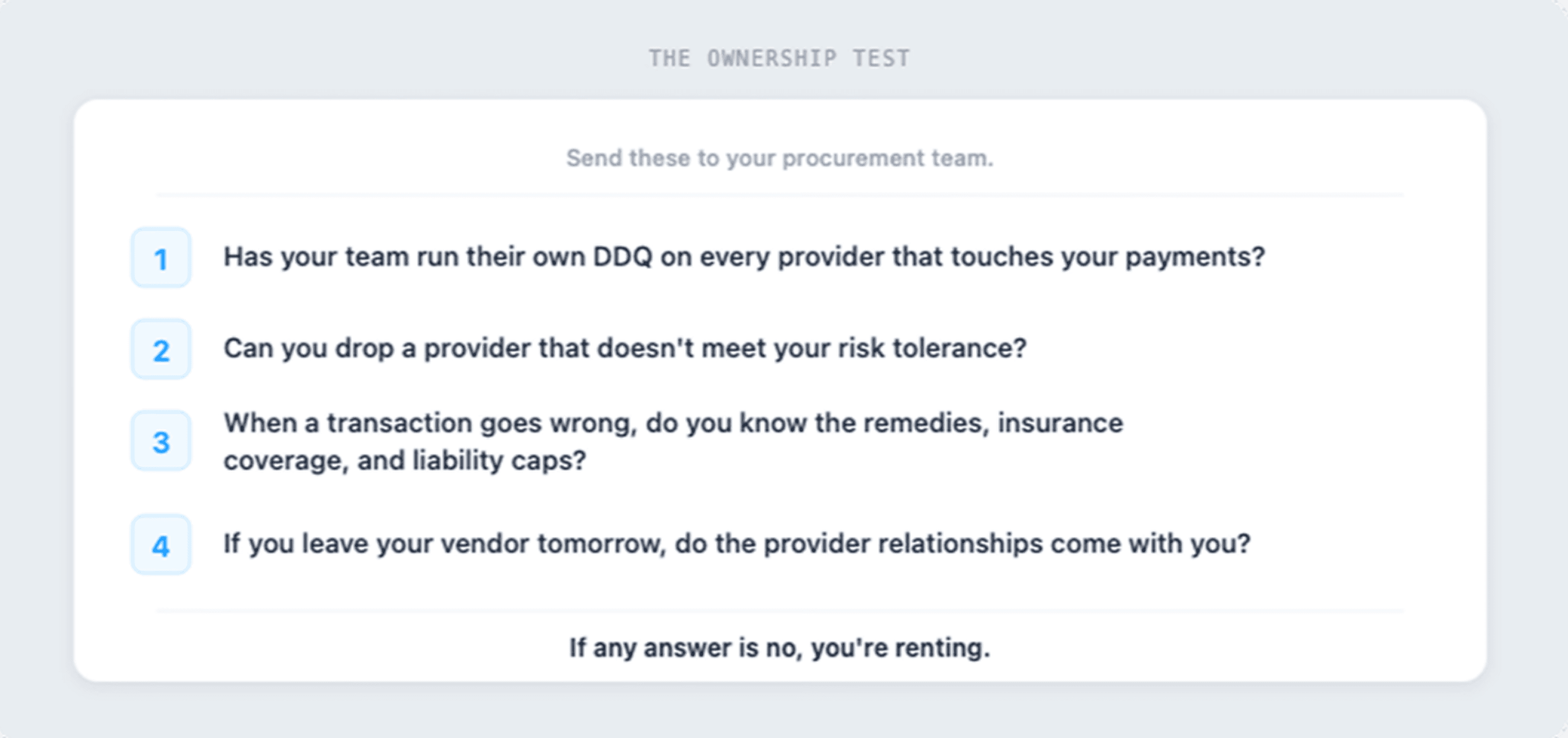
1. Has your team run their own DDQ on every provider that touches your payments? Not your vendor's DDQ. Yours. If you're trusting someone else's diligence on the companies that move your money, your compliance team is flying blind. They'd never accept that for any other critical vendor.
2. Can you drop a provider that doesn't meet your risk tolerance? If your vendor picks the providers, you consume whatever they give you.
3. When a transaction goes wrong, do you know the remedies, insurance coverage, and liability caps? Not your vendor's terms. The actual provider's terms. The ones you've never seen. If you can't answer this, you don't know what happens when something breaks. And something will break.
4. If you leave your vendor tomorrow, do the provider relationships come with you? Every contract, every negotiated term, every operational history. If the answer is no, you start from zero. That's renting.
Four questions. If the answer isn't yes to all of them, someone else owns your rails. And at some point, probably the worst possible point, that's going to matter.
You signed one contract. Five companies you've never met are moving your money.
Your vendor is routing transactions to providers that don't know your company's name. Providers whose contracts, insurance policies, and liability terms you've never seen. Underneath that single agreement, there could be three, five, ten different providers handling your payments across different corridors. You don't know their terms. You don't know their indemnity provisions. You don't know what happens when a transaction goes sideways, when there's fraud, when a provider loses its banking relationship in a market you depend on.
You think you own your payment rails. You're renting them.
The Unknowns Cascade
In traditional payments, this abstraction is tolerable. The underlying rails are Visa, Mastercard, SWIFT. Mature infrastructure, deeply regulated, well understood. When Stripe processes your payment, you don't need to know which acquiring bank they're routing to. The risk is priced in and the system is battle-tested.
Stablecoin payments don't work like that. Not yet.
The providers handling your stablecoin on and off ramps aren't Visa. They're fintechs with local banking relationships in specific markets. A licensed operator in Nigeria. A fintech with a SPEI connection in Mexico. A regulated exchange in Brazil. Each one has different capitalization, different insurance coverage, different regulatory standing, different operational maturity. The quality variance is enormous.
When your vendor wraps and resells these providers as a single service, they're absorbing that variance into a black box. You don't see it. And when something goes wrong, you discover everything you didn't know all at once.
You don't know what terms your vendor has with the underlying provider. You don't know what indemnity looks like. You don't know the liability caps on failed transactions. You don't know what happens with fraud. You don't know what's behind their insurance. You don't know what remedies exist when a payment doesn't arrive.
Each unknown stacks. And the stack gets heavier the longer you operate.
Own vs. Rent
The actual provider doesn't know your name. The provider knows your vendor's name. Your transactions are line items inside someone else's master agreement.
That distinction doesn't matter on a good day. It matters enormously on a bad one.
If your vendor gets debanked, your rails disappear. If a provider underneath your vendor loses its banking relationship in a critical market, you won't hear about it until payments stop. If you want to leave your vendor for a better option, the provider relationships stay behind. You start from zero.
I've watched this play out. Licensing delays at a major stablecoin infrastructure provider cascaded into their customers' operations. Companies that depended on a single provider found themselves locked out of entire markets because they had no alternatives and no direct relationships to fall back on.
In any other critical vendor relationship, this would be unacceptable. Imagine telling your board that 100% of your payment infrastructure exists inside a single vendor's contract, and you've never spoken to or diligenced the companies that actually move the money. That conversation doesn't go well.
The Two-to-Ten Trade
"But setting up direct provider relationships is more work."
It is. And here's why that argument falls apart.
With the right tooling, onboarding directly with a stablecoin provider takes two to three weeks. Light KYB, basic contract negotiation, technical integration. It's not months of work per provider like it would be if you were building from scratch.
Compare that to the alternative: eight, ten, fifteen years of operating on rails you don't control, governed by terms you didn't negotiate, with counterparties you can't name. Two to three weeks of setup in exchange for a decade of ownership. The ROI is absurdly asymmetric.
The short-term convenience of letting someone else handle everything is a terrible long-term trade when stablecoin payments become a material part of your business. And if you're reading this, they already are or they're about to be.
Take Control of the Stack
Direct counterparty relationships aren't just about avoiding catastrophic risk. They're about running your stablecoin program the way your procurement team expects every vendor relationship to be run.
With direct relationships, you can run your own DDQ program. You can evaluate each provider's SOC 2, their regulatory licenses, their insurance coverage. You can see the full picture and make informed decisions about who touches your money.
You can choose which providers to use in which corridors and drop the ones that don't meet your risk tolerance. That's not a feature you get when someone else owns the relationship. When your vendor picks the provider, you consume whatever they give you.
You can negotiate custom terms. Indemnity provisions, liability caps, fraud remedies. Your procurement department has a playbook for this with every other vendor that moves money. Stablecoin infrastructure shouldn't get a pass just because the market is newer.
And you own the portability. If you change vendors, your provider relationships come with you. Your contracts, your negotiated terms, your operational history. You're not starting over. You're moving.
The Ownership Test
Send these four questions to your procurement team. If they can't answer yes to all of them, you don't own your rails.
1. Has your team run their own DDQ on every provider that touches your payments? Not your vendor's DDQ. Yours. If you're trusting someone else's diligence on the companies that move your money, your compliance team is flying blind. They'd never accept that for any other critical vendor.
2. Can you drop a provider that doesn't meet your risk tolerance? If your vendor picks the providers, you consume whatever they give you.
3. When a transaction goes wrong, do you know the remedies, insurance coverage, and liability caps? Not your vendor's terms. The actual provider's terms. The ones you've never seen. If you can't answer this, you don't know what happens when something breaks. And something will break.
4. If you leave your vendor tomorrow, do the provider relationships come with you? Every contract, every negotiated term, every operational history. If the answer is no, you start from zero. That's renting.
Four questions. If the answer isn't yes to all of them, someone else owns your rails. And at some point, probably the worst possible point, that's going to matter.
Global Stablecoin Orchestration Network
Borderless Innovations Labs Inc. (Borderless) is a technology and smart contract development company. Borderless in not a broker-dealer or financial institution and does not engage any conduct or transactions requiring such registration. All financial products are offered by and through financial institutions directly. Borderless does not make any recommendation for the purchase or sale of digital assets. Our products and services are offered in limited jurisdictions so please contact our partnerships team for further information and refer to our Terms of Services.
Global Stablecoin Orchestration Network
Borderless Innovations Labs Inc. (Borderless) is a technology and smart contract development company. Borderless in not a broker-dealer or financial institution and does not engage any conduct or transactions requiring such registration. All financial products are offered by and through financial institutions directly. Borderless does not make any recommendation for the purchase or sale of digital assets. Our products and services are offered in limited jurisdictions so please contact our partnerships team for further information and refer to our Terms of Services.
Global Stablecoin Orchestration Network
Borderless Innovations Labs Inc. (Borderless) is a technology and smart contract development company. Borderless in not a broker-dealer or financial institution and does not engage any conduct or transactions requiring such registration. All financial products are offered by and through financial institutions directly. Borderless does not make any recommendation for the purchase or sale of digital assets. Our products and services are offered in limited jurisdictions so please contact our partnerships team for further information and refer to our Terms of Services.