Content
Borderless.xyz on Cointelegraph: Stablecoins behave like FX markets as liquidity splits
Apr 18, 2026

In a March report, payments startup Borderless found that pricing divergence in stablecoins depends largely on where liquidity is sourced.
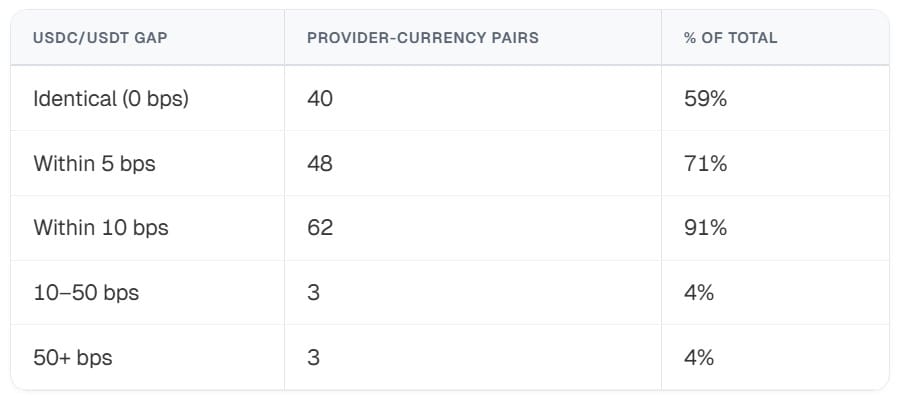
USDC and USDT trade at near-identical prices in most corridors, with 91% of pairs within 10 basis points. Source: Borderless
The report collected hourly buy and sell rates throughout February across 66 stablecoin-to-fiat corridors — or conversion routes such as USDC to Mexican pesos — covering 33 currencies and seven blockchains. The data showed that USDC and USDT traded almost identically in most cases.
Larger differences emerged at the provider level, where pricing gaps in the same corridor could exceed hundreds of basis points, making execution quality dependent on access to liquidity and routing across venues.
Stablecoins become harder to move at size
As stablecoins currently stand, their market structure resembles foreign exchange, where dollar proxies circulate across disconnected markets, according to Saxe. That becomes more visible in larger stablecoin movements across chains.
Stablecoins have become a centerpiece for institutions moving into digital assets, used for trading, cross-border payments and onchain treasury management. Firms rely on them to move capital between venues, settle trades and access yield opportunities across DeFi markets.
Some banks have begun issuing their own stablecoins, such as Societe Generale’s euro-backed token. Source: Societe Generale
Unlike retail users, institutions often move tens of millions of dollars at a time, where execution needs to be fast, predictable and efficient.
In such cases, fragmentation becomes a constraint. Instead of drawing from a single pool of dollar liquidity, institutions must navigate multiple chains, issuers and venues, each with different liquidity conditions. Moving size can shift prices, require splitting trades and introduce uncertainty into execution.
“Right now, they don't have the risk management, trust and infrastructure that they need to move or hold a lot of stablecoins at size onchain by default,” Saxe said.
Stablecoins need infrastructure, not more supply
Companies are starting to build infrastructure to address those gaps, but they are doing so from different assumptions about what the problem actually is.
Circle is treating stablecoins as the foundation of a new FX system, where multiple currencies, liquidity providers and settlement layers are connected through shared infrastructure. Meanwhile, Eco focuses on routing and execution, aggregating liquidity across fragmented markets.
Both approaches point to the issue of stablecoins existing across multiple chains or issuers, but the liquidity behind them is distributed and uneven. Moving funds requires interacting with that fragmented liquidity, which introduces pricing differences, routing complexity and execution risk.
For institutions, that complexity directly limits how much capital can move onchain.
Read full article: